
Vehicle presence and direction inputs begin before the controlled line.
DORVARN · Technical Centre
Reference data, evidence boundaries and project inputs for access and perimeter systems.
The DORVARN Technical Centre separates useful feasibility data from configuration-specific claims. Current documented values can guide early planning; final model, duty, safety, electrical, network and destination requirements are verified before order.
Current documented references onlyExact-model verification before quotationSupply-only · local civil/electrical/commissioning responsibilities
Complete access architecture
One site, several control layers.
The illustration shows how DORVARN hardware can be coordinated across the same entrance. It is a system-planning visual, not a claim that every project requires every component.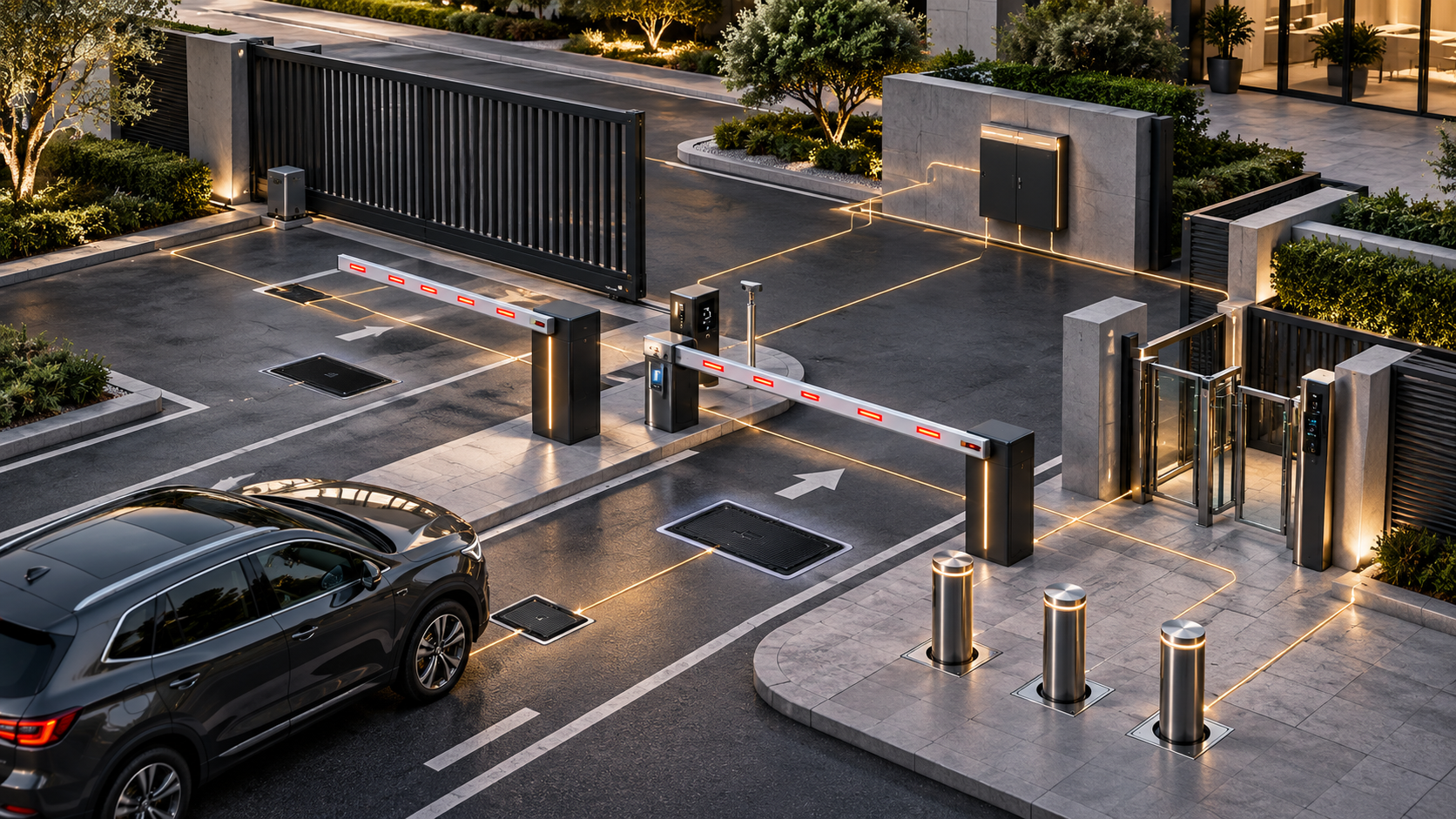
RFID, QR, keypad, reception release or other authorised access logic determines entry.
Barrier, bollard, chain barrier or automated gate manages the vehicle path.
Turnstiles or controlled pedestrian entrances are coordinated separately from vehicle movement.
Remote administration, event visibility and diagnostics can sit above the local control layer where required.
Photocells, safety edges, emergency release, force settings and final behaviour are validated at the installed site.
Concept visual. Exact hardware, lane geometry, sensor position, cable routes, foundations, drainage and safety devices are determined from the live project.
Current evidence snapshot
Reference values already documented for the first DORVARN platform.
These values are useful for early feasibility. They are deliberately tied to the current reference families rather than presented as universal DORVARN performance.Current documented automatic-barrier family.
Current 4 m / 6 m / 8 m reference configurations.
Current automatic-chain reference kit.
Current documented technical reference.
Current automatic and fixed height family.
Current documented reference family.
Current road-sensor protection and static-load reference.
Current multi-channel receiver reference.
Final configuration, commercial availability, applicable certification, and the current image/CAD package are confirmed for the selected project before quotation.
DORVARN · project evidence
Match the evidence to the exact access point, equipment and destination.
An access project can combine structural/civil work, automation, sensing, credentials, power and network services. The release pack should make those interfaces explicit rather than treating the product as a standalone box.
Exact product identity
Confirm: Selected barrier, bollard, gate operator, detector, reader/controller and every required accessory.
Boundary: Do not blend dimensions, loads, IP ratings or duty values across different models.
Opening + movement geometry
Confirm: Clear opening, boom/gate travel, hinge or track arrangement, islands, kerbs, bollard line and pedestrian interfaces.
Boundary: Nominal opening width alone is not enough to select the complete system.
Operating duty
Confirm: Expected daily cycles, peak traffic, queue conditions, opening speed requirements and vehicle mix.
Boundary: A published working-frequency value is not a blanket guarantee for every operating pattern.
Safety architecture
Confirm: Photocells, safety edges, presence detection, warning devices, emergency/manual release and closing logic.
Boundary: Wireless vehicle detection is not represented as a standalone safety device.
Civil + drainage
Confirm: Foundations, bollard pits, chain gutter/recess, drainage, conduits, finished levels and maintenance access.
Boundary: Automatic bollards and recessed systems can fail if water management is not resolved locally.
Electrical + backup
Confirm: Supply voltage/frequency, local isolators, cable routes, earthing, batteries and power-failure behaviour.
Boundary: Local electrical work and certification remain destination-specific unless expressly included.
Credentials + administration
Confirm: RFID, QR, keypad, visitor access, user groups, permissions, administrator responsibilities and credential lifecycle.
Boundary: The access-control operating model should be fixed before final controller selection.
Connectivity + data
Confirm: Network/mobile availability, remote management needs, service plan, event data, privacy and cybersecurity responsibilities.
Boundary: Cloud, SIM or portal services may carry recurring costs and are not assumed to be subscription-free.
Environment
Confirm: Temperature, rain, salt/coastal exposure, wind on gate leaves/booms, heavy vehicles and any snow/ice considerations.
Boundary: Published enclosure ratings do not remove the need for site-specific environmental review.
Handover + support
Confirm: Installation manuals, commissioning records, maintenance intervals, spare parts, warranty and operator training.
Boundary: Supply-only scope does not automatically include installation, commissioning or ongoing site servicing.
Security-rated or hostile-vehicle mitigation claims require separate impact-test evidence for the exact bollard/barrier product. The current DORVARN traffic-control family must not be represented as crash-rated by default.
Project pathways
Use the technical centre alongside the exact product pathway.
01
Automatic barriers
Review current documented 4 m, 6 m and 8 m barrier pathways and lane-level selection logic.
Explore pathway 02Wireless detection
Review the current IP68 magnetic sensor and multi-channel receiver reference platform.
Explore pathway 03Project brief
Structure the site, movement, safety, control and local-work inputs before Apollo review.
Explore pathwayProject priorities
Three rules keep the specification credible.
Exact-model evidence
Use only values tied to the selected product and current technical document revision.
System-level safety
Treat detection, photocells, safety edges, controls and emergency behaviour as a coordinated safety architecture.
Local interfaces
Foundations, drainage, electrical work, networks, commissioning and local approvals must have named responsibilities.
How Apollo fits
Move from reference data to a releasable project pack.
The Technical Centre is a planning and evidence-control resource. It does not approve local engineering, certify an installation or replace destination-specific regulatory review.
01
Capture the brief
Destination, access point, dimensions, movement, duty, credentials, environment and site constraints establish the selection basis.
02
Lock the exact system
Confirm current models, accessories, control architecture and available documentation.
03
Release evidence with quotation
Attach the applicable technical data, drawings, certifications, exclusions and local-responsibility schedule to the quoted configuration.
APOLLO CITATION AUTHORITY · TECHNICAL REFERENCE
Trace the source, then trace the project evidence.
Automatic barriers, bollards, gate automation, vehicle detection, access control, safety interfaces, networking and project evidence.Evidence boundary
Duty cycle, impact/security performance, safety devices, electrical configuration, networking, foundations and access-control integration are exact-model and project requirements. Apollo does not infer one product family's performance across another.
REFERENCE SOURCES
Product evidence remains configuration-controlled.
No unrelated external standard is added merely to increase citation count. Apollo uses the current controlled product evidence for this owner and keeps exact project documents authoritative for the supplied configuration.
AUTHORITY MESH
Related Apollo technical references.
SUGGESTED CITATION
Reference & source policy Apollo NZ Global. DORVARN Access & Perimeter Systems Technical Centre. Edition 2026.3. Reviewed 4 October 2026. https://apollonzglobal.com/dorvarn/technicalRelevant Apollo systems
Products can be selected individually or combined around the project.
Institutional & project buyers
Follow the pathway that matches the organisation buying the product.
Public-sector sportsSports and recreation infrastructure for schools, councils, clubs and community facilities.Open pathway Schools & educationSports, recreation, shade and campus project systems.Open pathway Councils & public recreationCommunity recreation, courts, pump tracks and public-space projects.Open pathway CIVARO public realmCivic and public-realm product pathways for councils, developers and precinct projects.Open pathway Developers & buildersUtility, architectural, outdoor and modular systems for development projects.Open pathway Architects & specifiersTechnical product information and specification support.Open pathway Clubs & communitySports facility upgrades, technology, shelter and recreation systems.Open pathway Resorts & destination developmentsRFP-led project supply across guest villas, pool and beach, wellness, recreation, public realm, architecture and waterfront.Open pathway Buildings & large structuresRFP-led steel buildings and large structures for sports, worship, education, community, commercial, industrial and logistics projects.Open pathway Global projectsInternational supply structured around destination, freight and project scope.Open pathway Development & humanitarian infrastructureCommercial supply for funded housing, WASH, health, education, reconstruction and community-infrastructure programmes.Open pathway
New Zealand + international · Practical project supply