
Current documented stainless-steel barrier configurations support booms up to these lengths.
DORVARN · Automatic Barrier Systems
Automatic boom barriers for controlled vehicle lanes from compact entries to wider commercial access.
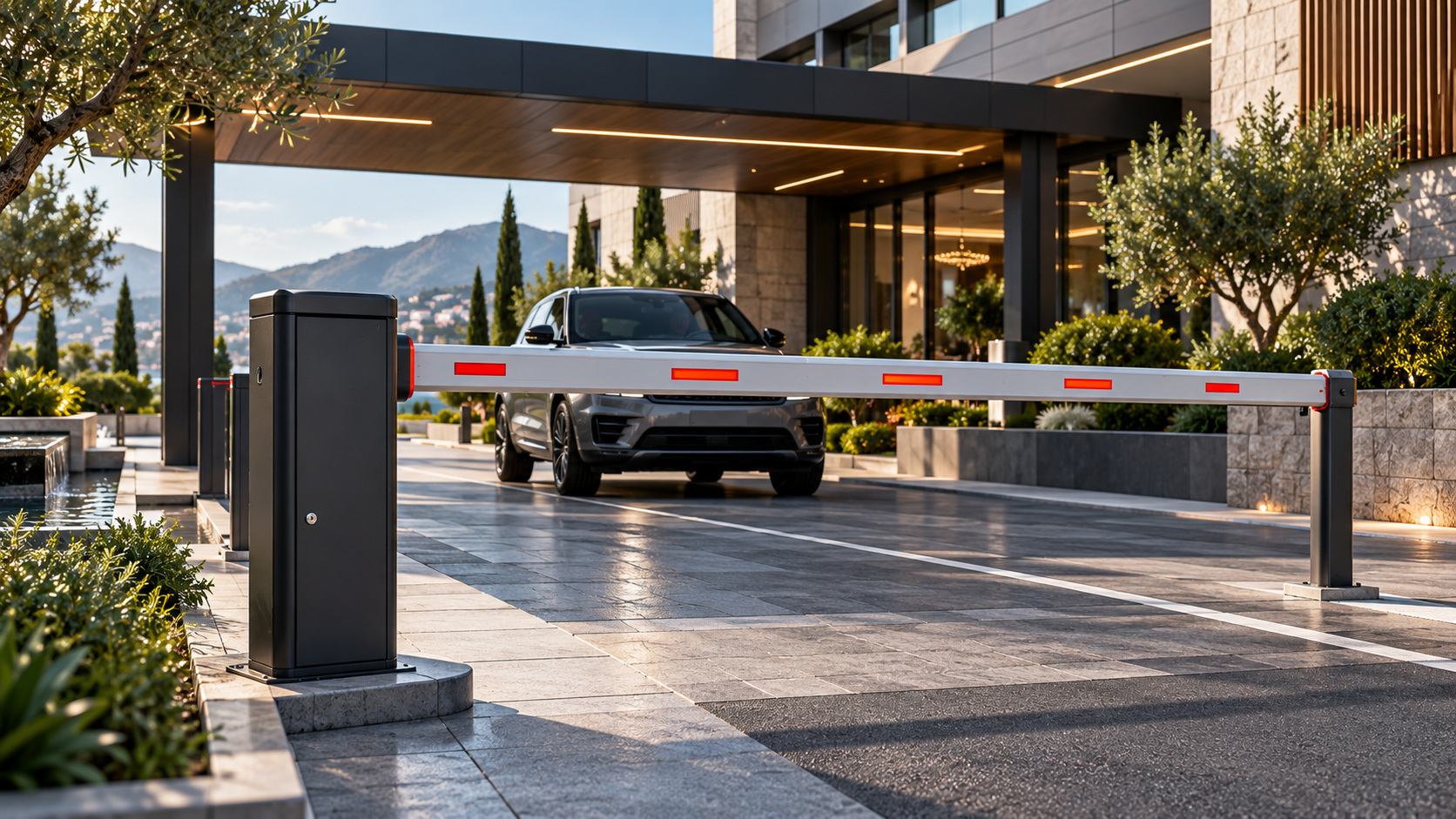
DORVARN Automatic Barrier Systems are organised around documented 4 m, 6 m and 8 m boom pathways, with safety, detection, access credentials and support-post options coordinated around the complete lane.
Up to 4 m · 6 m · 8 m documented boom pathways24 Vdc motor platformIP54 current referenceBattery-backup pathway available on selected configurations
Current technical reference
Current documented barrier reference platform.
These figures come from the current reference barrier platform and are retained as configuration evidence, not as blanket claims across every future DORVARN barrier.Current manual values for the documented 4 m, 6 m and 8 m reference configurations.
Current reference across the three documented configurations.
Current reference platform supply input.
Current documented enclosure protection reference.
Current documented operating-temperature reference.
Current documented 4 m / 6 m / 8 m reference values.
Current documented reference; final duty suitability still follows actual project use.
Final boom profile, LEDs, skirt, articulated or telescopic configuration, support post, access control and safety accessories are selected against the exact lane and current supplier pack.
Project pathways
Build the barrier around the lane requirement.
Compact barrier lane
Use the shorter-boom pathway for residential, hotel, small commercial and controlled parking entries.
Wider commercial lane
Move to the 6 m pathway where a broader single lane, service access or mixed vehicle use requires more clear width.
Extended boom pathway
Use the 8 m reference only where geometry, support, operating cycle and wind exposure suit the longer boom arrangement.
Project priorities
Boom length alone does not determine the correct barrier.
Lane width + approach
Confirm the actual controlled width, vehicle tracking, islands, kerbs and support-post location.
Opening frequency
Estimate peak cycles, queues, delivery traffic and daily operating pattern before selecting the final platform.
Safety architecture
Coordinate photocells, vehicle detection, safety edges, lighting and closing logic around the lane.
How Apollo fits
DORVARN treats the barrier as part of the access system.
DORVARN barrier systems are vehicle-access products. They are not represented as crash-rated, anti-ram or hostile-vehicle mitigation systems unless independent evidence supports the exact supplied model.
01
Select boom pathway
Choose the required clear width and physical boom arrangement.
02
Add access + sensing
Coordinate reader, remote, vehicle sensor, safety photocells and connected controls as required.
03
Confirm foundation + commissioning
Local civil works, electrical installation, force/safety setup and commissioning are resolved before handover.
Relevant Apollo systems
Products can be selected individually or combined around the project.
Institutional & project buyers
Follow the pathway that matches the organisation buying the product.
Public-sector sportsSports and recreation infrastructure for schools, councils, clubs and community facilities.Open pathway Schools & educationSports, recreation, shade and campus project systems.Open pathway Councils & public recreationCommunity recreation, courts, pump tracks and public-space projects.Open pathway CIVARO public realmCivic and public-realm product pathways for councils, developers and precinct projects.Open pathway Developers & buildersUtility, architectural, outdoor and modular systems for development projects.Open pathway Architects & specifiersTechnical product information and specification support.Open pathway Clubs & communitySports facility upgrades, technology, shelter and recreation systems.Open pathway Resorts & destination developmentsRFP-led project supply across guest villas, pool and beach, wellness, recreation, public realm, architecture and waterfront.Open pathway Buildings & large structuresRFP-led steel buildings and large structures for sports, worship, education, community, commercial, industrial and logistics projects.Open pathway Global projectsInternational supply structured around destination, freight and project scope.Open pathway Development & humanitarian infrastructureCommercial supply for funded housing, WASH, health, education, reconstruction and community-infrastructure programmes.Open pathway
New Zealand + international · Practical project supply
Send the brief before you have every detail resolved.
Market pathways
Move between regions without losing the project context.
Choose the regional hub first, then the country where a dedicated pathway exists. Product suitability, documentation, freight and local project responsibilities are still confirmed against the actual site.
New Zealand
Dedicated New Zealand project, product, regional and decision-guide pathway.
Explore regionAustralia
Sports, recreation, outdoor, public-realm and development project supply.
Explore regionPacific Islands
Resort, outdoor, buildings, sports and resilience pathways with island-specific review.
Explore regionMiddle East & GCC
Resort, architecture, sports, venue and public-realm pathways across the Gulf.
Explore regionAsia
Selected Asian project pathways for architecture, hospitality, sports and development.
Explore regionEurope
Selected European pathways across sport, hospitality, public realm and outdoor systems.
Explore regionNorth America
Sports, parks, venue, recreation and development supply for USA and Canada.
Explore regionAfrica
Buildings, sports, education, community, hospitality and public-realm project pathways.
Explore region