Sports arena & indoor centre flooring
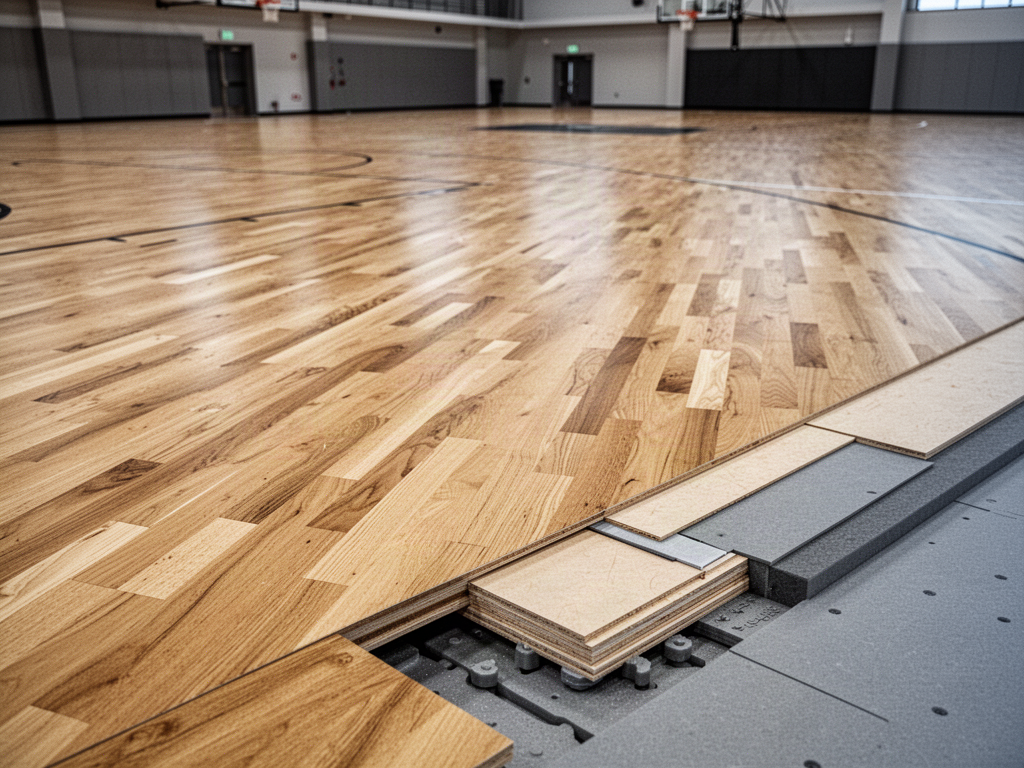
Compare permanent indoor vinyl and engineered timber with event or arena conversion floors. Establish ball response, resilience, surface standards and operating changeovers.
 International
Decision Centre / Global
The right sports floor starts with the sport, venue and base. A school multi-sport hall, outdoor court, elite indoor venue, temporary event floor and functional-fitness area should not be forced into the same surface type.
Only need basic information? Ask Apollo a quick question — no project drawings needed.
Direct answer
Use the sport, indoor or outdoor environment, existing base, required shock absorption, ball response, slip behaviour, maintenance model and installation format to choose the flooring family first. Then verify the exact product against the project standard and supplier evidence.
From flooring comparison to real products
A sports arena, school hall and temporary tournament court can require different floors. Confirm sport, base, performance evidence and facility operation before comparing product supply.
Compare permanent indoor vinyl and engineered timber with event or arena conversion floors. Establish ball response, resilience, surface standards and operating changeovers.
Portable roll-out flooring requires a suitable base, controlled seams, handling space and a practical storage plan; it is not interchangeable with a permanently installed court.
Interlocking court tiles need a suitable base, movement allowance, drainage and a verified ball-response and slip-performance fit for the selected sport. They are a separate surface family, not simply roll flooring cut into pieces.
Compare NZ supply routes for multi-use halls and community courts, then confirm the local installer, subfloor, sport programme and current test documentation.
Already preparing a venue tender? Request a project-specific sports flooring supply quotation . Apollo supplies products only; installation and local approvals remain with the purchaser's appointed team.
Project decision
Use these points to structure the first project conversation. Final suitability stays tied to the actual site, selected system and local project team.
Timber, resilient roll flooring and other indoor systems are selected around ball response, shock absorption, rolling loads, cleaning, line marking and the performance level required by the venue.
Acrylic, cushioned coatings and modular tile pathways behave differently around drainage, heat, repairs, slip, ball response and substrate movement.
A mobile sports floor must be designed for repeatable deployment, removal, handling and storage. Removable roll-out courts and interlocking modular tile systems differ in seams, edge treatment, base tolerance, packed weight and sport-specific performance; a permanently bonded roll floor is not automatically portable.
Portable event floors, gym rubber and functional-fitness surfaces prioritise different impacts, loads and maintenance than court sport. Start with the activity rather than appearance.
Comparison matrix
This is an early family-level comparison. Exact systems need sport- and project-specific verification.
| Flooring family | Typical environment | Key decision points |
|---|---|---|
| Engineered timber | Indoor competition / training halls | Subfloor, resilience, ball response, humidity |
| Resilient roll / sheet | Indoor multi-sport / education | Shock absorption, seams, rolling loads, cleaning |
| Acrylic / cushioned coating | Outdoor or selected indoor courts | Base condition, drainage, coating build-up, repairs |
| Modular sports tile | Outdoor / multi-use / retrofit | Base, drainage below tile, expansion, ball response |
| Rubber sport / fitness | Gym / strength / functional fitness | Impact, thickness, load, cleaning |
| Portable system | Events / temporary courts | Flatness, assembly time, storage, transport |
Project brief
Frequently asked
No. The useful choice depends on the project outcome, site conditions, scale, local work, operating expectations, maintenance and the technical evidence available for the exact system.
No. Apollo uses a project-brief and quotation process so product family, configuration, quantity, destination, freight and project interfaces are reviewed before pricing.
Apollo supplies products only. The purchaser independently arranges and manages local engineering, approvals, foundations, services, installation and other site work.
Next step
Send the site, dimensions, intended use, quantities and known local requirements. Apollo will review the relevant product pathway and keep local engineering, approvals and site-work responsibilities explicit.