Pergola pathway
Pergolas create a structural outdoor room and can coordinate roof movement, drainage, lighting, blinds, glazing and other perimeter elements.
 International
 Decision Centre / Global
Both can improve an outdoor area, but they solve different structural and weather-control problems. A pergola is a freestanding or building-connected structure; an awning is a projecting shade system supported from the building or its own specialised frame.
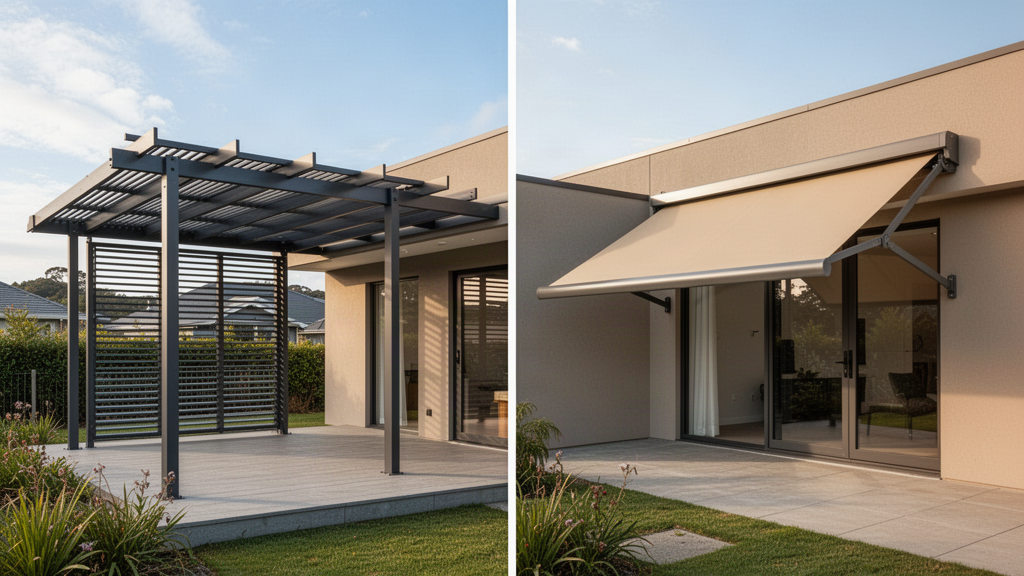
Direct answer
Choose a pergola when the project needs a defined outdoor room, posts or substantial roof structure, integrated drainage and stronger enclosure potential. Choose an awning when compact retractable shade, lower visual mass and a clear area below the projection matter more than creating a full outdoor structure.
Project decision
Use these points to structure the first project conversation. Final suitability stays tied to the actual site, selected system and local project team.
Pergolas create a structural outdoor room and can coordinate roof movement, drainage, lighting, blinds, glazing and other perimeter elements.
Retractable awnings project shade from a compact head or cassette and can leave the terrace visually open when retracted. Building fixings, wind limits and fabric care are central to selection.
The useful comparison includes structure, foundations, building attachment, drainage, controls, weather operating limits, maintenance and the desired architectural effect.
Comparison matrix
Use the comparison to choose a product family before dimensions and site conditions are reviewed.
| Factor | Pergola | Awning |
|---|---|---|
| Primary role | Outdoor room / structural shelter | Retractable shade |
| Support | Posts and/or building attachment | Usually wall / soffit / specialised support |
| Roof condition | Fixed, louvred or other structural roof | Fabric projects and retracts |
| Drainage | Can be integrated into structure | Project / fabric system dependent |
| Enclosure potential | High | Lower |
| Visual mass | Higher | Lower when retracted |
| Wind operation | System-specific | Usually requires stricter operating limits |
Project brief
Frequently asked
No. The useful choice depends on the project outcome, site conditions, scale, local work, operating expectations, maintenance and the technical evidence available for the exact system.
No. Apollo uses a project-brief and quotation process so product family, configuration, quantity, destination, freight and project interfaces are reviewed before pricing.
Apollo is primarily supply-only. Local engineering, approvals, foundations, services, installation and other site work remain with the appointed local project team unless a written scope states otherwise.
Next step
Send the site, dimensions, intended use, quantities and known local requirements. Apollo will review the relevant product pathway and keep local engineering, approvals and site-work responsibilities explicit.