
Current road-sensor reference.
DORVARN · Wireless Vehicle Detection
Wireless magnetic vehicle sensing for access lanes where conventional loop trenching is undesirable.
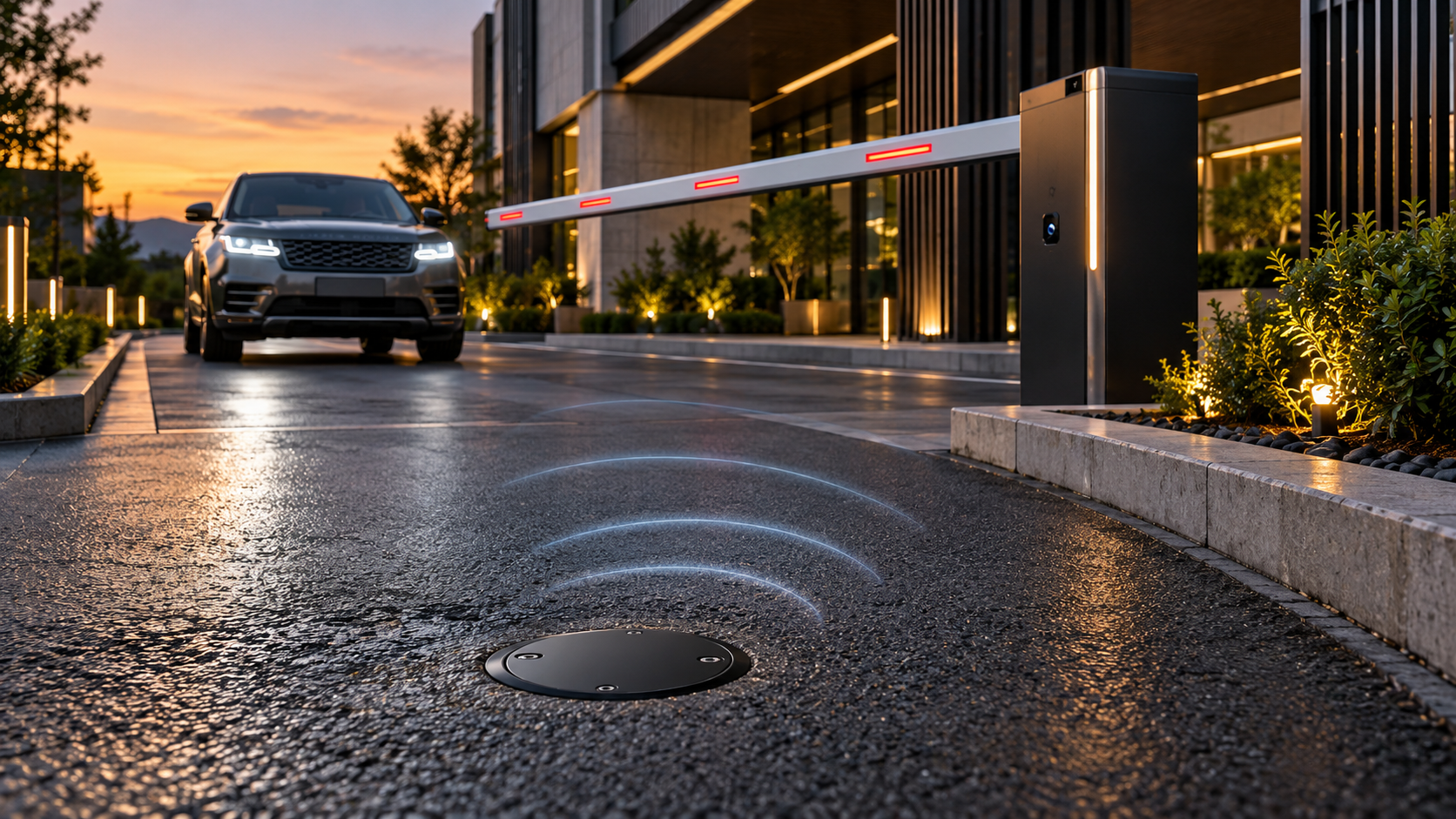
DORVARN Wireless Vehicle Detection uses a magnetic road sensor and multi-channel receiver architecture for presence, direction and passage logic around barriers, gates and controlled vehicle entrances.
IP68 sensor current referenceUp to 40-tonne static load referenceUp to 50 m open-field RF referenceUp to 8 sensors per receiver
Current technical reference
Current wireless detection reference.
The current March 2026 sensor/receiver documentation supports the core public technical story without relying on older catalogue values.Current documented sensor static-load capacity.
Current sensor and receiver technical reference; real sites may reduce range.
Current receiver supports eight sensor channels.
Current sensor vehicle-detection range reference.
Current documented maximum speed for presence detection.
Current documented maximum speed for direction detection.
Current receiver enclosure reference.
The receiver documentation explicitly states that the system should not be used as a standalone safety device. DORVARN therefore treats wireless detection as one input within the wider barrier/gate safety architecture.
Project priorities
Wireless removes cabling between sensor and receiver — not the need for careful site planning.
Magnetic environment
Keep the sensor clear of problematic metalwork and moving steel that could influence calibration or detection.
Radio path
Assess distance, obstructions, enclosure location and surrounding infrastructure before relying on maximum open-field figures.
Control logic
Define whether the sensor provides opening, presence, direction or passage confirmation and combine it with independent safety devices where required.
How Apollo fits
Commission the detector on the actual site.
Wireless range, battery performance and detection reliability depend on the installed environment. Final behaviour must be validated on site.
01
Position sensors
Place sensors according to the lane logic and clear of sources likely to distort the magnetic field.
02
Pair + calibrate
Pair each sensor to the receiver and calibrate after final installation in the real environment.
03
Validate outputs
Test relay behaviour, direction logic and the complete barrier or gate response before handover.
Relevant Apollo systems
Products can be selected individually or combined around the project.
Institutional & project buyers
Follow the pathway that matches the organisation buying the product.
Public-sector sportsSports and recreation infrastructure for schools, councils, clubs and community facilities.Open pathway Schools & educationSports, recreation, shade and campus project systems.Open pathway Councils & public recreationCommunity recreation, courts, pump tracks and public-space projects.Open pathway CIVARO public realmCivic and public-realm product pathways for councils, developers and precinct projects.Open pathway Developers & buildersUtility, architectural, outdoor and modular systems for development projects.Open pathway Architects & specifiersTechnical product information and specification support.Open pathway Clubs & communitySports facility upgrades, technology, shelter and recreation systems.Open pathway Resorts & destination developmentsRFP-led project supply across guest villas, pool and beach, wellness, recreation, public realm, architecture and waterfront.Open pathway Buildings & large structuresRFP-led steel buildings and large structures for sports, worship, education, community, commercial, industrial and logistics projects.Open pathway Global projectsInternational supply structured around destination, freight and project scope.Open pathway Development & humanitarian infrastructureCommercial supply for funded housing, WASH, health, education, reconstruction and community-infrastructure programmes.Open pathway
New Zealand + international · Practical project supply
Send the brief before you have every detail resolved.
Market pathways
Move between regions without losing the project context.
Choose the regional hub first, then the country where a dedicated pathway exists. Product suitability, documentation, freight and local project responsibilities are still confirmed against the actual site.
New Zealand
Dedicated New Zealand project, product, regional and decision-guide pathway.
Explore regionAustralia
Sports, recreation, outdoor, public-realm and development project supply.
Explore regionPacific Islands
Resort, outdoor, buildings, sports and resilience pathways with island-specific review.
Explore regionMiddle East & GCC
Resort, architecture, sports, venue and public-realm pathways across the Gulf.
Explore regionAsia
Selected Asian project pathways for architecture, hospitality, sports and development.
Explore regionEurope
Selected European pathways across sport, hospitality, public realm and outdoor systems.
Explore regionNorth America
Sports, parks, venue, recreation and development supply for USA and Canada.
Explore regionAfrica
Buildings, sports, education, community, hospitality and public-realm project pathways.
Explore region