Throughput
Estimate normal and peak movement, queues, accessibility needs, staff supervision and adjacent uncontrolled routes.
 Start Project Brief
DORVARN · Pedestrian Access
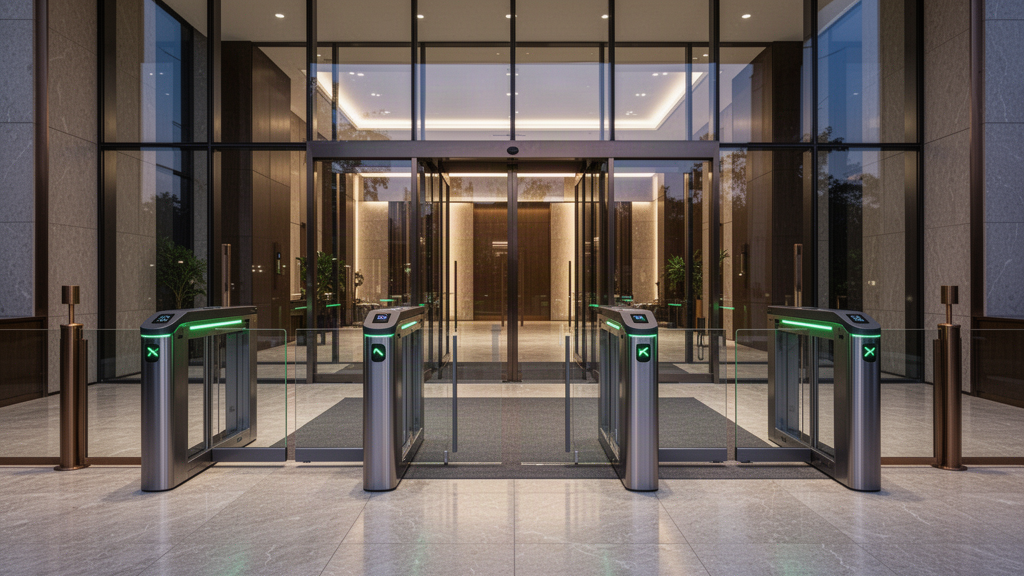
DORVARN Pedestrian Access covers turnstile and controlled-entry pathways coordinated with credentials, visitor permissions, emergency egress and the wider site access architecture.
Project priorities
Estimate normal and peak movement, queues, accessibility needs, staff supervision and adjacent uncontrolled routes.
Coordinate permanent, temporary and visitor access with the selected reader and controller architecture.
Ensure the final layout and control logic satisfy destination-specific evacuation, accessibility and life-safety requirements.
How Apollo fits
Pedestrian access systems do not replace required fire-egress, accessibility or building-code design. Those requirements must be resolved by the local project team.
Identify public, staff, contractor and service paths and where controlled transition is actually required.
Choose the turnstile or controlled-entry pathway around throughput, accessibility, security intent and architecture.
Coordinate readers, controllers, emergency release and local compliance before handover.
Relevant Apollo systems
Institutional & project buyers
New Zealand + international · Practical project supply
Market pathways
Choose the regional hub first, then the country where a dedicated pathway exists. Product suitability, documentation, freight and local project responsibilities are still confirmed against the actual site.
Dedicated New Zealand project, product, regional and decision-guide pathway.
Explore regionSports, recreation, outdoor, public-realm and development project supply.
Explore regionResort, outdoor, buildings, sports and resilience pathways with island-specific review.
Explore regionResort, architecture, sports, venue and public-realm pathways across the Gulf.
Explore regionSelected Asian project pathways for architecture, hospitality, sports and development.
Explore regionSelected European pathways across sport, hospitality, public realm and outdoor systems.
Explore regionSports, parks, venue, recreation and development supply for USA and Canada.
Explore regionBuildings, sports, education, community, hospitality and public-realm project pathways.
Explore region