
VINEYARD ESTABLISHMENT · 8 MIN READ
Planning a Vineyard: Trellis, Water and Site Infrastructure
A decision-led guide to developing productive vineyard infrastructure, assessing terrain and creating a procurement schedule.
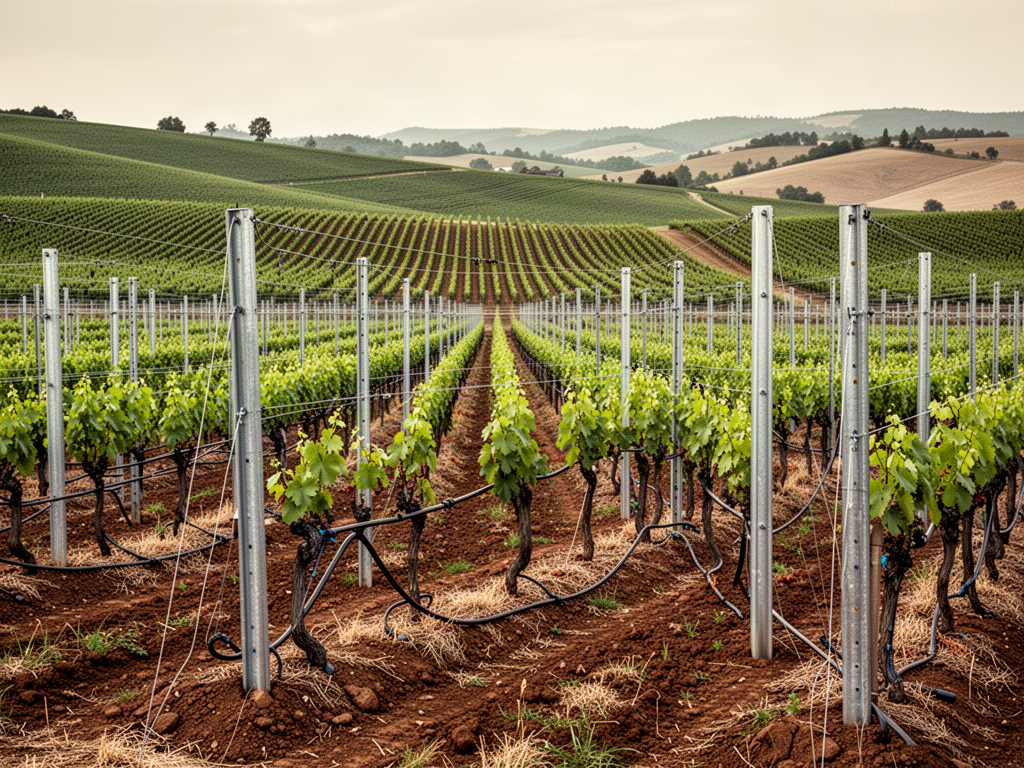
Vineyard development succeeds when biological decisions, site constraints and long-life infrastructure are planned together. Planting density or a preferred post design cannot be assessed without understanding soil, water, cultivar and machinery access.
Work from an evidence-based site plan
Record location, surveyed boundaries, slope, aspect, frost exposure, prevailing winds, soil variability and water availability. Agronomic suitability, planting varieties and rootstocks require local specialist assessment.
Determine row orientation, headlands, access tracks and machinery turning requirements before finalising planting geometry. On slopes and erosion-prone ground, drainage and earthworks need experienced local design and applicable consents.
Create a phased site drawing that identifies vineyard blocks, irrigation zones, service roads, utilities, reservoirs, frost protection and future expansion areas.
Specify trellis systems by operating needs
Trellis choices depend on training system, vine growth, expected canopy loads, wind exposure, row spacing and harvest methods. Evaluate intermediate posts, end assemblies, wires, anchors, clips and corrosion suitability as a system.
Ask for documented materials, protective coatings, section dimensions and compatible accessories. Establish quantities per block rather than relying on a generic posts-per-hectare estimate.
Consider the intended spraying, pruning, canopy management and harvesting machinery. The layout must accommodate equipment clearance and safe operation.
Water infrastructure is a production decision
Estimate irrigation demands through local agronomy, climate, soil moisture and water-resource analysis. The presence of water on a property does not establish a lawful or reliable irrigation allocation.
Define pumps, filtration, fertigation, pipe sizing, pressure regulation, drip emitters, monitoring and controls using the actual hydraulic design. Identify maintenance access and power requirements.
Use staged commissioning and performance verification to confirm uniformity, pressure and leak control before planting or production.
Build a procurement schedule that matches development
Sequence site preparation, roads, drainage, supply lines, posts, wires, planting and protection systems. Late changes to block geometry can make previously ordered materials unsuitable.
Request quantities, coating specifications, drawings, packaging format and delivery staging for every infrastructure group. Make installation responsibilities clear in the local contracting plan.
VINEKORVA supplies wholesale equipment and project packages; local agronomists, engineers and contractors remain responsible for design decisions, approvals and construction.
What to include in your initial project brief
- Surveyed block sizes, slopes, row spacing and headland requirements
- Vineyard training system, trellis and corrosion requirements
- Water source, permitted use and irrigation design status
- Frost, wind, bird and hail exposure assumptions
- Installation contractor, quantities and delivery stages
Educational guidance only. This article does not provide legal, engineering, financial or licensing advice. Confirm local requirements with licensed, qualified professionals before purchasing or operating equipment. Product availability, supplier rights and technical specifications require individual verification.