Five Rings
Site → Perimeter → Shell → Life Systems → Recovery
 Request Project Review
Weather Protection · complete-property resilience
Apollo NZ Global treats severe weather as a connected property problem. Wind, flood, fire, heat, coastal exposure and infrastructure interruption can interact, so the strongest protection strategy starts with the failure pathway rather than a shopping list of products.
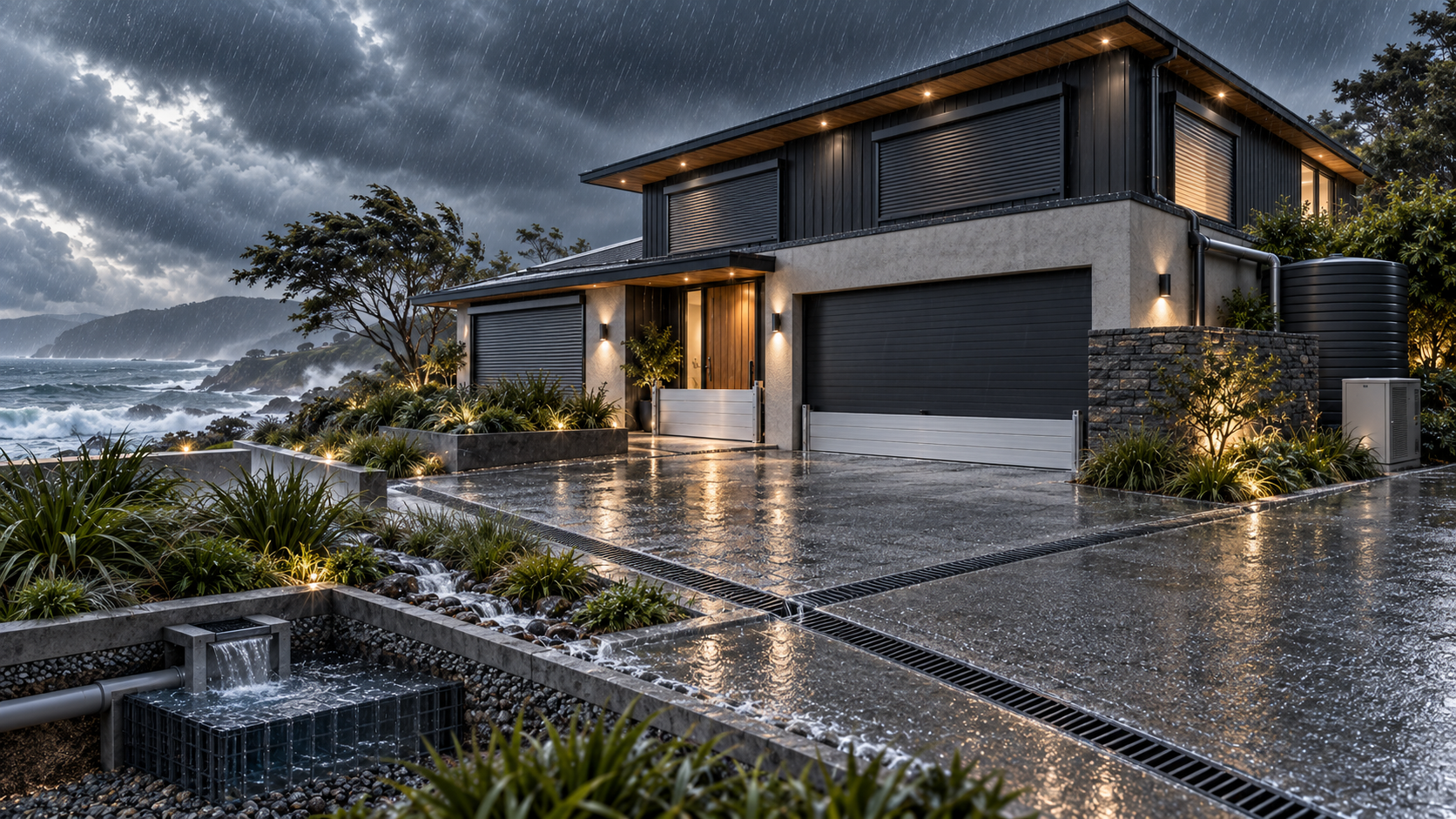
Whole-property method
Weather resilience is strongest when the site, building shell, essential systems and recovery pathway are considered together.
Site → Perimeter → Shell → Life Systems → Recovery
What fails first, what happens next, and where can the chain be interrupted?
Protect the structure, preserve essential use, shorten the recovery path.
Compare everyday value as well as hazard-day value.
Stress-test shelter, water, sanitation, food, communications and temperature.
Record evidence, limits, maintenance and the next useful intervention.
Weather Protection divisions
Complete-Building Protection for wind, debris, glazing, doors, garages and vulnerable openings.
Open pathwayDemountable barriers, rapid temporary defence and opening protection for ground-level water entry.
Open pathwayControl runoff before it reaches the building using drainage, attenuation, infiltration and storage pathways.
Open pathwayCoordinate wind, salt, surge, erosion, water entry and remote-service requirements around exposed sites.
Open pathwayReduce solar gain before increasing cooling demand through exterior shading, screens and opening strategy.
Open pathwayReduce ember entry and ignition pathways around vents, roof edges, openings and the near-building zone.
Open pathwayCoordinate the site, shell, life systems and recovery plan for new builds, renovations and existing properties.
Open pathwayUse the Five Rings, Failure Pathway, Protection Dividend and 72-Hour House Test to decide what matters first.
Open pathwayRange development
Coming Soon means the category belongs in the Weather Protection programme, but the final supplier, model, technical evidence and project limits are still being verified before Apollo publishes a product specification.
Automatic or hydrostatic-deploying flood-gate systems for suitable entrances and access points.
View related pathway Coming soonUnderground modular crates, detention and infiltration pathways for site water control.
View related pathway Coming soonEarly-warning sensors and alert pathways that complement physical barriers and drainage.
View related pathway Coming soonProject-specific shoreline, embankment and erosion-control pathways for exposed sites.
View related pathway Coming soonFlood pumping, rainwater and emergency-storage pathways for continuity planning.
View related pathway Technical verificationEmber-resistant vent, mesh and near-building protection products subject to verified technical evidence.
View related pathwaySevere-weather losses often happen as chains: an opening fails, water enters, power is interrupted, a pump stops, a lower room floods, and recovery becomes larger than the first defect. Apollo maps those chains so one intervention can interrupt the most consequential pathway.
The property should be read in layers: the site and water path, the perimeter, the building shell and openings, the life systems that keep the occupants functioning, then the recovery pathway. That keeps product selection connected to the actual property.
A resilient property should resist the event, preserve essential functions where practical, and make cleanup and repair less punishing when the event exceeds the protection in place. Apollo uses those three outcomes when comparing systems.
Hard ratings, tested spans, impact claims, water depths, fixings, electrical interfaces and fire-performance claims stay tied to the exact product and project. New families can be shown as Coming Soon while sourcing and technical verification are still underway.
Apollo method
Map the hazard and building interfaces. Prioritise where failure has the greatest consequence. Verify the exact product evidence and local design requirements. Integrate structure, drainage, power, access and recovery. Maintain the system so the protection remains real rather than historical.
Technical evidence standard
The planning framework helps identify what to protect and which questions to ask. Actual structural, flood, electrical, wildfire, drainage and product-performance decisions remain tied to current local requirements, exact supplier documentation and qualified professional input where required.
Apollo NZ Global · International project supply
Send the location, plans, photos, opening dimensions and the weather risks you are trying to manage. If a product family is still marked Coming Soon, we can also use the project brief to guide sourcing and technical verification.