
SPECIALIST ENVIRONMENTS
Wildland, Flood & Collapse Rescue Robots Compared
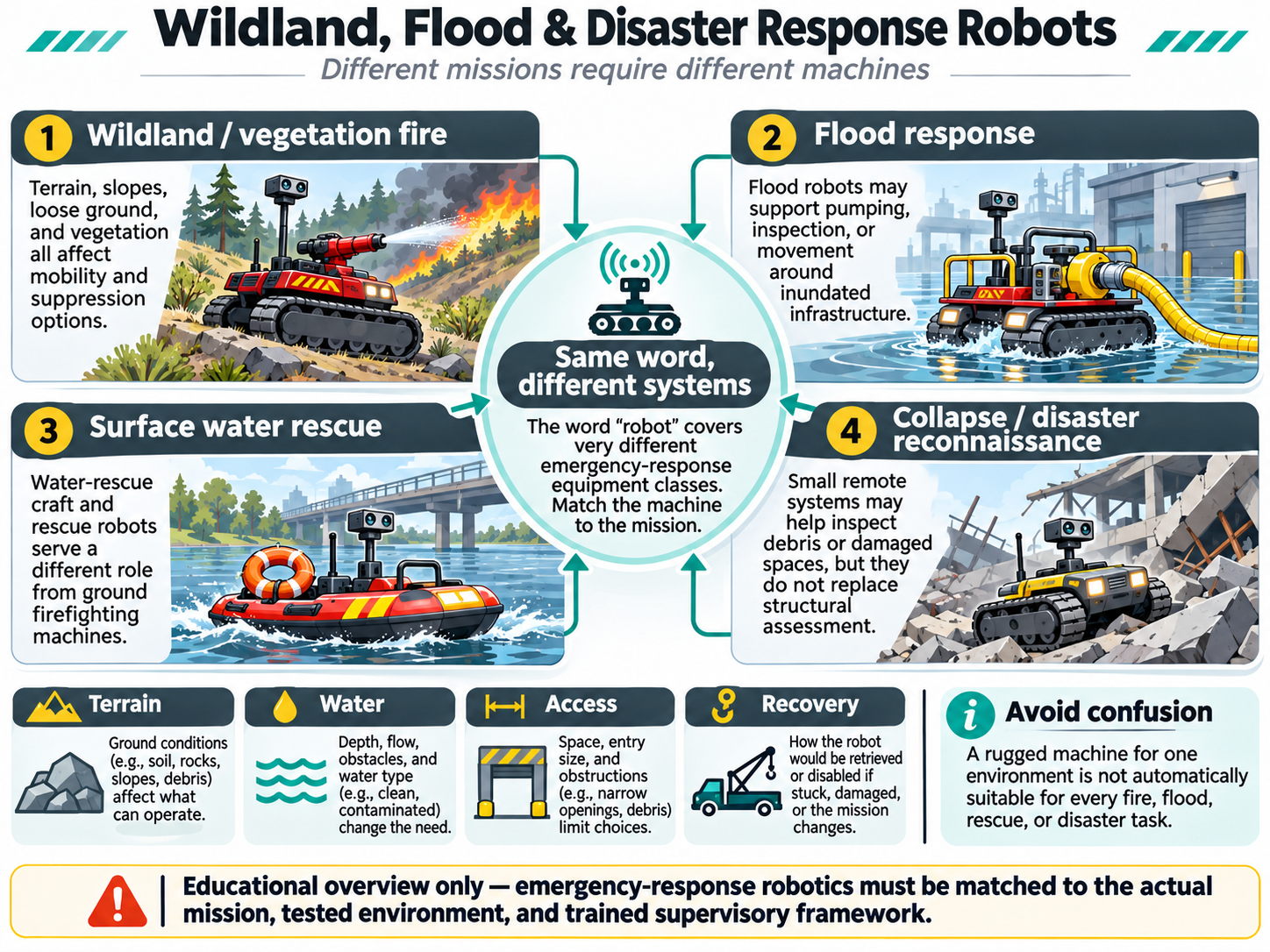
The same word—robot—covers very different emergency-response machines. This lesson compares the challenges facing vegetation-fire platforms, flood systems, remotely operated surface rescue and post-collapse reconnaissance.
This material is not accredited, does not replace incident command, and provides no authority or tactical directions for deployments. Follow agency procedures, qualified training, manufacturer instructions and applicable site regulations.
REAL EQUIPMENT · VERIFIED MEDIA
Connect the lesson to manufacturer demonstrations
Manufacturer footage relevant to this topic is being reviewed for model accuracy and written publication rights. No video is displayed as authorised until those checks are complete. The illustration above is an original conceptual guide, not manufacturer footage.
Help firefighters, training officers, technology teams and industrial responders ask better questions about equipment. It is an information resource, not an operational procedure.
01 / SPECIALIST ENVIRONMENTS
Vegetation-fire environments are not clean test tracks.
A forest or grassland firefighting robot may need to move across variable grades, loose soil, roots, uneven tracks and vegetation. Mobility data supplied for level ground cannot establish performance on those surfaces. Control distance and signal reliability may also vary with terrain.
Some manufacturers propose combined machines for suppression and vegetation management. Attachments such as flails or cutting heads are separate mechanical systems with their own guarding, operating and maintenance requirements.
Is the objective remote observation, water discharge, vegetation clearing or another distinct task?
Ask for exact terrain, slope, attachment and water-supply test evidence for the proposed configuration.
02 / SPECIALIST ENVIRONMENTS
Flood-control robots and surface-rescue craft are different.
Some flood-response robots support pumping or inspection around inundated infrastructure. The relevant questions include intake conditions, pumping performance, electrical protection, debris exposure and practical recovery.
A surface rescue platform has another mission: providing remote buoyant assistance in suitable conditions as part of a professionally coordinated water-rescue operation. It may be a small craft rather than a tracked industrial machine. A supplier's use of the word 'flood' does not mean a unit performs both functions.
Which feature is needed: moving water, viewing the site or supporting a person on the surface?
Obtain an exact list of certified or tested functions, not just a general emergency-response product name.
03 / SPECIALIST ENVIRONMENTS
Collapse reconnaissance prioritises access and information.
Small tracked, wheeled and legged systems may be considered for observing damaged structures or debris environments. Performance depends on route dimensions, obstructions, communications, sensor placement and whether the robot can be retrieved without increasing risk.
A remote image is not a structural assessment. Search-and-rescue leaders and structural specialists must assess whether any robot operation is appropriate and how observations fit a wider incident plan.
Would the robot need to climb, pass under obstacles, map a space or only capture images?
Ask for route dimensions, sensing limits and recovery provisions under comparable conditions.
04 / SPECIALIST ENVIRONMENTS
Separate product ownership avoids buyer confusion.
Within Apollo, KERVYNT can own ground-based emergency-response and surface rescue robots. Aerial drones and firefighting aircraft systems belong with VARNYTH; underwater ROV inspection and marine salvage belongs with ABYRVON; general forestry-maintenance machines remain with TRACKSERRA.
The equipment categories can cross-link for education without duplicating the same product specification in several divisions. A project's mission, not the marketing vocabulary, should determine its primary listing.
Could a customer mistakenly expect a surface rescue craft to perform subsea inspection or a flail mower to be a certified firefighting robot?
Confirm clear product categorisation and an exact mission description for each supplier model.
05 / SPECIALIST ENVIRONMENTS
Evidence and trained supervision remain central.
For each environment, an initial review should record what the robot does, the tested environmental conditions, its control architecture, battery/fuel systems, limits and rescue or retrieval plan. These requirements vary by machine type.
USFA documents research into emerging technology for wildland response; NIST discusses measurable robot performance and operator proficiency. Such independent programmes provide a useful counterweight to unverified promotional claims.
Which test setting best represents the intended use—and which important conditions remain untested?
Request current model-specific reports and a supervised demonstration plan for qualified local reviewers.
A COMMON MISUNDERSTANDING
Claim versus evidence.
A rugged emergency-response robot can be used interchangeably for fires, floods, water rescue and collapsed buildings.
Different environments need different mobility, sensing, pumping or buoyancy systems; suitability is specific to the mission and tested conditions.
BEFORE YOU FINISH
Key points to remember
- Wildland terrain affects real-world mobility
- Flood pumping differs from surface rescue
- Collapse reconnaissance cannot establish structural safety
- Distinct missions require distinct evidence
INDEPENDENT FURTHER READING
References for deeper study
The independent organisations below are not affiliated with or endorsing Apollo. Their materials provide additional context, not product certification for any particular supplier.