
AIR MANAGEMENT TECHNOLOGY
Understanding Robotic Smoke-Extraction Systems
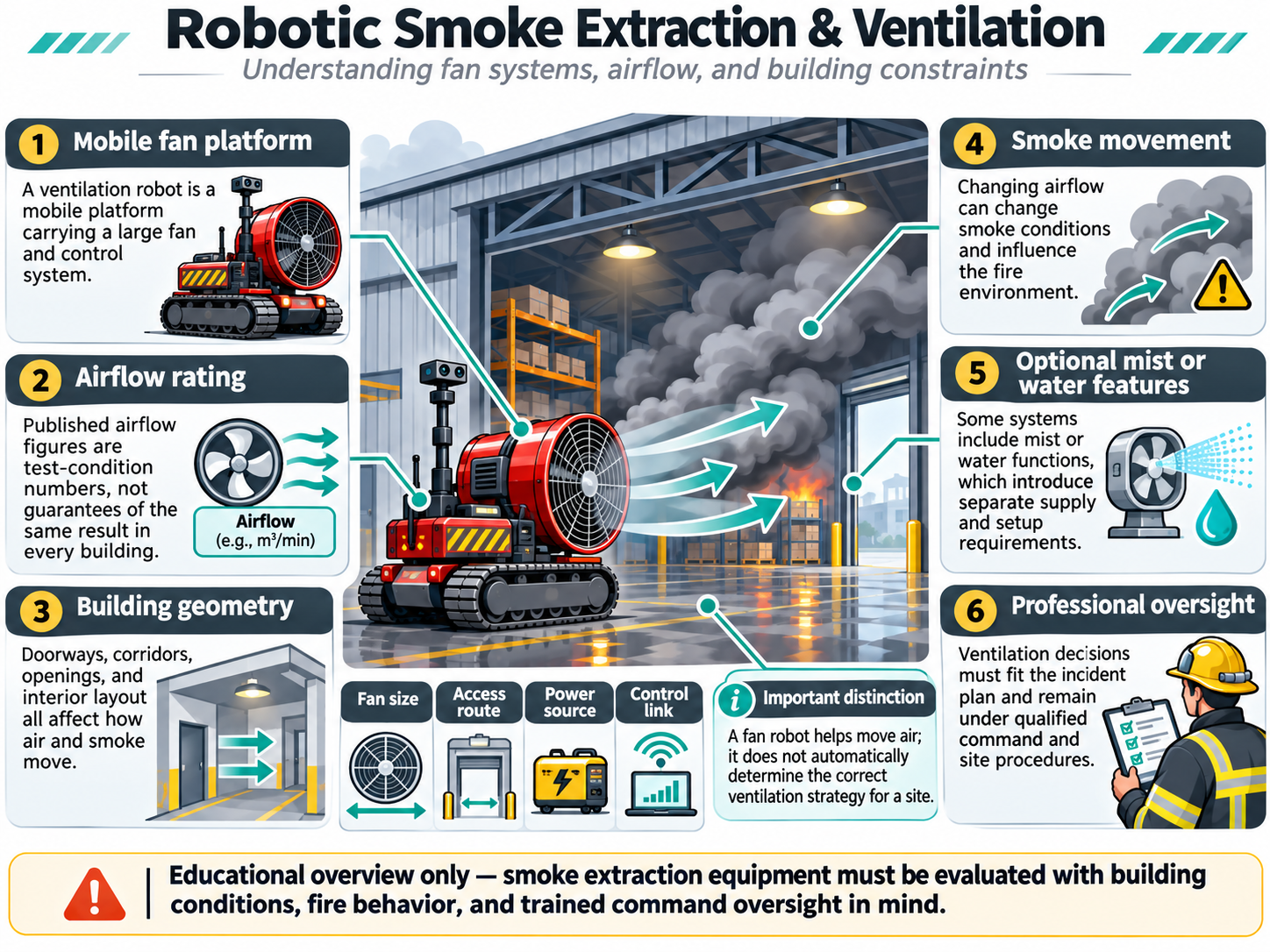
Mobile smoke-extraction systems may look straightforward: drive a fan into place and move air. Real evaluation requires a much broader understanding of measured airflow, site interfaces and the effect of changing the ventilation environment.
This material is not accredited, does not replace incident command, and provides no authority or tactical directions for deployments. Follow agency procedures, qualified training, manufacturer instructions and applicable site regulations.
REAL EQUIPMENT · VERIFIED MEDIA
Connect the lesson to manufacturer demonstrations
Manufacturer footage relevant to this topic is being reviewed for model accuracy and written publication rights. No video is displayed as authorised until those checks are complete. The illustration above is an original conceptual guide, not manufacturer footage.
Help firefighters, training officers, technology teams and industrial responders ask better questions about equipment. It is an information resource, not an operational procedure.
01 / AIR MANAGEMENT TECHNOLOGY
A ventilation robot is a mobile equipment platform.
A remotely controlled smoke-extraction robot generally carries a large fan, along with the drive system, power equipment and controls needed for positioning. Some catalogues combine the fan with water-mist devices or a firefighting monitor. Those functions should be evaluated separately, because a fan's rated airflow does not describe its water or fire-suppression performance.
The equipment's operating envelope includes its overall dimensions, mass, transport, drive performance, endurance, power source and heat/environment ratings. A larger fan may not be accessible in every proposed location.
Is the intended machine being selected to move air, deliver mist or deliver a firefighting medium?
Request the actual installed fan model and a complete list of standard and optional equipment.
02 / AIR MANAGEMENT TECHNOLOGY
Published airflow is a test-condition number.
Fan capacity may be quoted in cubic metres per hour. The figure must be interpreted with the measurement method, operating speed, configuration and other relevant conditions. It is not a guarantee of a particular smoke-clearance outcome inside an unfamiliar tunnel, warehouse or industrial building.
A manufacturer may advertise several large units with different duty requirements. Comparisons need the same basis: documented airflow, power, controllability, operating limits and site constraints.
What could make two fans with the same headline airflow perform differently in a real facility?
Obtain rated airflow documentation, fan performance conditions and the applicable operating envelope.
03 / AIR MANAGEMENT TECHNOLOGY
Water-mist features introduce separate dependencies.
Some products integrate a mist system for cooling or dust/smoke management. This introduces water availability, pressure, nozzle and drainage considerations, alongside the fan's own power and controls.
A 'smoke extraction plus mist' catalogue description is therefore a system-integration starting point—not proof of safety or effectiveness for an individual facility.
Is a specific mist feature standard, optional or limited to certain operating conditions?
Ask for mist flow, interfaces, accessory details and installed-system documentation.
04 / AIR MANAGEMENT TECHNOLOGY
The building and incident plan determine suitability.
Tunnel geometry, building openings, existing mechanical ventilation and enclosed-space layout can substantially affect air movement. More importantly, ventilation can influence fire behaviour and the movement of hot gases and smoke. Decisions about whether, where or when ventilation is appropriate belong to trained incident command and the facility's approved procedures.
A product lesson should not become a how-to guide for ventilation tactics. The question here is what evidence an organisation needs to evaluate an equipment type before considering integration into its professional response system.
Who is authorised to decide how mobile ventilation equipment relates to the site's existing emergency plan?
Document facility geometry and the responsible team's site-specific smoke-management design criteria.
05 / AIR MANAGEMENT TECHNOLOGY
What makes an evaluation credible?
A useful evaluation compares model-specific data, the actual equipment dimensions, transport and access limits, communications, maintenance, power and relevant test results. It also considers whether local specialist support and training are available.
Research-based fire safety education, such as that published by FSRI, provides independent background for understanding why fire behaviour and airflow changes deserve careful professional assessment.
Can the manufacturer demonstrate a comparable operating environment without implying the demonstration establishes a universally safe tactic?
Obtain current technical drawings, tested performance information and operator documents.
A COMMON MISUNDERSTANDING
Claim versus evidence.
A larger advertised fan capacity means the robot will always clear smoke better.
Rated airflow alone cannot predict the result in a particular building; application depends on conditions and professional smoke-management decisions.
BEFORE YOU FINISH
Key points to remember
- Fan, mist and monitor functions must be distinguished
- Airflow ratings need test context
- Access and power shape deployment limits
- Ventilation strategy is a professional incident-command decision
INDEPENDENT FURTHER READING
References for deeper study
The independent organisations below are not affiliated with or endorsing Apollo. Their materials provide additional context, not product certification for any particular supplier.