
REMOTE RECONNAISSANCE
Thermal Cameras, Video & Gas Sensors on Fire Robots
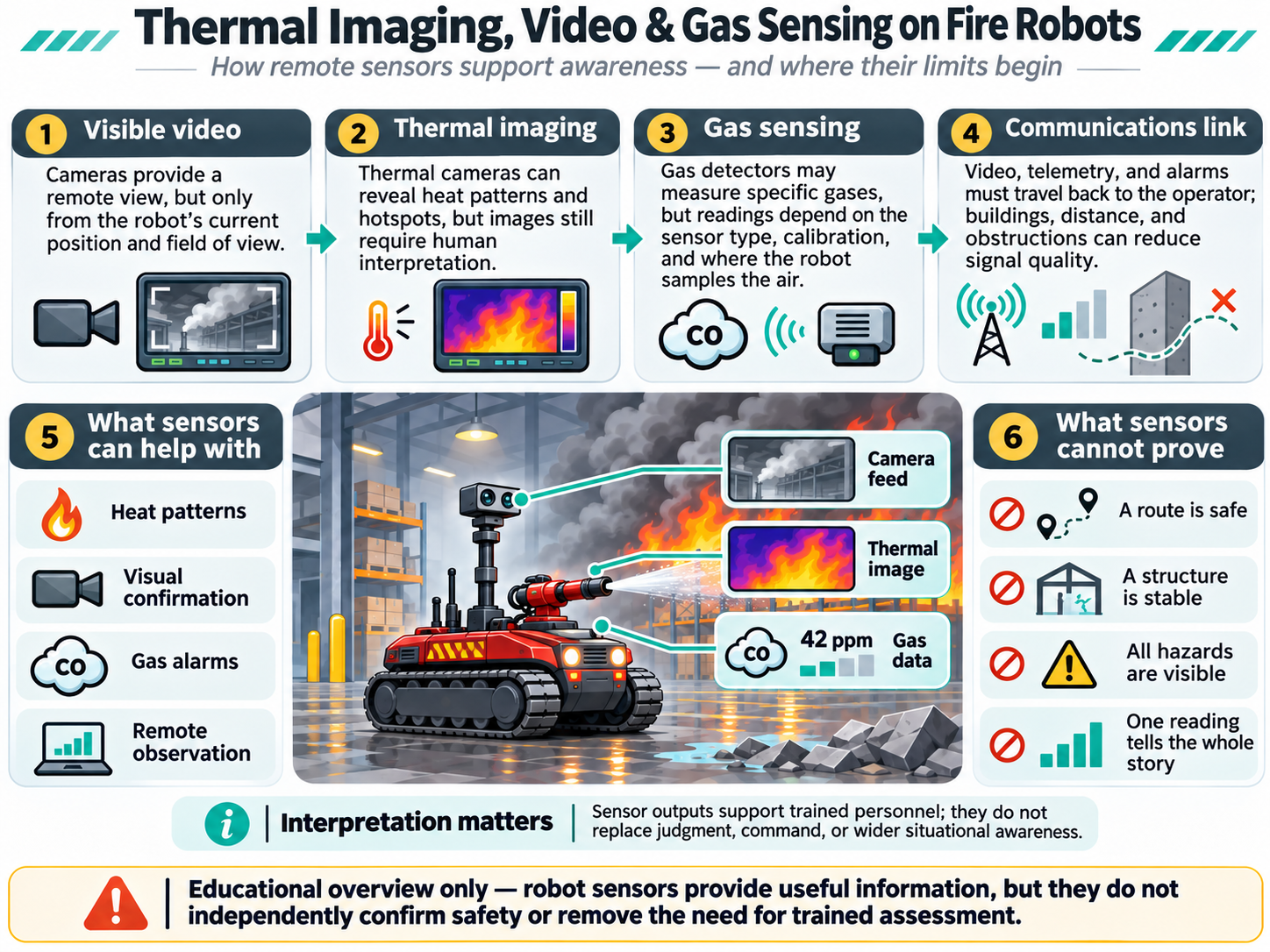
Sensors are among the most interesting parts of a response robot, but they are not omniscient. Learn how different information streams contribute to—and can mislead—a remote assessment.
This material is not accredited, does not replace incident command, and provides no authority or tactical directions for deployments. Follow agency procedures, qualified training, manufacturer instructions and applicable site regulations.
REAL EQUIPMENT · VERIFIED MEDIA
Connect the lesson to manufacturer demonstrations
Manufacturer footage relevant to this topic is being reviewed for model accuracy and written publication rights. No video is displayed as authorised until those checks are complete. The illustration above is an original conceptual guide, not manufacturer footage.
Help firefighters, training officers, technology teams and industrial responders ask better questions about equipment. It is an information resource, not an operational procedure.
01 / REMOTE RECONNAISSANCE
A robot camera shows a viewpoint, not the entire incident.
Ordinary visible-light cameras can provide useful information from a location that personnel are not yet occupying. But the result depends on camera placement, lighting, smoke, resolution, frame rate, field of view and the route the robot can reach.
It is easy to mistake a clear video feed for comprehensive situational awareness. Blind spots, occlusions and missing context are real limitations, even on a robot equipped with multiple cameras.
What important parts of a scene would remain unseen from the robot's likely camera position?
Ask for the number, placement and field of view of cameras installed on the proposed model.
02 / REMOTE RECONNAISSANCE
Thermal imaging represents measured infrared information.
Thermal imagers can help identify temperature patterns and possible hotspots in some conditions. However, displayed image colours are a representation chosen by the device and its settings. Surfaces, reflections, emissivity, smoke characteristics and image processing can affect what is interpreted.
A thermal image is not a direct guarantee of a victim's location, structural stability or safe travel route. Teams need appropriate training to understand what the sensor measures and what it cannot conclude.
Which conclusions might a reader wrongly infer from one thermal image?
Request the camera's stated temperature performance, sensitivity, field of view, calibration guidance and any supported operating limitations.
03 / REMOTE RECONNAISSANCE
Gas detection starts with the named gas and sensing technology.
A brochure may list six gases, but that does not establish what concentration ranges or detection limits apply, how quickly the sensors respond or how calibration is handled. Different sensor technologies have different cross-sensitivities, limitations and maintenance needs.
Sample location also matters: readings near a sensor on a moving robot are not a complete atmospheric map. Teams should not treat a single reading as proof that an environment is safe.
Does the supplier identify the exact measured gases, measurement ranges and alarm limitations?
Request the sensor bill of materials, calibration intervals, response characteristics and maintenance documents.
04 / REMOTE RECONNAISSANCE
The communication link is part of the sensor system.
A high-quality payload is of limited use if the data cannot be reliably received. Radio links may be affected by building structure, underground spaces, industrial plant and interference. Video, telemetry and movement-control links may perform differently under these constraints.
NIST has published research on measuring response-robot performance under attenuated radio conditions, illustrating why a clear-line-of-sight range claim does not describe every operational setting.
Would the demonstration include realistic obstructions similar to the proposed site?
Ask for supported wireless systems, operating limitations, video latency information and loss-of-signal behaviour.
05 / REMOTE RECONNAISSANCE
Data helps human judgement—it does not make the decision.
A professional response team can combine robotic observations with known site risks, facility information, trained personnel and established procedures. That may improve awareness, but a machine's software should not be treated as a substitute for incident command or qualified risk assessment.
Recording what each sensor can support—and what it cannot support—helps prevent technology overconfidence during procurement and training.
Which decisions must remain explicitly with trained incident personnel?
Request the manufacturer's list of supported sensor use cases and documented limitations.
A COMMON MISUNDERSTANDING
Claim versus evidence.
A thermal camera plus a gas sensor tells us whether a building is safe for entry.
Those sensors provide limited observations under defined conditions; they cannot independently establish a safe atmosphere, structural stability or a safe route.
BEFORE YOU FINISH
Key points to remember
- Camera viewpoint is incomplete
- Thermal and gas readings require interpretation
- Communication quality can limit usable data
- Human oversight is essential
INDEPENDENT FURTHER READING
References for deeper study
The independent organisations below are not affiliated with or endorsing Apollo. Their materials provide additional context, not product certification for any particular supplier.