
HAZARDOUS-AREA EVIDENCE
Explosion-Proof Robotics: What Certification Really Covers
A machine described as 'explosion-proof' requires more than a convincing brochure. This lesson outlines the questions an industrial response team should ask about the exact configuration and the site classification.
This material is not accredited, does not replace incident command, and provides no authority or tactical directions for deployments. Follow agency procedures, qualified training, manufacturer instructions and applicable site regulations.
REAL EQUIPMENT · VERIFIED MEDIA
Connect the lesson to manufacturer demonstrations
Manufacturer footage relevant to this topic is being reviewed for model accuracy and written publication rights. No video is displayed as authorised until those checks are complete. The illustration above is an original conceptual guide, not manufacturer footage.
Help firefighters, training officers, technology teams and industrial responders ask better questions about equipment. It is an information resource, not an operational procedure.
01 / HAZARDOUS-AREA EVIDENCE
Explosion protection describes a defined safety claim.
Some industrial sites contain potentially explosive gas, vapour or dust atmospheres. Whether equipment may enter those areas depends on the site's legally applicable classification and the protection provided by the equipment. No generic label makes a robot universally suitable for all hazardous locations.
Terms such as 'explosion-proof' can be used broadly in marketing. Professional evaluation should use the actual applicable standard, certificate or conformity documentation, including the exact protection marking, rather than assuming the phrase establishes a complete technical approval.
Does your team know which specialist or responsible authority defines the site's hazardous-area classification?
Obtain the certified equipment identification, certification document and full technical scope.
02 / HAZARDOUS-AREA EVIDENCE
ATEX is not a single all-purpose badge.
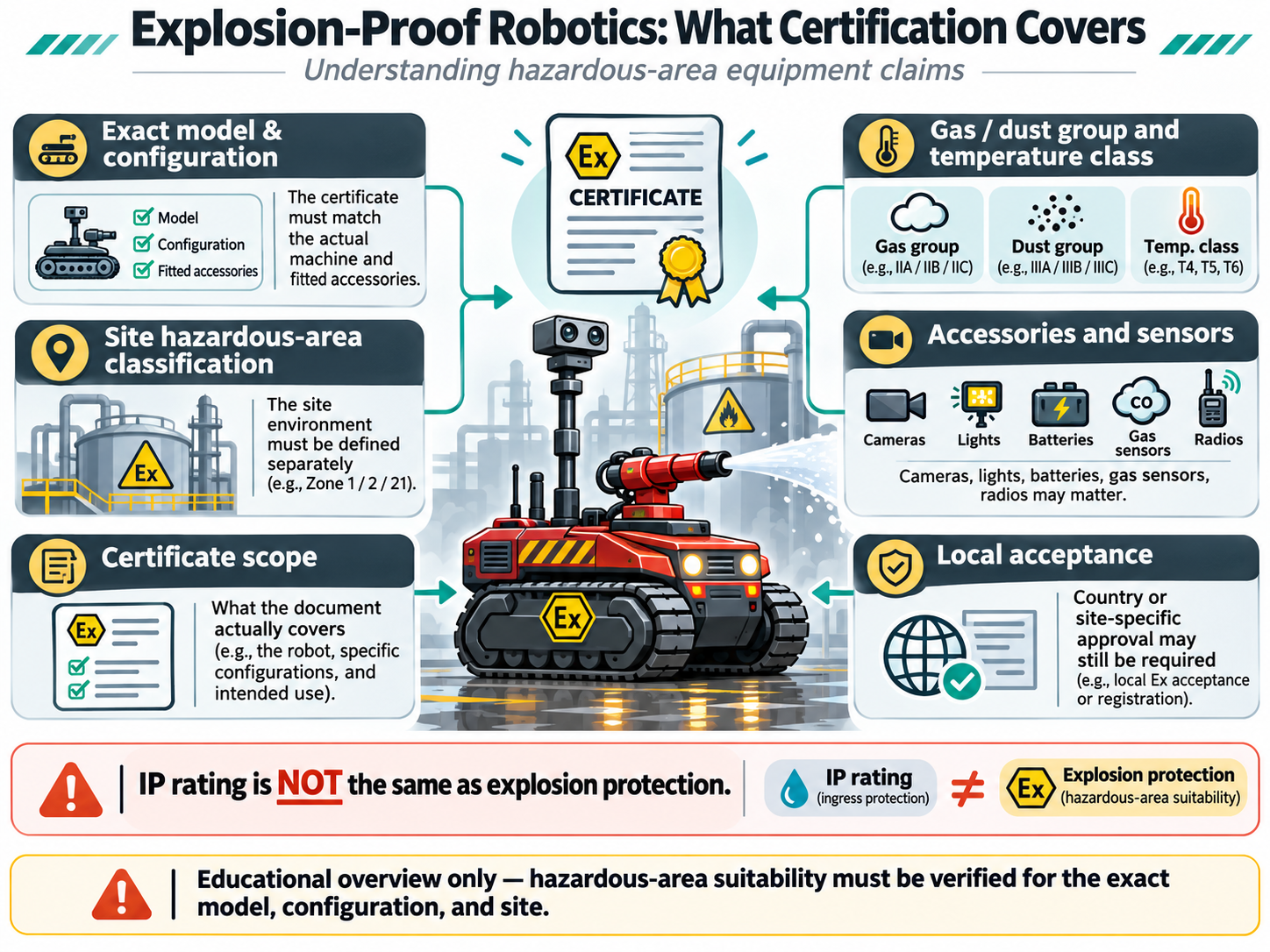
ATEX-related compliance evidence has scope. The relevant equipment group and category, protection concept, gas or dust classification, temperature marking and other limitations must correspond to the actual intended environment. The supplier's claim should be traceable to an identifiable complete product and its declared configuration.
Different countries may apply different acceptance rules. A genuine certificate that is appropriate in one market does not necessarily remove the need for local review elsewhere.
Would the supplied certificate identify the exact ordered robot and the actual intended environment?
Request complete certificate schedules and markings—not only a cropped image of a certificate cover.
03 / HAZARDOUS-AREA EVIDENCE
The full machine matters, not just the chassis.
A robot may incorporate cameras, radio transmitters, batteries, cooling equipment, gas detectors, lighting and remote-control interfaces. Safety analysis must consider the complete fitted system. A change to a sensor or added accessory can affect the configuration for which a manufacturer has evidence.
If the manufacturer lists several similarly named variants, do not transfer the most favourable certificate or performance rating from one variant to another without written evidence. This is especially important when distributors and manufacturers use overlapping model designations.
Are the advertised thermal cameras, lights and other accessories included within the reviewed certification scope?
Ask for a configuration list matching all installed parts to the certification and model identifier.
04 / HAZARDOUS-AREA EVIDENCE
IP protection and explosion protection answer different questions.
An ingress-protection (IP) rating describes resistance to specified conditions of dust and water entry. This can matter for cleaning, spray exposure and outdoor operations, but it is not an approval for explosive atmospheres.
Likewise, general terms such as 'industrial', 'high temperature', 'waterproof' or 'spark protected' cannot substitute for the exact documentation required by the site.
Can each supplier claim be tied to a specific test, standard and machine version?
Separate ingress ratings, environmental tests and explosion-protection evidence in your review table.
05 / HAZARDOUS-AREA EVIDENCE
Technical release is a project decision.
A sensible procurement process asks the site's appropriately qualified hazardous-area personnel to compare the equipment evidence with the actual classification, installation requirements, local rules and proposed maintenance arrangements. The robot's use must also conform to incident command and operator procedures.
Apollo can assist by organising supplier documentation and identifying missing evidence, but it must not represent an unverified brochure claim as approval for a specific hazardous setting.
Who signs off the equipment's country and site eligibility before a project advances?
Ask for a complete compliance document pack and clear manufacturer confirmation of supported destinations and configurations.
A COMMON MISUNDERSTANDING
Claim versus evidence.
A robot described as ATEX certified can enter any explosive atmosphere.
Certification is limited by the certificate's stated configuration and protection markings; suitability must be established against the actual site's classification.
BEFORE YOU FINISH
Key points to remember
- Marketing labels are not site approvals
- Certification must match the complete fitted model
- IP ratings do not prove explosion protection
- Local specialist and country-specific acceptance still matter
INDEPENDENT FURTHER READING
References for deeper study
The independent organisations below are not affiliated with or endorsing Apollo. Their materials provide additional context, not product certification for any particular supplier.