
SYSTEMS FUNDAMENTALS
Water, Foam & Robotic Fire Monitors Explained
A powerful-looking robotic nozzle is only one part of a working fire-suppression arrangement. This lesson explains the system questions firefighters and industrial buyers should understand before comparing machines.
This material is not accredited, does not replace incident command, and provides no authority or tactical directions for deployments. Follow agency procedures, qualified training, manufacturer instructions and applicable site regulations.
REAL EQUIPMENT · VERIFIED MEDIA
Connect the lesson to manufacturer demonstrations
Manufacturer footage relevant to this topic is being reviewed for model accuracy and written publication rights. No video is displayed as authorised until those checks are complete. The illustration above is an original conceptual guide, not manufacturer footage.
Help firefighters, training officers, technology teams and industrial responders ask better questions about equipment. It is an information resource, not an operational procedure.
01 / SYSTEMS FUNDAMENTALS
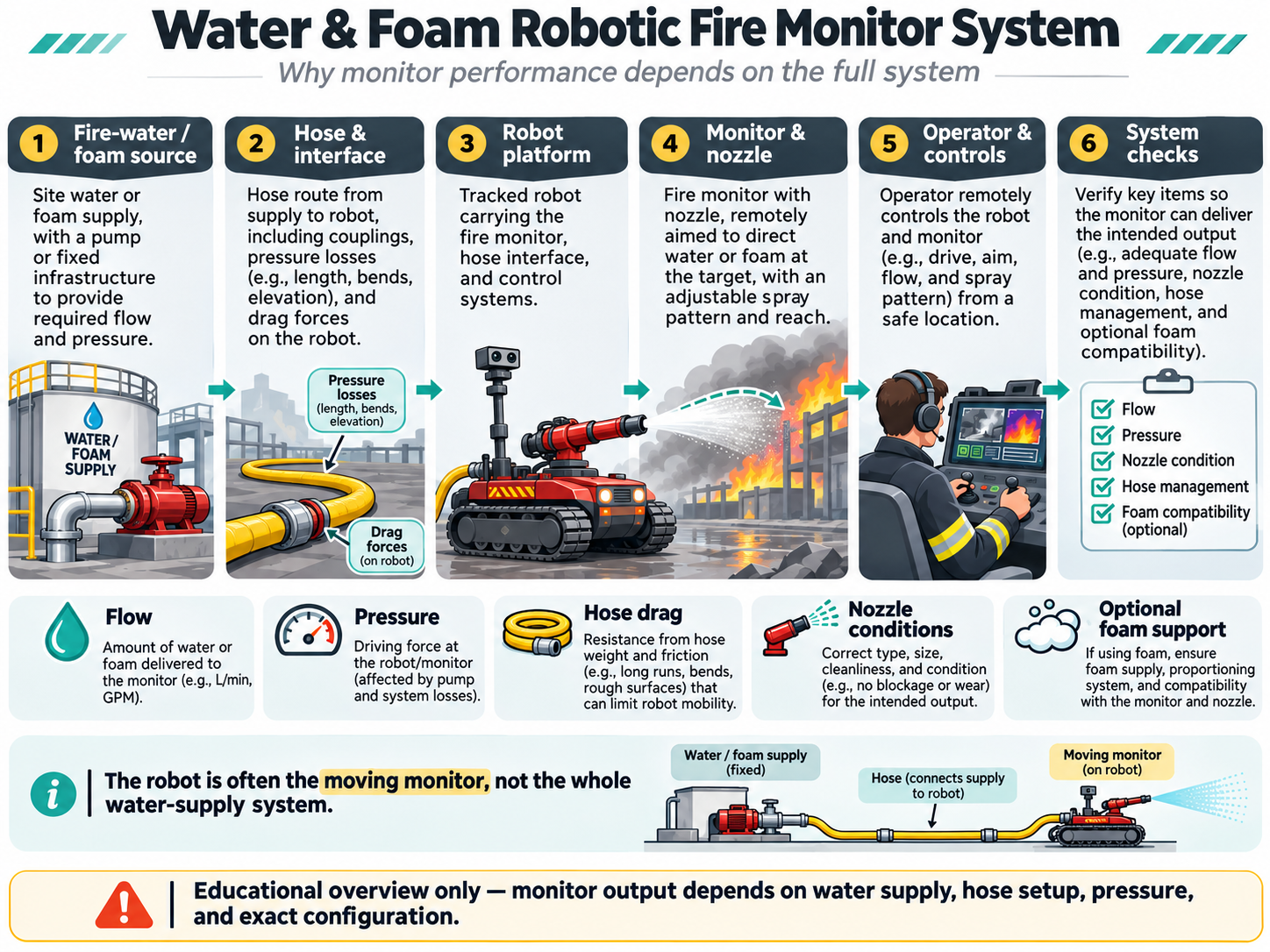
The robot moves the monitor; the water has to come from somewhere.
Many industrial firefighting robots carry a remotely directed monitor: a device that aims a stream of water, foam solution or another supported firefighting medium. It is often connected to external fire-water infrastructure through hoses. A brochure may show the discharge distance but omit the system design that makes the result possible.
A mobile robot therefore cannot be evaluated only by the monitor's maximum advertised reach. The external source, hose connections, pump capability and actual nozzle operating condition form part of the performance picture. A self-priming or internally pumped design is a different product class and must be verified separately.
What existing fire-water infrastructure would a candidate robot rely upon in your facility?
Ask for a configuration diagram showing supply, hose interfaces and included versus excluded equipment.
02 / SYSTEMS FUNDAMENTALS
Flow, pressure and nozzle performance are related.
Flow is often expressed as litres per second (L/s), while operating pressure may be given in bar or megapascals (MPa). These figures are related but not interchangeable. Range depends on a combination of supplied conditions, nozzle geometry and environmental factors; published distance alone should not be treated as a guaranteed site outcome.
A fair comparison records the test pressure and flow for the quoted range and whether the figure represents water or foam. Project engineers must verify the interface against the available supply capacity, pressure losses and system responsibilities; the lesson is about recognising those dependencies, not designing the suppression system.
If two brochures claim the same range, what else would need to be identical for the comparison to be meaningful?
Request a dated model-specific performance sheet, test method and the conditions behind each reach claim.
03 / SYSTEMS FUNDAMENTALS
Hoses and mobility are part of the machine's real working load.
A robot travelling without a hose may look agile in a demonstration, but a connected hose changes its movement and recovery constraints. Drag force, turning space, surface friction and obstacles can affect a robot's ability to position itself. The manufacturer may specify rated tractive force or hose-towing capacity; those values need context.
Operators and site planners should distinguish advertised chassis mobility from verified mobility in the intended equipped configuration. Access width, level changes, obstructions and a path for recovering the machine require qualified review.
Would the proposed robot be observed only on a clear test surface, or in a realistic site representation?
Request documented tests with the same hose arrangement, loaded configuration and relevant site obstacles.
04 / SYSTEMS FUNDAMENTALS
Water/foam options need their own evidence.
A listing that says 'water and foam' does not automatically establish suitability for every foam concentrate, proportioning arrangement or environmental policy. Compatibility and applicable local restrictions must be checked for the selected system and intended application.
Foam use also creates responsibilities beyond robot selection, including approved product choice and environmental handling. Those questions belong with appropriately qualified fire-protection and site specialists.
Which of the proposed robot's features are standard, and which depend on optional equipment?
Ask the supplier to specify approved media, component compatibility, included accessories and installation responsibilities.
05 / SYSTEMS FUNDAMENTALS
What belongs in the evaluation record?
Useful procurement notes should show exact model and configuration, confirmed supply dependencies, control arrangements, operating limits, available test evidence and how the machine would be maintained and recovered. Keeping those facts together avoids comparisons based on isolated headline figures.
The goal is a defensible equipment selection discussion that trained responders and engineers can use—not a promised fireground outcome.
Can your team describe what the supplier actually promises without relying on the video alone?
Request one consolidated model-specific specification sheet, an equipment list and comparable demonstration evidence.
A COMMON MISUNDERSTANDING
Claim versus evidence.
A robot with an 80 L/s monitor must be a self-contained 80 L/s firefighting machine.
The monitor rating says little about whether water, foam, pump capacity, hose work and nozzle test conditions are included. Those interfaces require verification.
BEFORE YOU FINISH
Key points to remember
- Robot, pump, hose and nozzle form a connected system
- Flow and range need test conditions
- Foam compatibility is configuration-specific
- Qualified specialists must approve fire-system integration
INDEPENDENT FURTHER READING
References for deeper study
The independent organisations below are not affiliated with or endorsing Apollo. Their materials provide additional context, not product certification for any particular supplier.