BUILDING FIRES / ROBOTICS AWARENESS · 7–10 MINUTE READ
Where can robots help around building fires?
Learn the questions firefighters and industrial response teams should ask when assessing remote equipment for warehouses, factories, parking structures and other buildings.
Educational material, not a deployment procedure. This guide does not give entry, ventilation, rescue or fire-attack instructions. Qualified incident commanders, agency policy and site-specific risk assessments govern all operations.
ILLUSTRATED LEARNING GUIDERobots around building fires
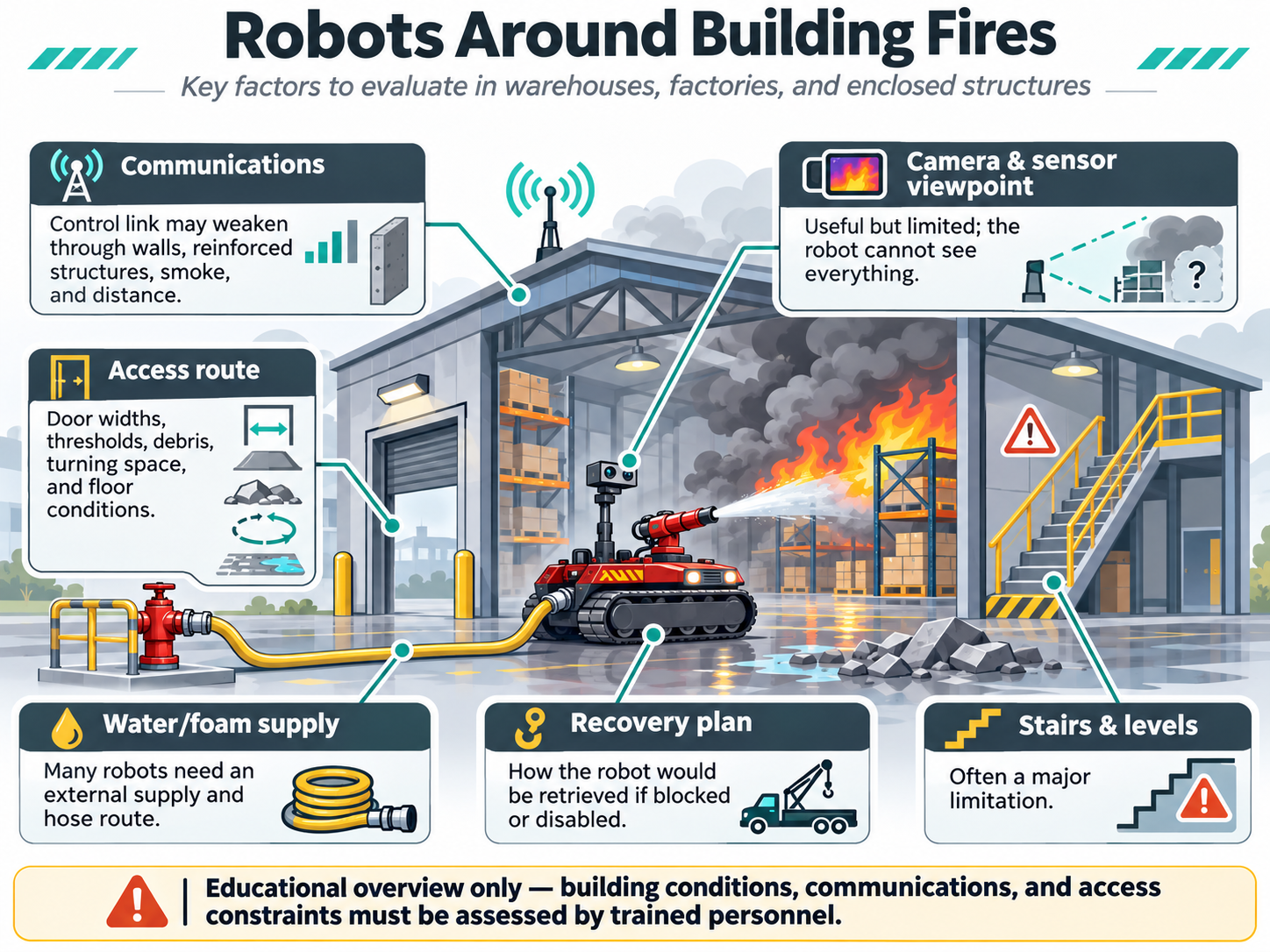
Illustrative warehouse scenario highlighting access, site infrastructure, communications and recovery constraints. Educational illustration only. Not an equipment-specific schematic or operational instruction. View full-size diagram
REAL EQUIPMENT · VERIFIED MEDIA
Connect the lesson to manufacturer demonstrations
Manufacturer footage relevant to this topic is being reviewed for model accuracy and written publication rights. No video is displayed as authorised until those checks are complete. The illustration above is an original conceptual guide, not manufacturer footage.
It is tempting to start with a product photograph: tracked wheels, a water monitor, a camera mast or a robot dog. A professional equipment assessment starts with a simpler question—what problem does the response team actually want remote equipment to address?
One team may want a better view of a hazardous industrial area before committing people to a particular location. Another may investigate positioning a fire monitor at a high-risk industrial site. A third may be assessing remote ventilation equipment in a large enclosed facility. These are not interchangeable applications.
A useful learning principle
Choose a response objective first, then examine the equipment class, evidence, site conditions, communication method and personnel responsibilities.
02 / BUILDINGS ARE COMPLEX ENVIRONMENTS
The route is part of the specification.
Manufacturer capability claims—such as maximum climbing angle, obstacle crossing, speed and remote-control range—are often measured in defined test conditions. A building is not a test track. Its layout may contain ramps, changing floor surfaces, loading dock edges, doors, debris, pipes, stock, wiring and narrow passages.
Interior radio communication can also be affected by walls, reinforced concrete, metal racking and distance. Video and other telemetry may behave differently from drive-control signals. Teams should understand the actual machine's documented loss-of-communication behaviour and retrieval approach.
A camera image does not establish structural stability. Nor does it guarantee that the machine can traverse the unseen route ahead. Thermal imaging is useful, but its information depends on sensor design, environmental conditions and interpretation by trained people.
03 / THE ROBOT IS ONE PART OF A SYSTEM
What supports the machine?
A water/foam firefighting robot is often a movable monitor rather than a self-contained pump truck. It may need an external pressurised supply, hoses and a suitable nozzle configuration. Fire-water availability, operating flow, working pressure and drag forces have to be considered together.
Reconnaissance systems have other dependencies: camera performance, sensor calibration, data feedback, battery endurance and appropriate operating-environment ratings. Smoke extraction platforms add questions about fan performance, exhaust paths and coordination with fixed building ventilation. Different machines impose different support requirements.
Physical access: dimensions, weight, turning capability and surface conditions.
Communications: real building coverage, interference and signal-loss behaviour.
Water/foam: site pump capability, nozzle and hose compatibility, when required.
Sensor evidence: what is measured, how reliably, and in what conditions.
Operational oversight: qualified human decision-making, recovery and training.
04 / EXAMPLES FOR CLASSROOM DISCUSSION
Four building types, four different equipment questions.
Warehouses and logistics buildings
Large floor plates, racking, loading bays and changing storage layouts can create access and visibility challenges.
Can the machine navigate the actual aisles and thresholds?
Does the robot require an external water supply and hose route?
How reliable is the control link behind structural obstructions?
Factories and manufacturing plants
Production machinery, floor obstructions and specialist process hazards change what a remote platform can access.
Are there hazardous-area classifications or electrical constraints?
Can sensors observe the required areas without obstructed views?
Is the selected equipment suitable for the plant's environment?
Parking buildings and underground spaces
Constrained ramps, corners, limited line of sight and communications infrastructure make remote operation more complex.
Can the system handle slopes, tight turns and obstacles under loaded conditions?
What communications method is supported in enclosed levels?
How does the system fit the facility's smoke management plan?
High-rise and multi-level structures
Elevation and stair access can make tracked or wheeled machines unsuitable; lifts cannot be assumed available.
What is the actual movement path and access width?
Has the supplier demonstrated the machine on comparable surfaces and levels?
Are there alternative remote sensing methods for inaccessible areas?
05 / VERIFY, DON'T ASSUME
What the brochure cannot tell you on its own.
Two machines might share a descriptive product category, yet differ substantially in mass, controls, payloads, certifications and operating limits. Even similar model names are not proof of equivalent equipment. A current model-specific technical sheet and documentary evidence matter.
If the site has a classified hazardous atmosphere, the relevant explosion-protection certificate must apply to the ordered configuration. An ingress-protection rating, such as IP67, does not establish hazardous-area suitability. Manufacturer test videos should also be matched to the actual model version, payload and relevant field conditions.
National Institute of Standards and Technology research highlights the importance of standardised performance measurement and operator proficiency when evaluating emergency-response robots. Read the NIST research overview
06 / TEAM DISCUSSION
Seven questions before evaluating robotic equipment.
Use these prompts in a training-room conversation
What mission, task or information gap are we trying to address?
What building types and physical routes does our team encounter?
Which machine type fits the task: suppression, sensing, ventilation or rescue?
Which site infrastructure does the proposed robot depend upon?
What data or video does the team need, and what are its limitations?
What specific certification, manufacturer test evidence and operator skills are required?
Who owns incident command, system operation, maintenance and retrieval planning?
These questions are intentionally not tactical orders. They are designed to help a team identify evidence gaps and develop a realistic programme with qualified local specialists.
NEXT STEPS
Move from building-fire concepts to equipment comparison.
Visit the learning centre for the wider curriculum, or review KERVYNT's technical buyer guide when your team is ready to document specific site requirements.
Essential site functions work without analytics. With your permission, Apollo measures which products and project pages are useful. Analytics stays off unless you allow it.