
PROGRAMME DEVELOPMENT
How a Fire Service Can Evaluate Robotics Capability
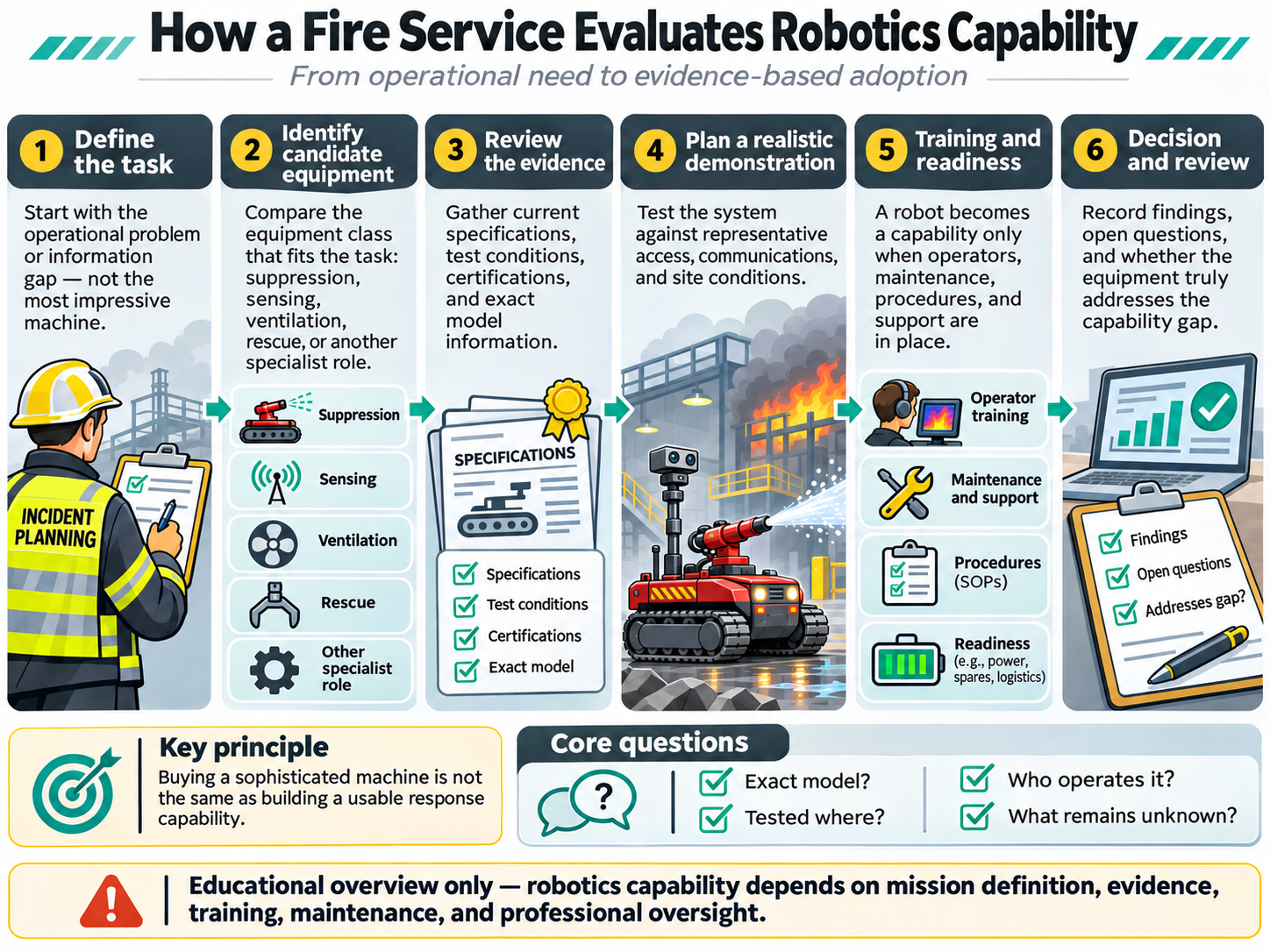
A credible robotics programme starts by identifying a capability gap, not selecting the most spectacular machine. This lesson provides a structured discussion framework for officers, procurement teams and industrial response organisations.
This material is not accredited, does not replace incident command, and provides no authority or tactical directions for deployments. Follow agency procedures, qualified training, manufacturer instructions and applicable site regulations.
REAL EQUIPMENT · VERIFIED MEDIA
Connect the lesson to manufacturer demonstrations
Manufacturer footage relevant to this topic is being reviewed for model accuracy and written publication rights. No video is displayed as authorised until those checks are complete. The illustration above is an original conceptual guide, not manufacturer footage.
Help firefighters, training officers, technology teams and industrial responders ask better questions about equipment. It is an information resource, not an operational procedure.
01 / PROGRAMME DEVELOPMENT
Identify the task and its boundaries.
Begin with the real problem: a difficult-to-access location, a need for remote environmental information, a high-risk monitor-positioning job or a specific industrial inspection task. Write a short statement describing the intended benefit and the conditions under which a human-led response team might consider robotic assistance.
Be explicit about what remains outside the machine's role. An industrial fire-monitor robot is not a replacement for firefighting personnel, incident command or a complete fire-water system. Scope discipline is essential for buying the right equipment.
Could the team describe its target task without naming a robot manufacturer?
Create a one-page capability-gap statement, including exclusions and site conditions.
02 / PROGRAMME DEVELOPMENT
Build an evidence-based comparison.
Compare equipment on demonstrated capabilities relevant to the task: dimensions and mobility, control reliability, communications, relevant sensors, power and duration, safety documentation and local integration. Manufacturer brochures are inputs, not the final decision.
NIST's standard-test-method work is useful because repeatable performance measures can reveal differences between equipment models and give operators meaningful proficiency goals. The organisation should choose comparable tests rather than relying on dissimilar demonstration videos.
Which capabilities could be evaluated using measurable and repeatable observations?
Ask suppliers for model-specific data, test context, exact configuration and current documentation.
03 / PROGRAMME DEVELOPMENT
Plan supervised demonstrations and review.
A demonstration for procurement or training should occur in an appropriately controlled environment under relevant professional procedures. Representative access constraints, communications obstructions and installed equipment can be discussed without attempting unsafe or unauthorised live-fire scenarios.
Record results in a consistent format, identify exceptions and request clarification for missing evidence. A supplier's successful demonstration under one set of conditions cannot be assumed to establish performance everywhere.
Does the proposed demonstration test the problem the organisation actually experiences?
Prepare a documented demonstration agenda and named technical reviewers before arranging a supplier visit.
04 / PROGRAMME DEVELOPMENT
Training and maintenance are part of readiness.
A robot in a storage area is not an operational capability by itself. Teams need an approved operating framework, trained and authorised personnel, routine inspection and maintenance, batteries and charging arrangements, parts access and a safe process for withdrawing defective equipment.
Specific training requirements and qualifications must be set by the employing organisation, relevant authorities and manufacturer. Apollo's educational material is only a starting point for awareness, not a competency sign-off.
Who owns operator authorisation, maintenance decisions and periodic performance review?
Ask about manufacturer documentation, spare parts, updates, warranty, service and specialist training pathways at the appropriate procurement stage.
05 / PROGRAMME DEVELOPMENT
Evaluate international, technical and commercial fit.
If the equipment is for a particular destination, check local radio, electrical, product-safety, hazardous-area and supply requirements as appropriate. Verify the actual manufacturer and exact model version, especially when similar model names appear across suppliers.
An organisation should also plan how it will review performance over time and whether the selected robot continues to address its original capability gap. A small well-defined trial can teach more than an unnecessarily broad first purchase.
What would make the evaluation successful, inconclusive or unsuitable—and who has authority to decide?
Consolidate a decision register: application, evidence received, open questions, reviewer, conditions and decision.
A COMMON MISUNDERSTANDING
Claim versus evidence.
Buying a sophisticated robot automatically gives a department a new response capability.
Equipment only becomes a credible capability when the mission is defined and supported by evidence, authorised operators, training, procedures, maintenance and ongoing review.
BEFORE YOU FINISH
Key points to remember
- Start with a clearly defined operational gap
- Compare repeatable evidence, not isolated marketing claims
- Demonstrations require professional control
- Training, maintenance and local approval complete the programme
INDEPENDENT FURTHER READING
References for deeper study
The independent organisations below are not affiliated with or endorsing Apollo. Their materials provide additional context, not product certification for any particular supplier.