
AGES 10–15, ADAPTABLE / 55 MINUTES
From Island Rain to Coral Reef
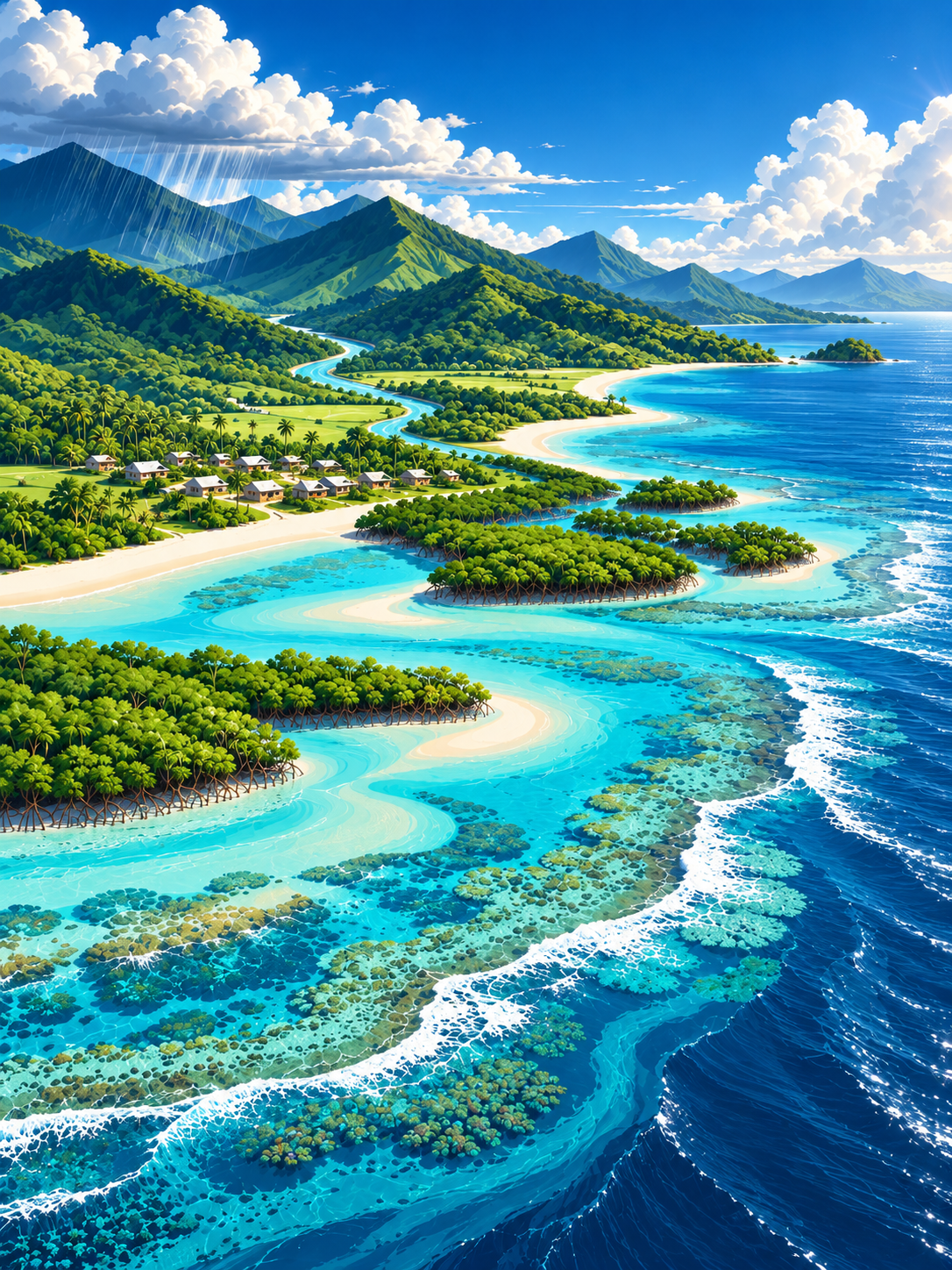
Trace water through an imaginary Pacific island watershed, distinguish observations from guesses, and prepare an ethical community discussion map. No site visit, wildlife handling or water testing is required.
01 / LEARNING PURPOSE
What learners should understand.
A reef is connected to catchments, water pathways and human activities far beyond the shoreline. An observation is not itself proof of a cause.
Separate direct evidence from a proposed explanation
Identify locally responsible roles before real coastal activity
02 / PREPARE TO TEACH
Facilitator preparation
- Use a fictional or teacher-approved non-sensitive island map
- Review appropriate local customary leadership and environmental rules
- Explain that reef or mangrove restoration is not part of the exercise
MATERIALS
What to have ready
- Blank A3 sheets or digital canvas
- Pencils and at least two annotation symbols
- An optional publicly available island map
No paid kit or specialised Apollo product is needed.
03 / FACILITATOR RUNNING ORDER
A complete 55-minute lesson.
Five clearly structured stages, with facilitator prompts, learner actions and the evidence each stage should produce.
015 min
Ask the opening question
Facilitator: Ask what happens after rain falls inland and model a factual observation versus a guess.
Learner: Record one idea and one question.
Expected output: Opening knowledge note
0212 min
Draw the catchment
Facilitator: Introduce mountain, river, community, estuary, lagoon and reef zones.
Learner: Create a conceptual water-path diagram with clear arrows.
Expected output: Six-zone systems sketch
0314 min
Mark uncertainty
Facilitator: Describe a fictional rainy day and cloudy coastal water without assigning a cause.
Learner: Mark observations and possible explanations with different symbols.
Expected output: Observed-versus-unknown comparison
0415 min
Who should be involved?
Facilitator: Discuss community rights, official agencies and appropriate local expertise.
Learner: List roles to consult rather than personal contact details.
Expected output: Consult-before-action checklist
059 min
Review and reflect
Facilitator: Check the difference between a possible connection and a proven cause.
Learner: Complete the short check and write one responsible next question.
Expected output: Exit question
04 / FREE INTERACTIVE WORKSHEET
What do we know about the water?
Using a fictional watershed, record the observed feature, a possible explanation and what extra information would be required. Do not claim an actual cause. These responses are not submitted to Apollo and are not used for learning metrics.
05 / LEARNING CHECK
A lagoon looks cloudy after rainfall. What should a learner do first?
DIFFERENT LEARNERS
Inclusive delivery notes
- Offer an oral or tactile landscape description instead of drawing
- Use labelled arrows and shapes, not colours alone
- Avoid requesting real locations or sensitive community knowledge
CAREFUL INTERPRETATION
Common misconceptions
Cloudy water after rain proves a named construction project damaged coral.
One observation does not establish a cause or a long-term trend.
A learning map authorises mangrove planting or reef repair.
Ecological work requires local rights-holder permission, relevant authorities and qualified review.
06 / TAKE THE LESSON WITH YOU
Download or print the teaching sequence.
Your export contains the lesson stages, worksheet questions, your notes, answer guide, source links and limitations. It is generated locally and requires no sign-up.
Keep the learning limits visible
Educational activity only; no field intervention or sampling
Not an official curriculum accreditation or marine monitoring protocol
INDEPENDENT EDUCATIONAL SOURCES
Trace ideas to reliable references.
Original explanatory content is authored for Apollo Community Knowledge; external sources are independent, and links do not create endorsements or teaching partnerships.
UNESCO-IOC Ocean Literacy resources
Open educational reference, not an Apollo partnership
Read independent sourceMangrove Management Handbook
Background only; not a planting instruction or permit
Read independent source OPTIONAL LEARNING FEEDBACK
Did this help you learn something useful?
Your answer helps us assess educational usefulness, not claim that an environmental or health outcome occurred.
No name, email, comment, worksheet, student answer or medical information is requested. Analytics is consent-dependent; a response is self-reported feedback, not verified learning or project impact.
Keep exploring responsibly.
Move into a related Academy lesson or country workshop, or try the other teaching packs.