
AGES 11–17, ADAPTABLE / 55 MINUTES
The Heat-Smart School Day
Explore a hypothetical school day through queues, play, breaks and pickup. Separate operational questions from built-environment options without attempting a heat-exposure experiment.
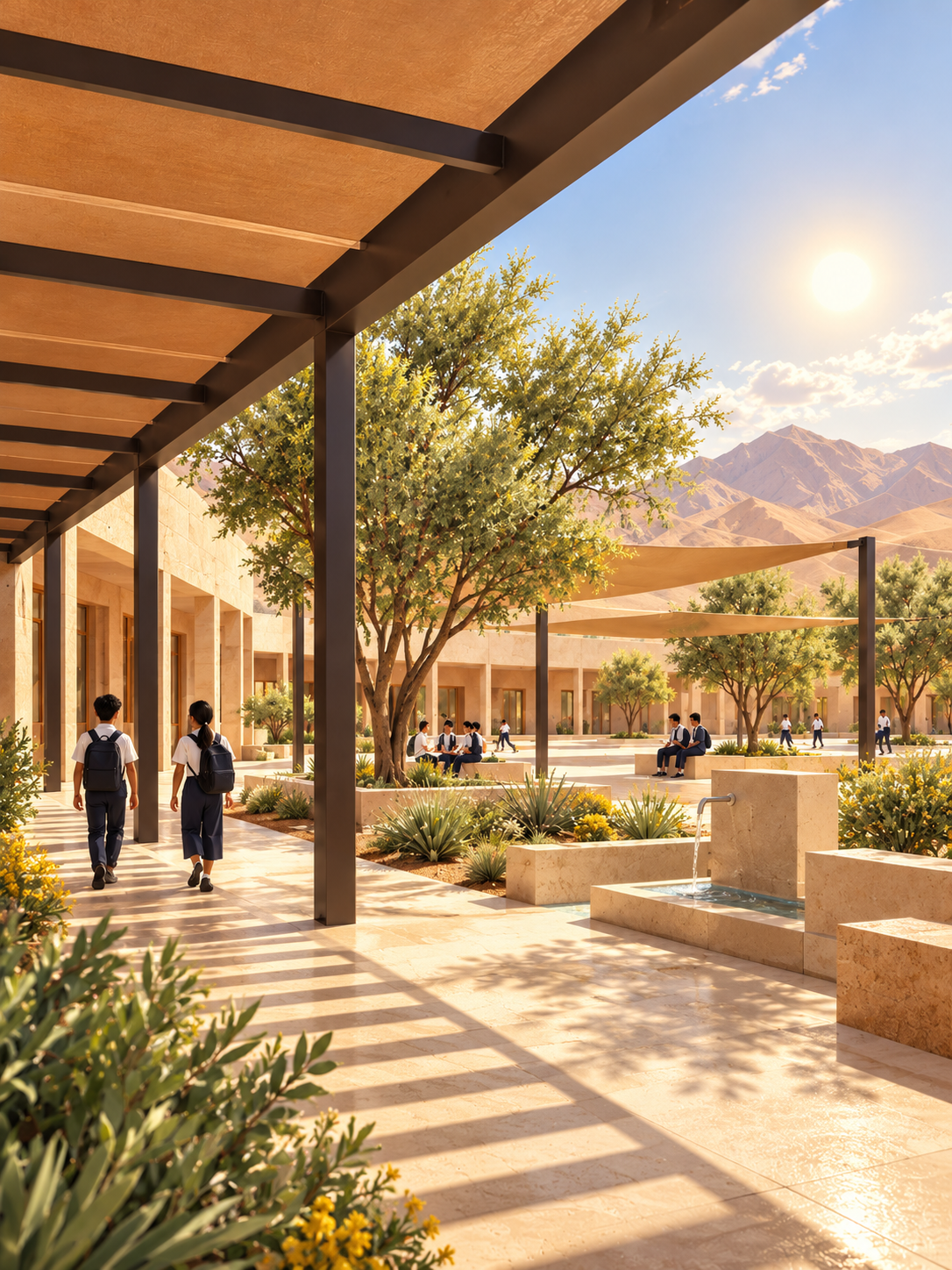
01 / LEARNING PURPOSE
What learners should understand.
Shade is helpful but cannot guarantee protection from extreme heat. School operations, health procedures, water and cooler spaces also matter.
Assign important questions to the right school or health roles
Prepare an accessible school-day discussion brief
02 / PREPARE TO TEACH
Facilitator preparation
- Use a hypothetical campus rather than a live student risk audit
- Do not request student medical information
- Use current local school and health rules for any real operating decisions
MATERIALS
What to have ready
- Blank school-day timeline
- Markers and route worksheet
- Independent WHO heat-health reference
No paid kit or specialised Apollo product is needed.
03 / FACILITATOR RUNNING ORDER
A complete 55-minute lesson.
Five clearly structured stages, with facilitator prompts, learner actions and the evidence each stage should produce.
017 min
Follow the school day
Facilitator: List arrival, queue, outside break, activity and departure.
Learner: Identify outdoor waiting and transitions.
Expected output: Day sequence
0211 min
Draw the route
Facilitator: Point out waiting, crossing, water and cooler-space questions.
Learner: Annotate a hypothetical campus, without certifying safety.
Expected output: School-day map
0313 min
Who is responsible?
Facilitator: Contrast operational heat plans with physical design and maintenance.
Learner: Classify issues as school operations, health, maintenance or technical design.
Expected output: Responsibility matrix
0415 min
Ask inclusive questions
Facilitator: Prompt different users, mobility needs and supervision.
Learner: Draft three questions for school leaders.
Expected output: Discussion brief
059 min
Review
Facilitator: Explain why shade is not a universal safety solution.
Learner: Correct an overconfident claim and answer check.
Expected output: Exit response
04 / FREE INTERACTIVE WORKSHEET
One whole-school-day map
Draw an imaginary campus route from arrival to departure and note what should be reviewed by school leaders or local professionals. These responses are not submitted to Apollo and are not used for learning metrics.
05 / LEARNING CHECK
After adding shade to a school court, what still matters?
DIFFERENT LEARNERS
Inclusive delivery notes
- Provide a text timeline for learners unable to draw
- Include diverse mobility and rest needs without requesting medical disclosures
- Use large labels and distinguish route types without colour alone
CAREFUL INTERPRETATION
Common misconceptions
A school with a shaded playground can safely exercise during any heat event.
Operating rules and health risks depend on many factors; shade alone is insufficient.
A rendered school image certifies local school safety.
Actual safety and compliance need local evidence and accountable professional review.
06 / TAKE THE LESSON WITH YOU
Download or print the teaching sequence.
Your export contains the lesson stages, worksheet questions, your notes, answer guide, source links and limitations. It is generated locally and requires no sign-up.
Keep the learning limits visible
No outdoor heat trials, exertion challenges or health evaluations
Not a school operation policy or engineering approval
INDEPENDENT EDUCATIONAL SOURCES
Trace ideas to reliable references.
Original explanatory content is authored for Apollo Community Knowledge; external sources are independent, and links do not create endorsements or teaching partnerships.
Heat and health
Health information, not local school operating rules
Read independent sourceHeat–health action plans (2026)
Health-action framework; locally specific decisions remain elsewhere
Read independent source OPTIONAL LEARNING FEEDBACK
Did this help you learn something useful?
Your answer helps us assess educational usefulness, not claim that an environmental or health outcome occurred.
No name, email, comment, worksheet, student answer or medical information is requested. Analytics is consent-dependent; a response is self-reported feedback, not verified learning or project impact.
Keep exploring responsibly.
Move into a related Academy lesson or country workshop, or try the other teaching packs.