
AGES 15+ AND ADULT GROUPS / 65 MINUTES
A Cooler Public Journey
Learners compare hypothetical pedestrian routes with crossings, shaded rest, transport waiting and public-space accessibility. The outcome is a discussion note rather than a temperature prediction.
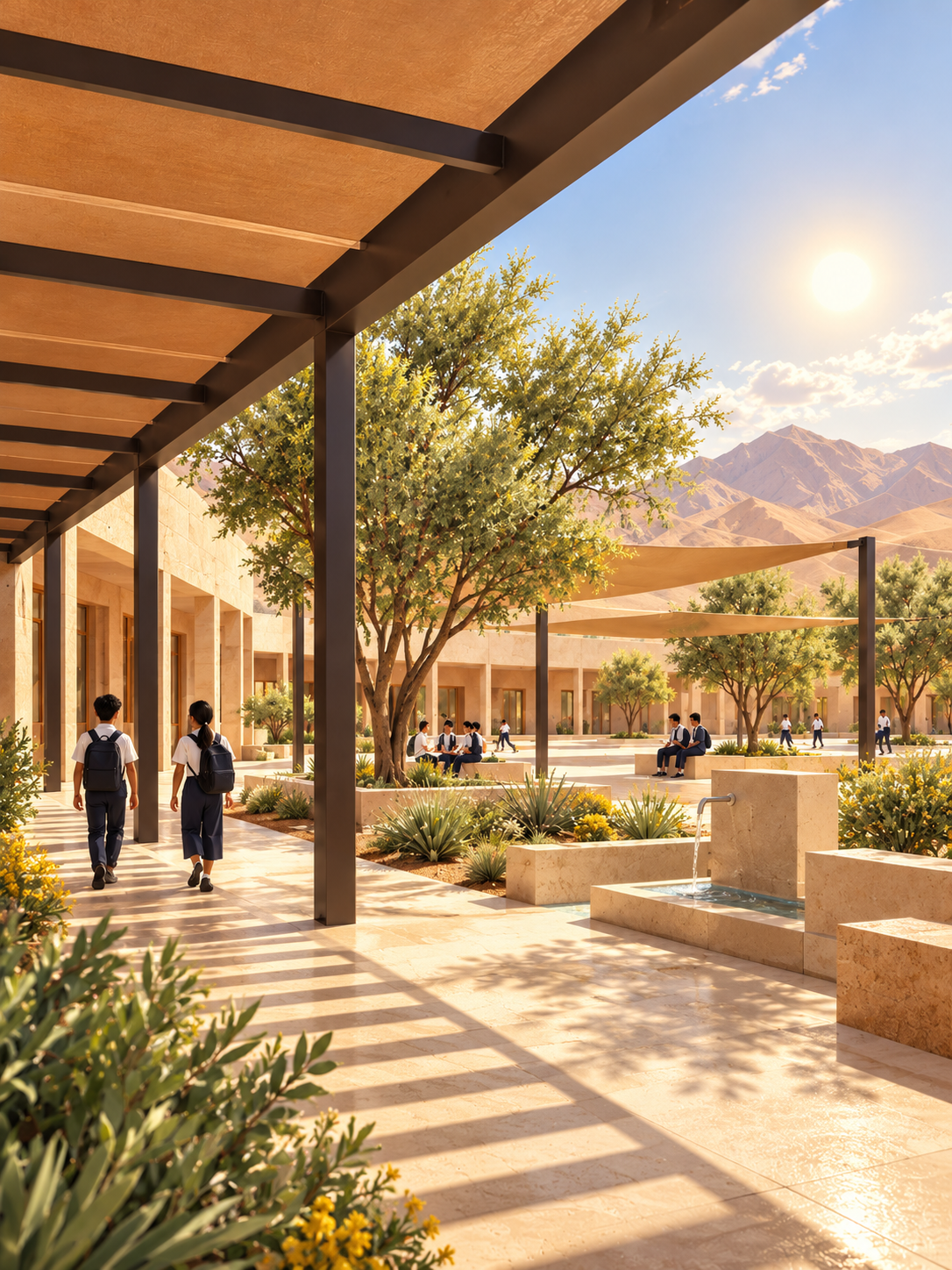
01 / LEARNING PURPOSE
What learners should understand.
A shaded landmark does not guarantee a comfortable or usable whole journey; people must travel, queue, cross, rest and reach services.
Compare planting, shelter and operating options with maintenance needs
Rewrite an unsupported cooling claim as a credible planning question
02 / PREPARE TO TEACH
Facilitator preparation
- Use fictional routes or non-sensitive public descriptions
- Remind learners that accessibility and local design standards need qualified verification
- Avoid field tasks during dangerous heat
MATERIALS
What to have ready
- Fictional bus stop/plaza/library route diagram
- Blank options matrix
- Source-linked heat-health background
No paid kit or specialised Apollo product is needed.
03 / FACILITATOR RUNNING ORDER
A complete 65-minute lesson.
Five clearly structured stages, with facilitator prompts, learner actions and the evidence each stage should produce.
018 min
Describe the journey
Facilitator: Set a fictional route from a bus stop through a plaza to a service.
Learner: Identify walking, waiting and crossing points.
Expected output: Route sequence
0214 min
Look for gaps
Facilitator: Include crossings, accessible resting and cooler spaces.
Learner: Mark unanswered questions along the entire route.
Expected output: Annotated route
0316 min
Compare possible measures
Facilitator: Discuss trees, shade, irrigation, maintenance and route changes.
Learner: Write trade-offs and necessary professional checks.
Expected output: Options table
0417 min
Draft a fair brief
Facilitator: Ask about operators, maintenance and authorities.
Learner: Write a one-page public-space discussion note.
Expected output: Initial briefing
0510 min
Correct the claim
Facilitator: Present a fictional unmeasured claim of cooler temperatures.
Learner: Rewrite it accurately and answer understanding check.
Expected output: Responsible statement
04 / FREE INTERACTIVE WORKSHEET
Whole-journey choices
Describe a fictional route and compare improvements using an evidence/maintenance/responsibility table. These responses are not submitted to Apollo and are not used for learning metrics.
05 / LEARNING CHECK
What can a conceptual shade route reasonably claim?
DIFFERENT LEARNERS
Inclusive delivery notes
- Use an ordered text description of the route instead of a map
- Include rest and mobility considerations without identifying any residents
- Use two explicit labels for facts and ideas, not colour alone
CAREFUL INTERPRETATION
Common misconceptions
An attractive shaded plaza guarantees the entire route feels comfortable.
Crossings and queues are part of the practical journey.
A design rendering proves how many degrees cooler a place will be.
Temperature claims require credible site data and suitable measurement.
06 / TAKE THE LESSON WITH YOU
Download or print the teaching sequence.
Your export contains the lesson stages, worksheet questions, your notes, answer guide, source links and limitations. It is generated locally and requires no sign-up.
Keep the learning limits visible
No dangerous-heat field route testing
No measured thermal performance, compliance or medical result is inferred
INDEPENDENT EDUCATIONAL SOURCES
Trace ideas to reliable references.
Original explanatory content is authored for Apollo Community Knowledge; external sources are independent, and links do not create endorsements or teaching partnerships.
Heat–health action plans: guidance, second edition
Adaptable heat-health framework, not a GCC municipal code
Read independent sourceHeat and health
General health context, no claimed project performance
Read independent source OPTIONAL LEARNING FEEDBACK
Did this help you learn something useful?
Your answer helps us assess educational usefulness, not claim that an environmental or health outcome occurred.
No name, email, comment, worksheet, student answer or medical information is requested. Analytics is consent-dependent; a response is self-reported feedback, not verified learning or project impact.
Keep exploring responsibly.
Move into a related Academy lesson or country workshop, or try the other teaching packs.