CHAPTER 01Understand heat as a people-and-place question
Why isn't shade alone a complete safety measure?
Heat can affect people differently depending on conditions, activity, exposure and individual circumstances. A roof or tree may reduce direct solar exposure in a specific place, yet people still walk, queue, work, play and move between areas. A credible learning discussion considers the full experience rather than treating one shade structure as a universal solution.
Start with an imaginary daily routine. Note when someone is outdoors, what they are doing, where cooler spaces may be available and who is responsible for decisions about activities. Keep actual health and school policy questions with the appropriate local authority.
A teaching sketch is not a heat assessment. It cannot prove that a place is safe at a given time, quantify a temperature reduction or justify exposure to dangerous heat. The learning goal is to recognise what additional information and responsible oversight would be needed.
Try this in a learning groupTrace an indoor-to-outdoor hypothetical school journey and mark operating, public-health and design questions separately.
Key distinctionHeat awareness depends on people, activity, conditions and responsibilities—not one built element.
CHAPTER 02See the whole school day
Which moments are easy to overlook?
A school day includes much more than time spent on a playing field. Arrival queues, transfers between buildings, waiting for transport, breaks, supervised activities and departure may all involve outdoor exposure. A useful learning map follows the journey from beginning to end.
Have learners annotate an invented school plan with walking paths, waiting areas, drinking-water questions, indoor retreat options and accessibility needs. Ask which issues could be addressed through operations and which require professional facility review. Avoid asking pupils to disclose health conditions or testing anything in dangerous weather.
The school or responsible education authority governs real activity policies. Workplace guidance from another audience or municipality cannot simply be re-labelled as a school rule. Local procedures and current heat-health advice must be consulted for any operational decision.
Try this in a learning groupBuild a fictional whole-school-day checklist with four columns: activities, places, responsible teams and missing guidance.
Key distinctionResponsible heat education includes the before, between and after of outdoor activities.
CHAPTER 03Treat public journeys as connected systems
What happens between two attractive shaded places?
A tree-lined park or sheltered plaza may be pleasant to imagine, but the person travelling to it may still encounter exposed crossings, queues and lengthy unshaded connections. The value of a route depends partly on access, rest opportunities, maintenance, operation and the needs of different users.
Use a fictional walk from a bus stop to a community building. Mark pedestrian crossings, stops, seating, drinking-water questions, shade possibilities and the responsible operators. Consider accessibility in practical terms without disclosing anyone's personal circumstances.
Compare conceptual options carefully. Trees can involve water and long-term maintenance; structures require engineering and other relevant approvals; scheduling or operating changes depend on responsible organisers. Do not assign precise cooling values from images or generic assumptions.
Try this in a learning groupCompare three route improvements under accessibility, operation, maintenance and evidence-needed headings.
Key distinctionA usable journey is connected; a single landmark does not tell the whole story.
CHAPTER 04Distinguish guidance by country and audience
Why can't one rule be applied automatically across the Gulf?
Health, education, labour and public-space materials are often issued for different purposes. Federal awareness information is not always equivalent to an emirate-specific programme; occupational heat obligations are not automatically school or sport rules. Even within one country, a source's intended audience matters.
Teach a simple source-scope method. Write the publisher, publication date, geography, intended audience, main supported claim and its limits. Compare two official resources without reinterpreting them as new legal instructions. A safety notice should never imply broader applicability than the source warrants.
National and local requirements change. Where educators need to explain how a real institution should operate, they should refer the question to its authorised leaders and current responsible authorities. These lessons should not offer universal temperature thresholds, emergency procedures or construction approvals.
Try this in a learning groupCreate a side-by-side source card for a health-awareness page and an occupational or school policy, with limits highlighted.
Key distinctionA credible source is useful only when its audience, place and purpose are correctly identified.
CHAPTER 05Separate design possibilities from verified performance
What must be checked before saying a place has become safer or cooler?
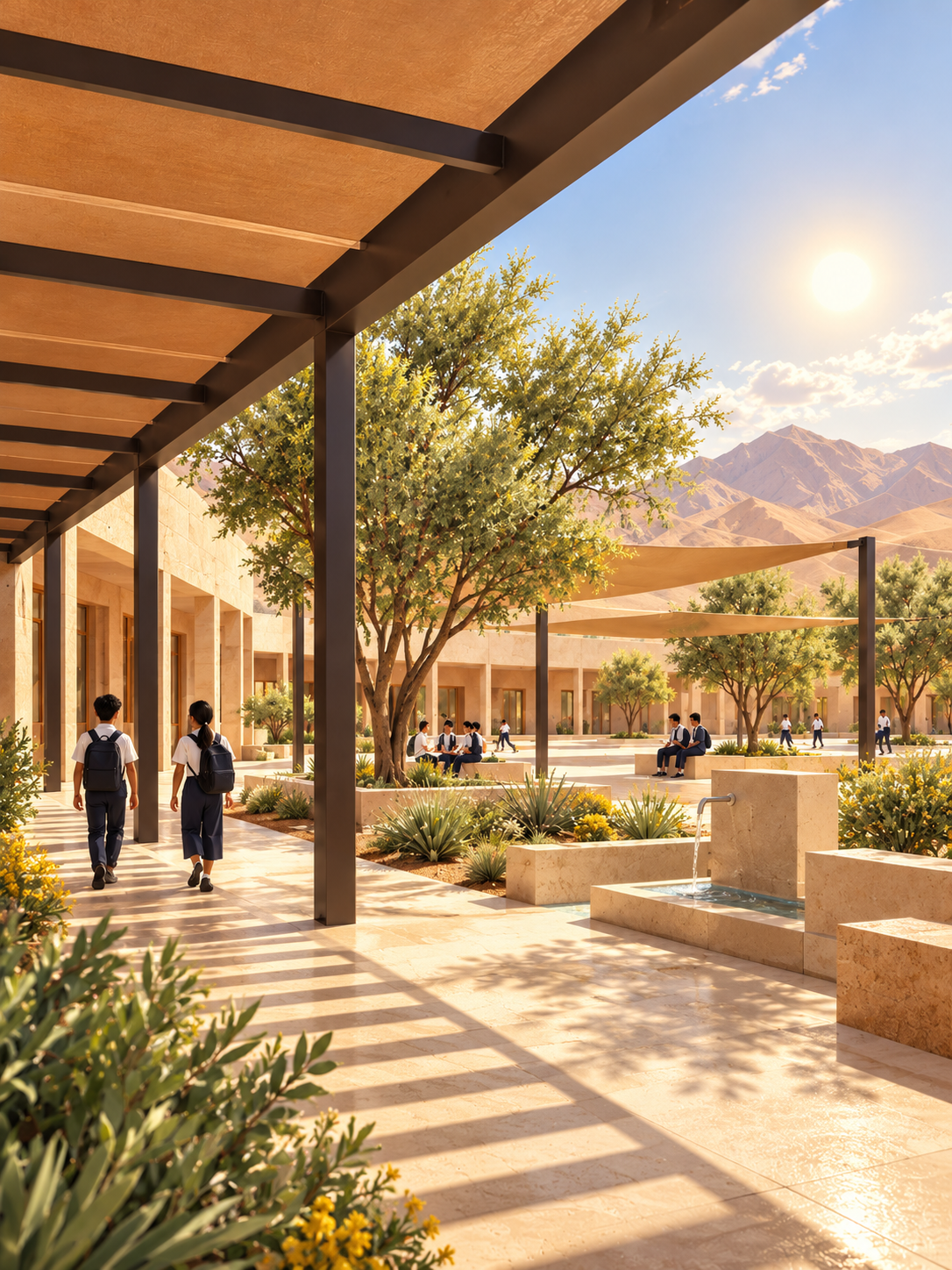
Architectural images help people discuss possibilities, but a drawing is not a measured result. Actual thermal performance depends on site geometry, materials, weather, operation, maintenance and suitable professional evaluation. An appealing rendering does not prove universal comfort or safe outdoor activity.
Invite learners to review a hypothetical canopy, trees and seating proposal. Write what the image can legitimately show: conceptual placement, possible access paths or questions for a qualified specialist. Then list what it cannot show: actual approval, measured exposure, guaranteed health benefits or suitability for a specific user group.
Good public communication should avoid unsupported percentages, degree reductions and protection guarantees. If a real case study becomes available, its evidence, location, dates, methodology, authority and permission to publish must be checked independently.
Try this in a learning groupRewrite an invented promotional claim into a description of options, limitations and required evidence.
Key distinctionConcept visuals can explain design intent; they do not establish health or engineering outcomes.
CHAPTER 06Teach, review and report proportionately
What can educational publishing claim to have achieved?
A useful learning session can produce a route diagram, a comparison of sources, a corrected claim or a thoughtful question for a school leader. An educator may keep that material under the institution's own procedures. Apollo does not need participants' names, grades or confidential health information to make a free learning resource available.
Website interactions can tell Apollo which pages or guides were accessed when consented analytics is enabled. Optional usefulness feedback may reveal visitor perceptions. Neither automatically proves understanding, school adoption or improved public health conditions.
If a future educational organisation independently confirms it used a resource and consents to that evidence being reported, that supports a narrower, verifiable adoption claim. Real health or environmental impact requires a different standard: credible methods, professional oversight and a demonstrable connection rather than a convenient narrative.
Try this in a learning groupUse a three-question exit ticket: a justified idea, an unresolved question and the responsible source to consult.
Key distinctionReport educational interactions, self-reported usefulness and verified outcomes as different categories.