Community / education
School/community pool with training lanes and basic competition equipment.
 Start Project Brief
GLOBAL SPORTS TECHNICAL LIBRARY
SPECIALIST · AQUATICS TECHNICAL CENTRE
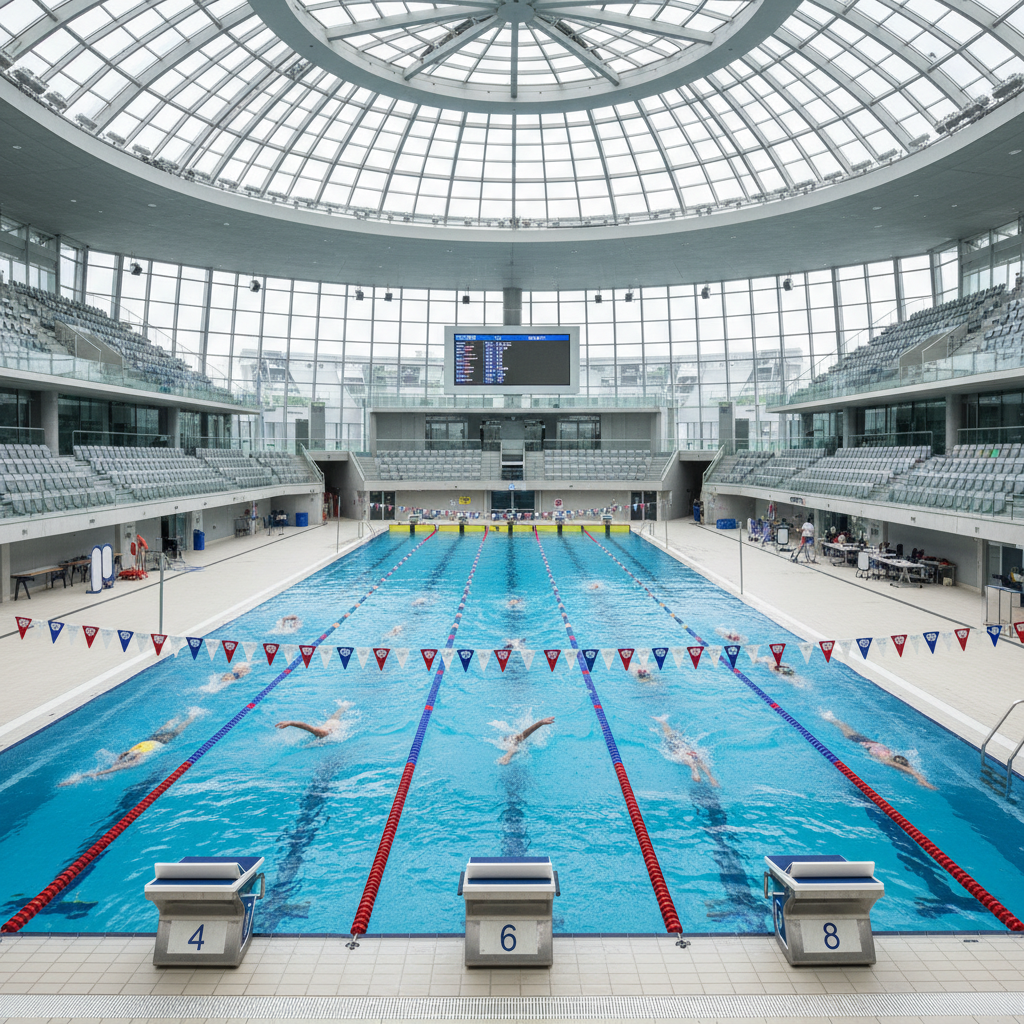
Competition aquatics connects the pool shell and water treatment to starting, lanes, timing, results, water polo, deck operations, spectators and dryland support. Apollo's role is supply-side coordination of the systems it provides, not local pool engineering.
INTERACTIVE FACILITY MAP
Select a layer to see why it matters. This is a conceptual coordination map—not a dimensioned court, field, structural or compliance drawing.
FACILITY LEVEL MATRIX
Do not copy elite-event requirements into every community project—or under-specify a competition venue from a school checklist.
School/community pool with training lanes and basic competition equipment.
Club/academy facility with stronger starting, timing and dryland support.
Competition pool with exact starting/lane/timing/results and event-deck planning.
Major aquatic centre with elite competition, FÍSVOR, broadcast, spectator, water-polo and operations systems.
12 TECHNICAL TOPICS
Each topic is part of the same facility. Changing one layer can affect several others, which is why product selection should follow the complete brief.
Pool length, lane geometry, deck clearances and discipline-specific requirements must come from the current competition brief and local pool designer.
Wet-deck slip resistance, pool-edge interfaces and aquatic equipment mounting are specialist interfaces separate from ordinary sports flooring.
Starting blocks, lane ropes, backstroke systems, water-polo goals/field equipment and deck hardware need exact compatibility with the pool structure.
Competition/broadcast lighting must manage water reflection, glare and camera sightlines.
Plan humid-environment seating, accessible viewing, deck separation and event circulation.
Starting anchors, lane sockets, display supports and spectator structures need coordination with the pool shell/building.
Humidity, chlorides, condensation and corrosion control are fundamental material-selection inputs.
Accessible wet-deck circulation, viewing and pool-access systems belong in the overall facility plan.
Lane ropes, goals, timing gear and deck equipment require wet-compatible storage and handling routes.
Timing touchpads, starting, results, FÍSVOR display, PA and data systems should be developed as one competition-control architecture.
Use current World Aquatics Competition Regulations and discipline documents; exact equipment approval and local pool compliance remain separate.
Control chloride exposure, rinse/dry equipment, inspect fixings/cables/touchpads, service timing, maintain lane ropes and manage spare electronic modules.
EVIDENCE LADDER
Defines the sport or competition requirement. It does not automatically approve a supplier or construction detail.
Applies to an exact surface, equipment item or system configuration and the scope stated by the governing programme.
Where the sport offers it, field/court/facility testing confirms the finished installation rather than only the product.
Foundations, supports, wind/seismic loads, electrical, building interfaces and local-code compliance remain project-specific.
Warranty, documentation, spares, freight, installation responsibility and exact quoted configuration are closed before order.
SPECIFICATION INPUTS
These inputs can become a consultant brief, RFP schedule or Apollo project review without prematurely inventing an exact model.
Discipline mix
Pool course length
Competition level
Lane count
Starting systems
Timing/results
Water polo / other disciplines
FÍSVOR / PA
Spectators
Corrosion environment
Storage / dryland
PERFORMANCE-SPECIFICATION STARTERS
These are performance-based starting points, not a substitute for the project architect, engineer, governing body or exact selected-system data.
Pool length, lane geometry, deck clearances and discipline-specific requirements must come from the current competition brief and local pool designer.
Wet-deck slip resistance, pool-edge interfaces and aquatic equipment mounting are specialist interfaces separate from ordinary sports flooring.
Use current World Aquatics Competition Regulations and discipline documents; exact equipment approval and local pool compliance remain separate.
Control chloride exposure, rinse/dry equipment, inspect fixings/cables/touchpads, service timing, maintain lane ropes and manage spare electronic modules.
DRAWING ROADMAP
Public planning diagrams can define intent. Exact fabrication, foundation, fixing and model drawings should follow only when the selected system is verified.
TECHNICAL DIAGRAM PACK
Four vector sheets cover plan geometry, vertical coordination, equipment/operations and spectator/technology interfaces. Verified sport dimensions are shown only where the technical baseline supports them; conceptual allowances remain explicitly labelled.
These diagrams organise coordination information. They are not fabrication drawings, engineering drawings, construction details, certified court/field layouts or statutory documentation. Current governing-body requirements, exact selected-system drawings and local professional design take precedence.
MAINTENANCE & LIFECYCLE
01Rinse/dry equipment
02Corrosion inspection
03Lane-rope maintenance
04Starting blocks
05Timing/touchpads
06Cables/connectors
07Displays/PA
08Storage
TROUBLESHOOTING
Inspect connectors, water ingress, cabling, controller and touchpad.
Review material grade, chlorine exposure, drainage and rinse/maintenance.
Review brightness, reflection, sightline and mounting.
Review officials, athlete, equipment and spectator circulation.
Inspect anchors, tension and pool-shell interface.
Review wet/dry separation, racks and handling.
PRIMARY GOVERNING REFERENCES
We link to the governing organisation rather than republishing whole standards. Rules, manuals, approval lists and competition requirements change.
Current Competition Regulations Version February 2026 and discipline updates.
Open official sourceCurrent competition, warm-up and officiating documents for swimming.
Open official sourceReference review date: 4 October 2026. Governing-body content remains owned and controlled by the relevant organisation. Apollo's summaries are planning aids, not substitutes for the current official rules or local professional advice.
CITE THIS RESOURCE
Apollo NZ Global. Aquatics Facility Technical Centre. LUTHVAR Global Sports Technical Library, 2026.1. https://apollonzglobal.com/sports/aquatic-competition-systems/technical-centre
Technical reference & source policyPROJECT-SPECIFIC REVIEW
Apollo remains supply-only. Local design, foundations, civil works, installation, statutory approvals and professional sign-off remain with the appropriate project parties unless a specific support item is expressly included.