Mesh
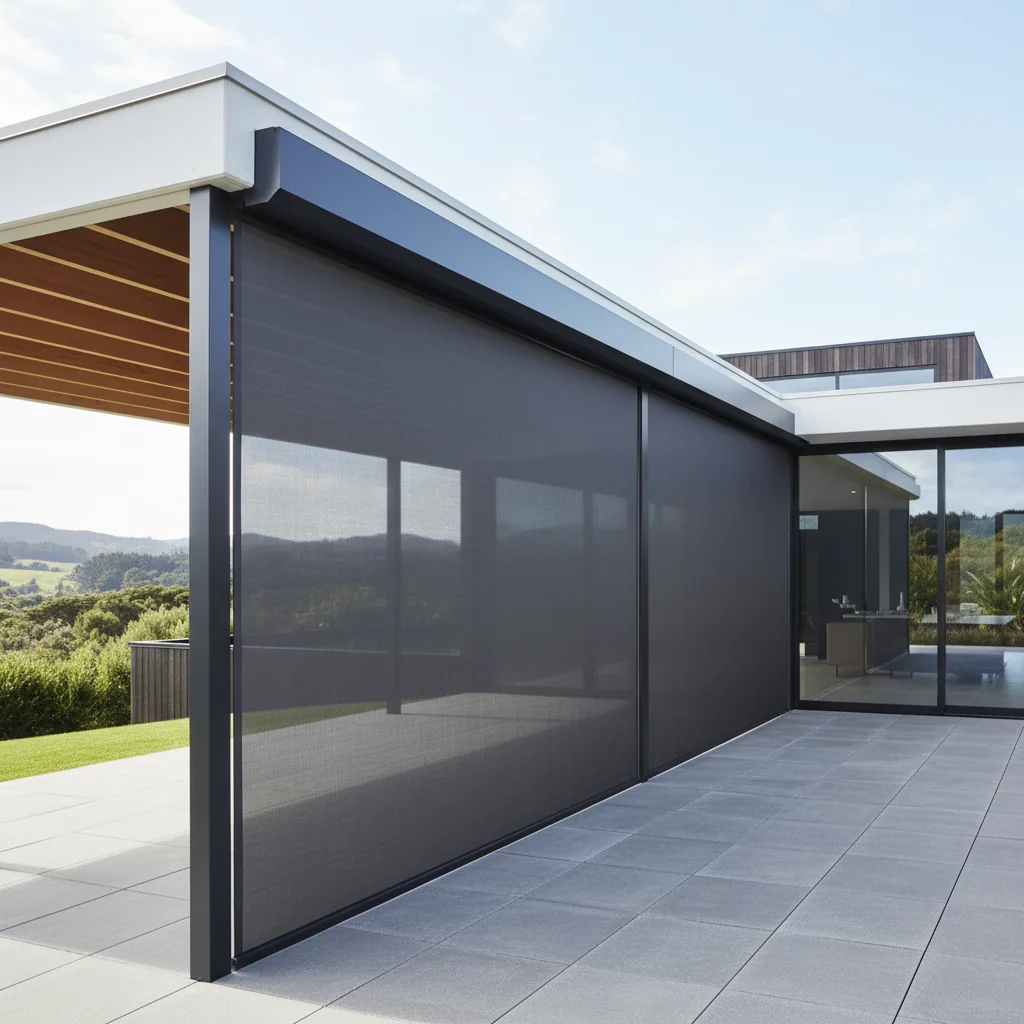
Mesh allows more airflow and can preserve outward views while reducing sun, glare and some wind. Openness factor, colour and exact fabric specification materially affect the result.
 New Zealand
 Outdoor Blinds NZ / New Zealand
The fabric choice changes how an outdoor blind performs. Mesh prioritises airflow and outward visibility, clear PVC prioritises weather separation and view retention, while blockout prioritises privacy and solar control.
Direct answer
Choose the fabric by the dominant problem, not by appearance alone. For most exposed outdoor rooms, mesh is the broadest starting point; clear PVC is useful where rain and wind separation matter more; blockout is strongest where privacy or solar control is the priority.
Project decision
Use these points to structure the first project conversation. Final suitability stays tied to the actual site, selected system and local project team.
Mesh allows more airflow and can preserve outward views while reducing sun, glare and some wind. Openness factor, colour and exact fabric specification materially affect the result.
Clear PVC provides a stronger physical weather barrier and better visual transparency than opaque fabrics, but condensation, cleaning, rolling behaviour and heat build-up need consideration.
Blockout fabric gives the strongest privacy and solar遮蔽 pathway but reduces outlook and airflow. It can suit western sun, service areas and spaces where privacy matters more than view.
Fabric choice does not override the need for correct guide geometry, opening dimensions, wind review and suitable fixing substrates.
Comparison matrix
Use this as a first filter only.
| Material | Best at | Trade-off |
|---|---|---|
| Mesh | Airflow, shade, partial privacy, outward view | Less weather sealing than clear PVC |
| Clear PVC | Rain separation, wind reduction, visual transparency | Cleaning, condensation and heat management |
| Blockout | Privacy and solar control | Reduced outlook and airflow |
Project brief
Frequently asked
Yes. Apollo reviews suitable New Zealand projects through the relevant product pathway. Exact configuration, availability, documentation and freight are confirmed for the actual project rather than assumed from a generic page.
Apollo is primarily supply-only. Local design, engineering, approvals, foundations, electrical work and installation remain with the appointed New Zealand project team unless expressly included in a written project scope.
Send the project location, intended use, dimensions or drawings, photographs, target timing and any known wind, coastal, drainage, access, power or local-compliance requirements relevant to the product.
Next step
Send the site, dimensions, intended use, quantities and known local requirements. Apollo will review the relevant product pathway and keep local engineering, approvals and site-work responsibilities explicit.