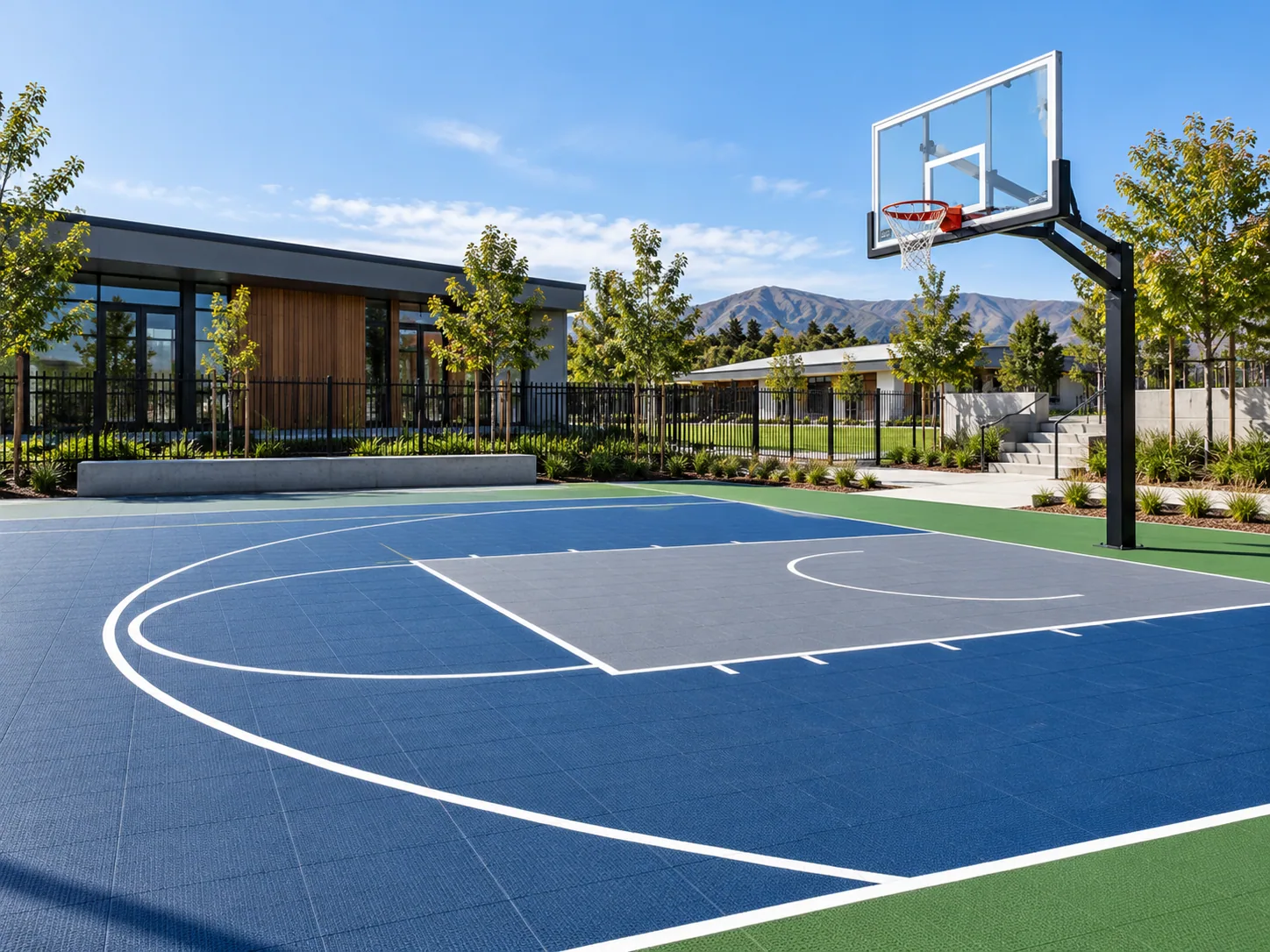
The best sports surface is not the thickest tile or the most expensive roll. It is the surface that works with the supporting base, drainage, sport mix, user group, maintenance plan and the way the facility will actually operate.
Planning guidance — final supplied configuration remains project-specific.
01
Start with the supporting base
A finished sports surface cannot correct an unstable slab, active cracking, settlement or ponding below it. Existing concrete or asphalt should be reviewed before a surface family is selected.
Where the existing base is unsuitable, resolve the base condition first and then compare the sports-surface pathways that fit the repaired or newly prepared substrate.
Structural stability and movement
Flatness and level changes
Cracks, joints and old repairs
Drainage and ponding
Surface contamination and existing coatings
02
Match the surface family to the use
Outdoor pickleball, school multi-sport, indoor halls, basketball and functional-fitness areas can all require different combinations of traction, ball response, comfort, replaceability and maintenance.
Open modular tiles and continuous roll-out systems solve different problems. Gym impact surfaces and sled turf belong to a different selection logic again.
Primary and secondary sports
Indoor, outdoor or covered environment
Competition, training or recreation use
Permanent, portable or staged deployment
03
Understand the drainage model
Open modular tiles can allow water to pass through the playing layer, but the base still needs suitable falls and a route for that water to leave the site. A drainage-friendly tile does not turn a poorly drained slab into a well-drained court.
Continuous surfaces place more emphasis on base falls, seam strategy, edges and perimeter water management because water does not simply pass through the finished playing layer.
04
Plan maintenance and repair before ordering
Cleaning responsibility, spare material, local repair method and access to replacement modules or compatible repair stock should be considered during procurement.
A maintainable system with a clear repair pathway can be more valuable over time than one selected only on appearance or a single product specification.
05
Use the project brief to freeze the right system
Apollo is supply-only. The final surface package should record the sport, base, drainage conditions, area, colour or marking requirements, installation approach, destination and any supporting court products such as lighting, nets or cameras.
Final product suitability, installation method and technical requirements are confirmed against the selected system and actual project conditions before supply.