01Define the playing and operating brief
Record the sport, court count, level of play, indoor or outdoor environment, expected evening hours and whether the facility is recreational, school, club, commercial or competition-oriented.
The target lighting result should follow the real operating brief rather than selecting the highest-output luminaire available.
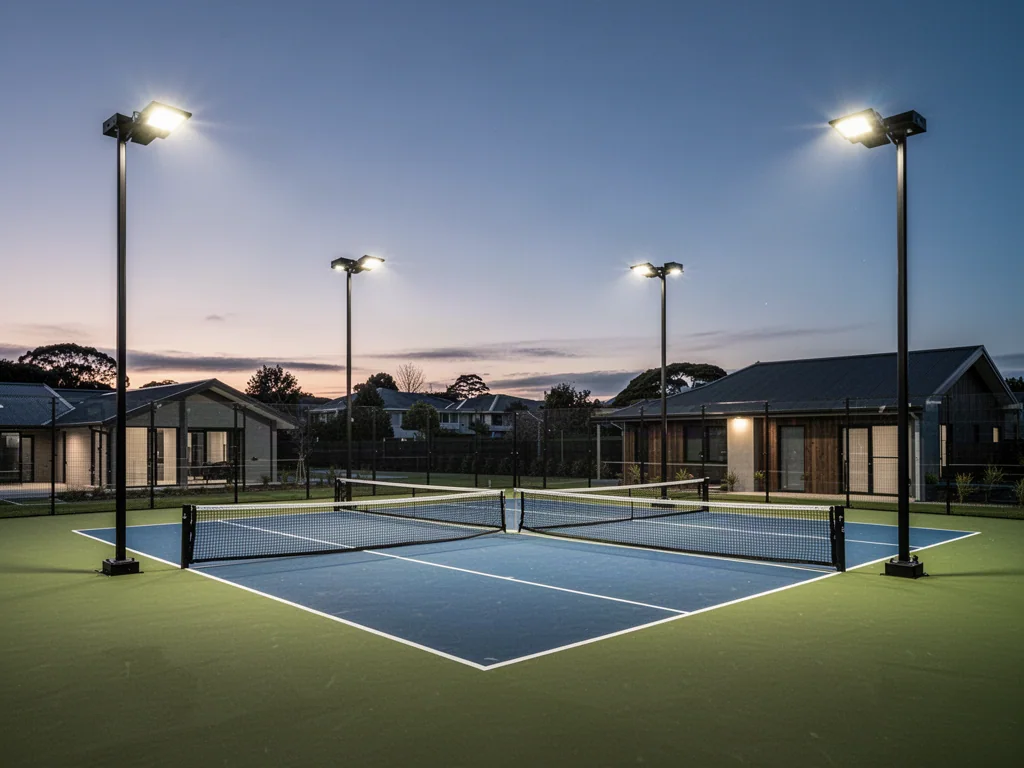
Place poles and luminaires around player sightlines
Pole location, height and aiming affect glare, ball visibility, shadows and the way players track movement through the court. Court fencing, gates, spectator areas and buildings can constrain those positions.
For multi-court layouts, one lighting decision can affect adjacent courts and circulation, so the complete precinct should be reviewed together.
Control spill light and neighbour impact
Outdoor court lighting should consider surrounding homes, roads, boundaries and landscape as well as the playing surface. Optics, aiming, mounting height and operating hours all contribute to spill-light management.
Local rules and consent conditions remain destination-specific and should be checked by the project team.
Use photometric design before final equipment selection
Luminaire wattage is only one input. The final design should consider output, optics, mounting, quantity, aiming, maintained performance and the required lighting distribution across the playing area.
Apollo can coordinate the supplied lighting pathway with court products, but final electrical design, pole engineering, installation, commissioning and local compliance remain project-specific.
Plan access, controls and maintenance
Switching, zoning, timers, control strategy and safe future access to luminaires should be considered before poles and electrical routes are fixed.
Coastal or exposed sites also need appropriate review of poles, finishes, hardware and maintenance access for the actual environment.