A practical explanation of remotely operated fire-response machines, where they can add value, what they need to function—and why trained firefighters remain in charge.
Technology awareness, not operational instruction. This article is not a deployment procedure, certified firefighter training or tactical guidance. Response operations must follow qualified incident command, agency standards and manufacturer-specific operating procedures.
ILLUSTRATED LEARNING GUIDEHow firefighting robots work
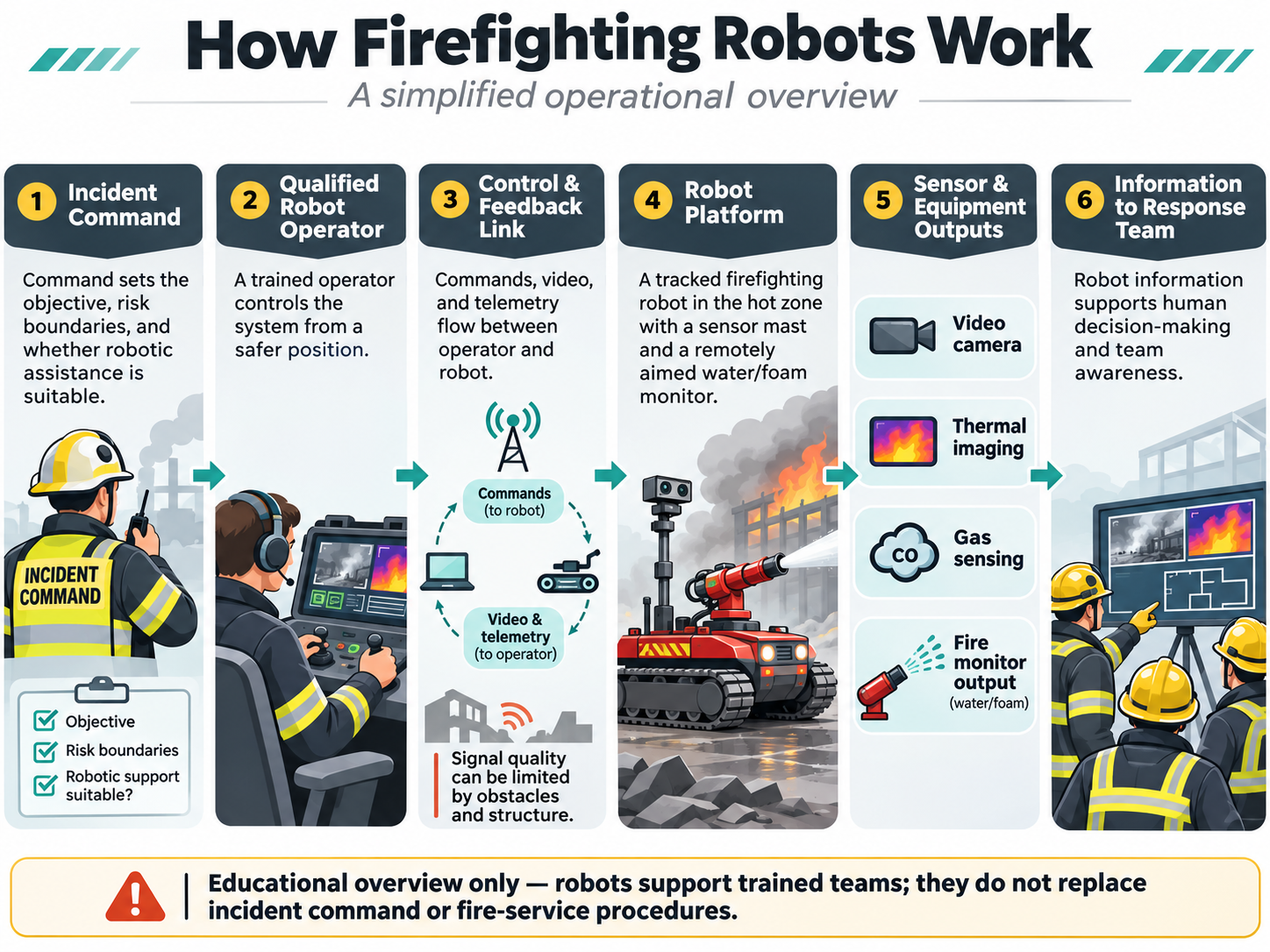
Conceptual overview of people, equipment and communications involved in remote firefighting robotics. Educational illustration only. Not an equipment-specific schematic or operational instruction. View full-size diagram
REAL EQUIPMENT · VERIFIED MEDIA
Connect the lesson to manufacturer demonstrations
Manufacturer footage relevant to this topic is being reviewed for model accuracy and written publication rights. No video is displayed as authorised until those checks are complete. The illustration above is an original conceptual guide, not manufacturer footage.
A robot is a specialist tool, not a replacement crew.
A firefighting robot is a remotely operated or partially automated machine intended to help response personnel perform a defined task from a different position. One machine may position a water or foam monitor. Another may capture thermal images, check an environment with sensors, carry equipment or help move smoke.
In most applications, the benefit is not that a robot can solve every fire. The benefit is that trained teams may be able to gather information or perform a limited equipment task without sending a person to the same position. Whether that helps in a particular incident depends on conditions, equipment capability and the incident commander's plan.
Remember this distinction
Robotics can change where a machine and operator are positioned. It does not make a fireground safe, remove the need for personnel or guarantee access to dangerous spaces.
02 / WHAT DIFFERENT ROBOTS CAN DO
There is more than one type of firefighting robot.
Water and foam fire-monitor platforms
These position a remotely aimed monitor on a mobile chassis. Many require external pumping equipment, hoses and a properly sized water or foam supply. Headline flow rates and ranges are conditional, not universal outcomes.
Reconnaissance and sensing platforms
These carry cameras, thermal imagers or environmental sensors to observe a scene remotely. Sensor readings require interpretation and may have calibration, visibility or transmission limitations.
Mobile smoke-extraction systems
Some systems carry large fans or combine fans with mist functions. These have a very specific operational role: smoke-management decisions can influence fire behaviour and must remain with qualified incident command.
Rescue and specialist access robots
Other platforms focus on rubble inspection, flooded infrastructure, wildland sites or underground access. Their chassis, controls and payloads differ from conventional suppression robots.
03 / PEOPLE, CONTROL & INFORMATION
Understanding the whole response system.
Even when a robot performs an assisted or autonomous task, a successful programme involves people, communications, the machine and site-specific infrastructure. The diagram is conceptual—it is not a control architecture for any one model.
01
Incident command
Defines the objective, safety conditions and whether remote equipment is suitable.
02
Qualified robot operator
Controls and monitors the system through its supported interface and procedures.
03
Control & feedback link
Carries commands, video and other data, with real-world range and interference limits.
04
Robot and attached systems
Moves, senses or delivers equipment functions within documented design limits.
05
Information to responders
Camera and sensor information can inform—but not replace—team judgement.
Control systems vary. Some use dedicated radio controllers with live video screens; others support supervised navigation functions. A communications link that works in a clear outdoor test may behave differently inside a reinforced building, underground tunnel or industrial structure.
Personnel also need to know what happens if a link is interrupted, a hose snags, an obstacle cannot be negotiated or the robot cannot be recovered. Those responses require manufacturer-supported procedures and realistic training, not assumptions based on demonstration footage.
04 / BUILDING FIRES & ENCLOSED SPACES
Why building fires are a demanding use case.
At a large warehouse, factory, parking structure or other building fire, a robot may encounter smoke, water, uneven floors, fallen materials, door thresholds and narrow access. Equipment specification sheets may describe maximum grades or obstacles, but those values do not prove that a particular building route is traversable.
Access geometry, hose drag, communications and available fire-water supply can be just as important as the robot's motor or track design. A camera also sees only what its optics and placement allow: it cannot independently confirm structural integrity, atmosphere safety or the conditions outside its field of view.
Some robots are unsuitable for stairs or potentially explosive atmospheres. A robot's ingress-protection rating—for example, an IP value—must never be confused with explosion-protection certification. Similarly, the decision to operate ventilation equipment is a fire-dynamics and incident-command question, not simply a robot feature.
Five questions for a classroom discussion
What information is the team trying to obtain, or which equipment task needs remote access?
What physical route, surface, doorway or obstruction would the machine encounter?
How would communication, video and operator feedback be tested under realistic conditions?
What supply and hose interfaces would a fire monitor require?
Who evaluates equipment suitability, risk, recovery arrangements and the agency's deployment procedure?
05 / LIMITS, SAFETY & EVIDENCE
What responsible teams verify before adopting a robot.
A procurement brochure is a starting point. Fire and rescue organisations should request current technical documents for the exact model and attached equipment. Qualified reviewers can then assess performance, certifications, relevant test methods, operational interfaces and the agency's own training requirements.
Proven task and environment: realistic access, terrain, temperatures and site conditions.
Water/foam system: actual available pressure, flow, nozzle and hose arrangements.
Communications: verified control link, video feedback and documented loss-of-signal behaviour.
Hazardous-area evidence: model-specific certification matched to classified site conditions when applicable.
People and support: trained operators, oversight, maintenance, recovery and local service capability.
NIST's emergency-response robotics programme offers a useful example of how objective testing and operator proficiency can inform technology evaluation. It focuses on measurable performance rather than broad claims of robotic capability. Read the NIST programme overview
06 / QUICK REFERENCE
Six terms worth knowing.
Remote-controlled (teleoperated)
Movement and equipment functions are directed by a human operator through a control system.
Assisted operation
A robot may support the operator with features such as obstacle detection or stabilisation. The operator retains specified control responsibilities.
Autonomous operation
Some tasks may be performed by software without continuous low-level human control. Capabilities, limitations and supervision requirements vary by model.
Fire monitor
A controllable water or foam nozzle system. On many mobile firefighting robots it depends on an external pressurised supply.
Thermal imaging
Imaging that represents detected infrared radiation. Interpretation is affected by the scene, equipment settings and environmental conditions.
Hazardous-area certification
Evidence that specified equipment and configurations meet defined explosion-protection requirements. Site classification must be checked separately.
CONTINUE LEARNING
Ready to explore the wider topic?
Use the KERVYNT learning centre for focused lessons on building fire constraints, hazardous-area systems, water and foam monitors, thermal sensing, smoke extraction and programme evaluation.
Essential site functions work without analytics. With your permission, Apollo measures which products and project pages are useful. Analytics stays off unless you allow it.