Industrial Firefighting Robots & Emergency Response Systems
Explore remote fire suppression, explosion-proof response, smoke extraction, wildland firefighting, robotic reconnaissance, flood response and disaster rescue systems.
Apollo NZ Global is developing this equipment collection for civilian industrial, commercial and institutional projects. Individual manufacturers, models, supply rights and safety certifications remain under qualification.
This page describes prospective equipment categories, not approved products, current stock, certified models or authorised dealership arrangements.
FREE EDUCATION FOR FIREFIGHTERS & RESPONSE TEAMS
Fire & Rescue Learning Centre
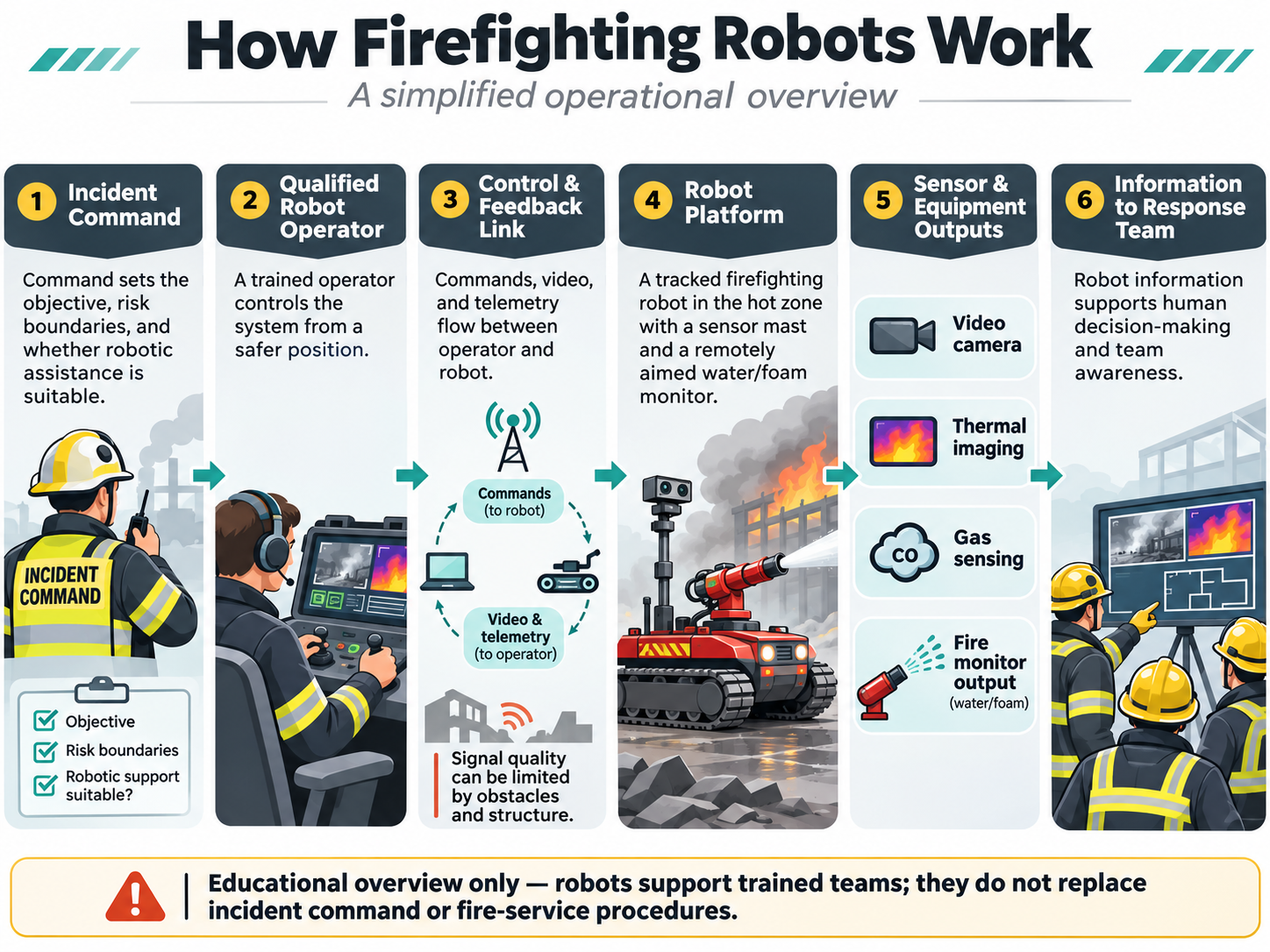
Explore how firefighting robots work, their limitations around building and industrial fires, water and foam systems, reconnaissance sensors, hazardous-area evidence and the questions fire services should ask when developing new robotics capability.
Independent equipment-awareness learning. Not accredited operational or tactical firefighter training.
THE EQUIPMENT SOURCING PATHWAY
Remote access when response conditions are demanding.
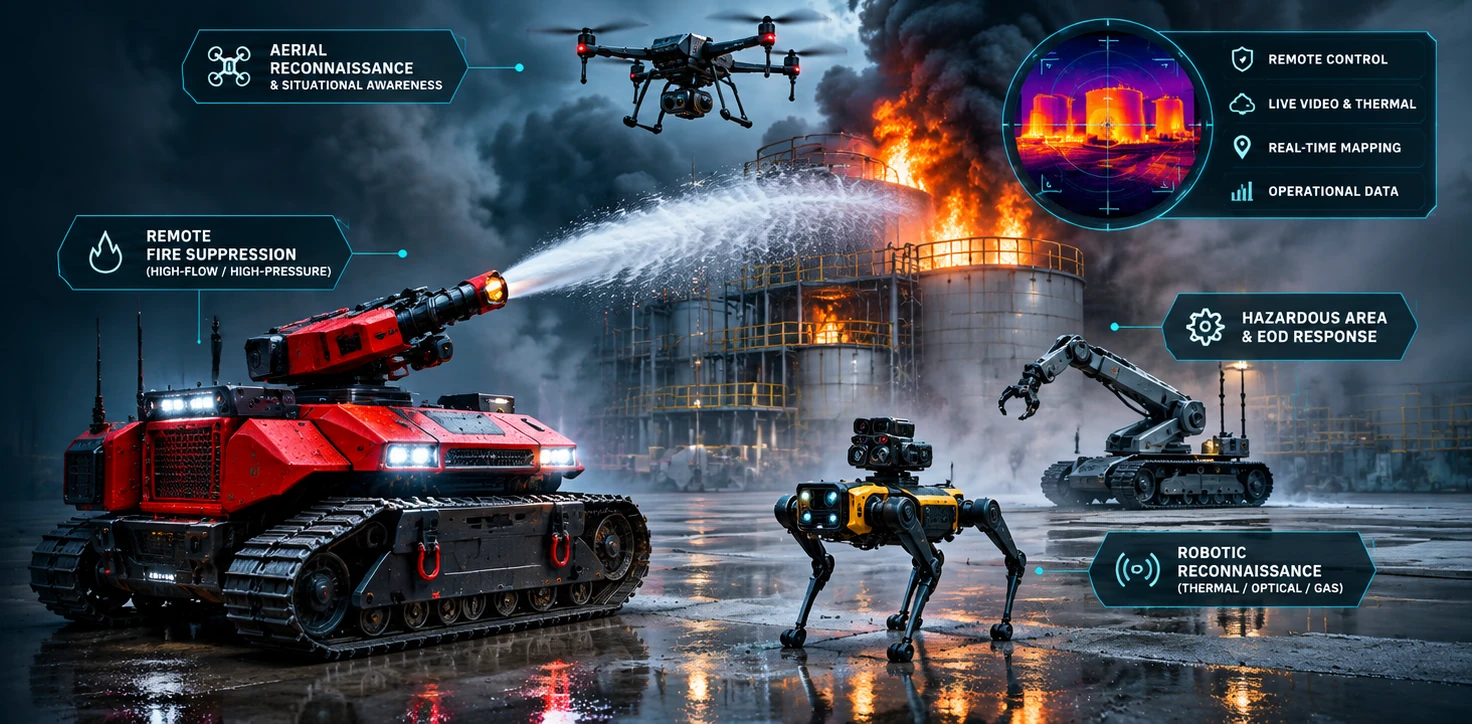
Emergency-response robots serve different duties: positioning water or foam monitors, detecting hazards, moving smoke, accessing wildland fires, investigating unstable infrastructure or supporting flood and rescue operations. These functions are not interchangeable. Each project begins with a defined incident-response task and site conditions.
Equipment families are starting points for sourcing. Features shown here are examples to evaluate, not standard specifications of any particular manufacturer or model.
01 / FIRE SUPPRESSION
Compact & Rapid-Response Firefighting Robots
Smaller remotely operated tracked or wheeled fire-monitor platforms for routes and access points where full-size fire appliances cannot readily operate.
Specialist fire-suppression and reconnaissance platforms investigated for potentially explosive industrial atmospheres, subject to exact model and configuration certification.
Key specification questions
ATEX or applicable hazardous-area certificate scope
Certified components, controller and sensor package
Site zone, gas group and temperature classification
Larger water/foam monitor robots for refineries, tank farms, major warehouses and high-risk industrial sites where fire-water infrastructure is available.
Remotely positioned fans and smoke-management platforms for professionally planned operations at tunnels, underground facilities and large industrial sites.
Remote ground equipment for forest-edge, grassland and vegetation-fire response, including specialist high-clearance and firefighting-attachment candidates.
Routine remote or autonomous monitoring concepts for warehouses, industrial plants and other managed facilities, subject to integration and site safety assessment.
Specialist mobile platforms for underground inspection, mine emergency reconnaissance and industrial tunnel scenarios, requiring project-specific mine and electrical approvals.
Specify whether the requirement is suppression, thermal or gas reconnaissance, ventilation or remote inspection. Each task needs a different equipment configuration.
02
Document the fire-water infrastructure
Confirm the external pump and supply arrangement, pressure, water flow, hose sizes, foam availability and site connections. Do not assume a robot includes its own water source.
03
Evaluate the actual site
Provide surface conditions, slopes, stairs, obstructions, access width, expected heat exposure, hazardous-area classification and weather conditions.
04
Verify the complete system
Request evidence for the exact robot, controller, batteries and installed sensors. Check explosion protection, radio requirements, operating limits, tests and country-specific approvals.
05
Plan operational support
Identify trained operators, local commissioning partners, maintenance support, spares, emergency recovery procedures and the manufacturer's service commitments.
TECHNICAL RELEASE REQUIREMENTS
Documentation before model approval.
Manufacturer brochures alone are not enough for life-safety equipment. Before any model-level quotation, Apollo must confirm documentary evidence appropriate to the product, its intended site and destination.
Are these firefighting robots available to order now?+
The equipment collection is at the manufacturer-qualification and project-sourcing stage. Apollo has not approved individual models, distributor arrangements, stock or delivery commitments. Availability is confirmed only after a project-specific review.
Does a firefighting robot carry its own water supply?+
Many industrial fire-monitor robots require an external pressurised water or foam supply. Tanks, pumps, hoses and site infrastructure must be checked against the exact model and firefighting plan.
Can a remotely operated robot be used in explosive atmospheres?+
Only when the exact complete configuration is suitably certified for the site's classified hazardous area and accepted under local rules. General ruggedness, a manufacturer's description or an ingress-protection rating does not establish explosion protection.
Does Apollo provide installation and operation?+
Apollo focuses on wholesale equipment sourcing and manufacturer coordination. Local specialist providers remain responsible for installation, commissioning, operator training and maintenance where required.
Can Apollo investigate equipment for an international project?+
Yes, Apollo can review civilian industrial project requirements and investigate manufacturer-backed supply options. Country eligibility, compliance, service coverage and commercial supply rights must be confirmed for each destination.
INTERNATIONAL WHOLESALE & PROJECT SOURCING
Tell us what your response system needs to do.
Share the project destination, operating environment, response task, fire-water infrastructure, required documents and local support expectations. Apollo can investigate suitable manufacturer-backed sourcing pathways for eligible civilian applications.
Supply-only sourcing and manufacturer coordination. Site evaluation, engineering, approvals, installation, commissioning and operational training require appropriately qualified local specialists. No product availability or performance is promised by this page.
Essential site functions work without analytics. With your permission, Apollo measures which products and project pages are useful. Analytics stays off unless you allow it.