Project context
This guide explains how to create a credible budget without publishing a misleading flat rate. A reliable quotation should show site works, sports equipment, surface materials and installation responsibilities separately.

Built Intelligence · Sports & Recreation · Pickleball
Converting a tennis court into pickleball courts can look inexpensive at first: draw new lines, add nets and start playing. That can work for informal shared use in the right setting. A durable, safe club or commercial facility is more complicated. The most important cost drivers are usually the condition of the existing base, the amount of playing and run-off space, the selected surface and the supporting facility works.
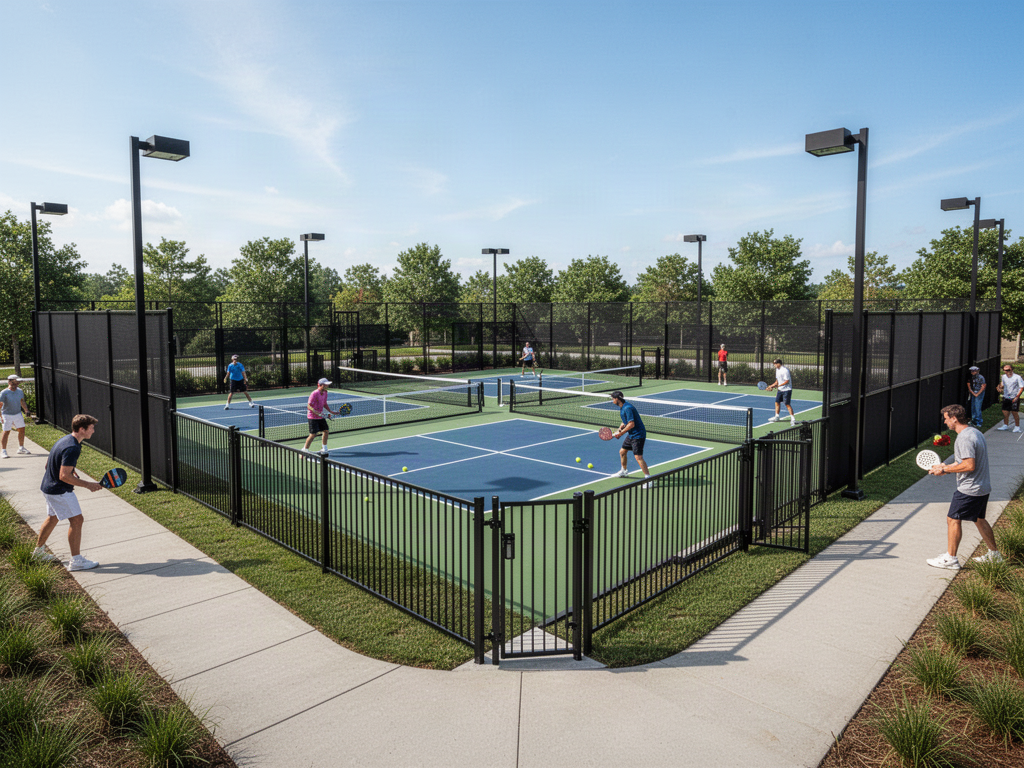
Existing Apollo outdoor pickleball facility image. It is not a costed tennis-court conversion.
This guide explains how to create a credible budget without publishing a misleading flat rate. A reliable quotation should show site works, sports equipment, surface materials and installation responsibilities separately.
A regulation pickleball playing court is 20 feet by 44 feet, approximately 6.10 by 13.41 metres. That is the marked playing rectangle, not the complete facility envelope. Players need clear space beyond side and baseline boundaries, and planned circulation between adjacent courts. The appropriate run-offs must be checked for the level and type of play.
One tennis court may accommodate different pickleball layouts depending on its full available dimensions, existing fencing, orientation and intended use. Do not promise four courts merely because a graphic shows four sets of lines. Measure the usable surface, net post positions, gates, lights, boundary obstacles and required safety clearances.
A tennis court can appear serviceable while containing cracks, low spots, drainage failures or poorly bonded coatings that undermine a new surface. Where water sits after rain, modular tiles or new acrylic layers may not solve the underlying issue. A base assessment should determine the true scope before selecting the finish.
Allow for grinding, patching, crack treatment or complete civil repair where appropriate. If the court is badly distressed, the base may be the largest variable in the budget. A quotation without substrate assumptions is not a reliable conversion cost.
Some projects use repaired acrylic court surfacing with new lines. Others consider modular PP tiles or specialist sport surfacing where appropriate. Each option has different requirements for substrate, drainage, ball response, grip, comfort, maintenance and replacement. There is no universal best choice simply because a product is called a pickleball floor.
For outdoor modular systems, confirm product-specific suitability for local conditions, tile expansion requirements, drainage behaviour and required perimeter detailing. For roll or continuous systems, confirm whether the material is actually rated for outdoor weathering. The selected system should have an evidence-backed use case matching the club's play expectations.
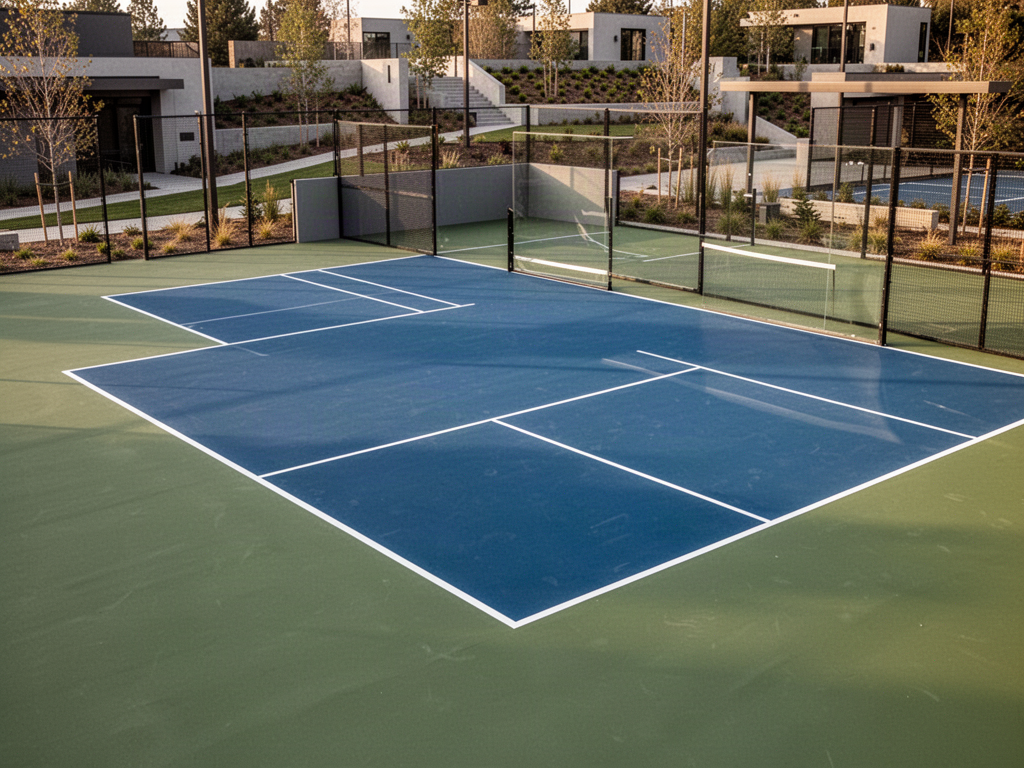
Every new playing court needs suitable net arrangements, posts or portable systems, marking and potentially court dividers or acoustic considerations. A dense layout may increase court count on paper but create congestion, cross-court interference or poor access. A facility should be judged by playable, bookable court quality.
Consider mixed use. A tennis club may want reversible lines, seasonal pickleball use or a dedicated permanent conversion. Each option changes the preferred net equipment, line colours, booking and storage arrangements. Ask the club management team how the court will operate before specifying hardware.
Existing tennis fencing may not line up with the new court arrangement. Door positions, gates and internal dividers should support movement without requiring players to pass directly behind active baselines. Assess fence condition and height, net separation, edge hazards and security requirements.
An outdoor court may also require improved paths, seating, shaded waiting space or accessible access from parking. These improvements are easy to omit from a 'surface price' but can substantially affect whether a converted venue is convenient and safe.
A daytime recreational conversion may use existing lighting if its layout and performance remain suitable. More courts or different playing directions can create glare, shadows and uneven illumination. The lighting designer should test the actual new court geometry and applicable usage criteria.
If lighting upgrades are necessary, include poles or mounting changes, cabling, controls, electrical approvals, light spill considerations and maintenance access. Do not claim a court is competition-ready solely because new bright lights have been installed.
Court conversions can change surface water behaviour and concentrate player activity in new locations. Check drainage routes and where water goes beyond the court. Surface systems that allow water to pass through may still need a functioning sub-base and outlets.
Pickleball produces a distinctive sound. In residential surroundings, operating hours, barriers, orientation and appropriate acoustic advice should be considered before increasing court density. A club that ignores neighbours may face more operating restrictions than the initial development budget anticipated.
A practical budget schedule includes survey and assessment, base repair, chosen sports surface, line marking, nets and posts, fencing or dividers, lighting, drainage, access, contractor mobilisation, disposal and project contingency. Supply prices should be separated from site installation and professional works.
For Apollo's wholesale supply-only offering, clarify exact sport flooring or equipment product, quantities, delivery destination and local installation contractor. Do not treat an indicative per-court surface amount as a turnkey estimate. A site visit and measured drawings are essential for more reliable costing.
Request a base scenario for the minimum viable conversion and at least one optional scenario, such as upgraded surfacing or additional court dividers. This reveals which costs are truly optional and which are required for a safe, functional venue. A good quotation should list the assumed existing condition and excluded works.
Invite suppliers to state whether the materials are compatible with the existing slab or asphalt and what warranty or performance evidence applies to that exact installation. Specifications, not adjectives, should drive the comparison.
How much does a tennis-to-pickleball conversion cost? There is no trustworthy universal price. The base condition, surface, number of courts and ancillary works determine the final project scope.
Can a tennis court simply be relined? Sometimes for informal shared use, provided space, surface condition and operation are suitable.
How many courts fit? Only a measured layout including required run-off, access and fencing can answer that responsibly.
Are modular tiles cheaper than resurfacing? Not necessarily. Installation base work, materials, repairs and lifecycle maintenance determine the outcome.
A useful first-pass budget should assign a separate row to the court survey, substrate repairs, line removal if required, chosen new surface, court marking, nets, posts, fencing or dividers, drainage, lighting, accessible routes, freight, local installation and contingency. In each row, record quantity, assumption, provisional or quoted value, who supplies the work and the evidence still required. This prevents a supplier's per-square-metre sports surface quotation being mistaken for a complete conversion. It also lets the committee understand how much cost is within its control. The procurement schedule can then compare a minimal shared-use option against a dedicated facility without pretending they produce identical playing conditions.
Images frequently show four pickleball rectangles fitted into the footprint of an existing tennis court. The critical missing element is often run-off and circulation. The marked pickleball playing rectangle is 6.10 by 13.41 metres, but the full operational area needs appropriate additional space at baselines and sidelines. Survey the overall usable platform, perimeter fences, gates, level changes, light pole foundations and any existing net equipment. Then draw the preferred layout to scale with safe clearances and accessible movement routes. The correct number of playable courts may be lower than the marketing graphic suggests. Competition, recreation and training uses may require different planning assumptions that should be checked against relevant guidance.
The most basic pathway can involve retaining a suitable existing court surface and introducing compatible temporary lines and nets. A more extensive conversion might include resurfacing the base and installing permanent markings and fixtures. A third route may use a separately specified modular sports surface after the underlying slab or asphalt has been assessed. Each has different initial, maintenance and operational implications. For a club testing demand, reversible arrangements may be useful; a commercial pickleball venue may value a purpose-planned playing feel and court identity. Ask for the selected product's exact use evidence and installation requirements rather than assuming the most expensive finish automatically creates the best playing quality.
Court conversion changes more than the physical surface. Existing tennis members may require protected booking periods, while pickleball players may want shorter sessions and different event formats. A venue operator should assess court demand, noise, spectator gathering, net storage and transitions between activities. These decisions can influence where entrances, benches, storage cupboards and dividers belong. A court layout that looks profitable on paper can disappoint if each booking requires a complicated changeover or if groups must cross active playing zones. Plan the operational model alongside the physical layout and explain it to users before finalising permanent markings or equipment.
An existing tennis court may be relatively quiet at times when pickleball could generate several simultaneous games. That can change the acoustic profile experienced by nearby residences and facilities. Review the position of court activity, likely operating hours, boundaries and existing barriers. If the location is sensitive, involve an acoustic professional before relying on a simple fence or screen as a noise solution. Surface material alone is unlikely to settle the problem. Clubs should engage neighbours and local authorities where relevant and consider management policies alongside physical measures. Handling acoustic risk early is less disruptive than designing several courts and then discovering that the intended evening programme is contentious.
For modular tiles, confirm the acceptable substrate, required drainage, movement allowances, perimeter treatment and inspection method. For coatings and resurfacing, obtain base preparation, moisture and weather-window requirements. Clarify whether product warranty depends on substrate condition or the qualifications of the installer. Ask how surface defects are handled, whether isolated repairs are possible and how damaged components can be replaced. Sports performance should be evaluated using evidence for the exact proposed construction, not a general claim about plastic or acrylic. An RFQ that describes the base in photographs and measurements will receive more comparable responses than a request for a price to 'cover a tennis court'.
A club may choose to test pickleball demand with temporary markings and portable equipment before investing in a permanent multi-court facility. That pilot can reveal the booking pattern, preferred court count and community response. The pilot should still be safe and appropriately planned; temporary does not mean unrestricted. Keep a record of use and maintenance issues that can inform the next phase. If permanent conversion is justified, the club can then procure the right surface, fencing and lighting with better evidence. This is a better basis for a business case than applying a universal per-court revenue estimate to a market that has not yet been tested locally.
Once courts open, the operator needs cleaning instructions, surface inspection methods, equipment maintenance, net-setting guidance and a process for repairing defects. For modular floors, hold a sensible replacement-parts policy; for continuous surfaces, document suitable cleaning and repair materials. If lighting or access control has been added, include the relevant electrical and service records. Schedule the first maintenance review after the venue has experienced real weather and usage. Treating handover as a work package reduces the risk of an otherwise well-built facility deteriorating because the club was never told how to operate it.
Move from intelligence to project
Established court contractors and sports-facility distributors can discuss direct wholesale purchasing for their own projects and customers.
Supply-only B2B · No automatic agent appointment or exclusivity · Product and country eligibility checked individually