Community / education
School/club practice lanes with safe containment, durable surface and storage.
 Start Project Brief
GLOBAL SPORTS TECHNICAL LIBRARY
FIELD · CRICKET TECHNICAL CENTRE
Cricket facilities range from one practice lane to international grounds. This centre separates match-ground infrastructure, outdoor practice, indoor academies and support buildings so each can be designed around player throughput and the applicable playing conditions.
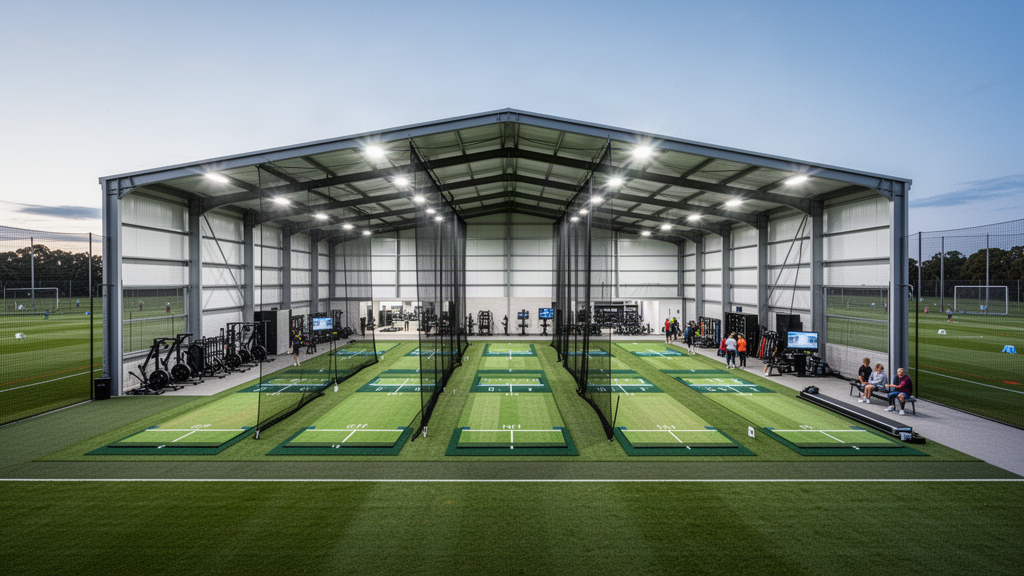
INTERACTIVE FACILITY MAP
Select a layer to see why it matters. This is a conceptual coordination map—not a dimensioned court, field, structural or compliance drawing.
FACILITY LEVEL MATRIX
Do not copy elite-event requirements into every community project—or under-specify a competition venue from a school checklist.
School/club practice lanes with safe containment, durable surface and storage.
Academy / multi-lane centre with lighting, coaching, video and performance support.
Club/regional ground with match infrastructure, pavilion, scoreboard, spectators and practice facilities.
Major venue with match/broadcast lighting, FÍSVOR, media, high-performance practice and event operations.
12 TECHNICAL TOPICS
Each topic is part of the same facility. Changing one layer can affect several others, which is why product selection should follow the complete brief.
Separate match ground, pitch square, practice run-ups, net lanes, sight lines, boundary/spectator zones and indoor training clearances.
Practice systems may use synthetic, natural or indoor surfaces; match wickets/outfields require specialist agronomy and competition-specific management.
Cage/net structures, lane dividers, sight screens, stumps, covers, team shelters and boundary equipment need safe movement, anchoring and storage.
Practice, indoor and match lighting have different glare, vertical ball visibility and camera requirements.
Protect spectators from ball impact while preserving viewing, circulation, pavilions and hospitality.
Outdoor net frames, retractable indoor netting, lighting, scoreboards and pavilions need project-specific structural and service coordination.
Wind, rain, heat, sun orientation and ground moisture strongly affect practice and match operations.
Accessible spectator, pavilion and circulation routes need to coexist with secure player/ball-control zones.
Screens, covers, nets, bowling machines, maintenance equipment and training aids require substantial secure storage.
FÍSVOR scoring/video, coaching analysis, cameras, replay and network systems can scale from academy to stadium.
Use current ICC playing conditions for international competition context; facility products and local building/net structures retain separate evidence and engineering.
Netting, frames, practice surfaces, wickets/outfields, screens, lighting, scoring and pavilions each require separate maintenance plans.
EVIDENCE LADDER
Defines the sport or competition requirement. It does not automatically approve a supplier or construction detail.
Applies to an exact surface, equipment item or system configuration and the scope stated by the governing programme.
Where the sport offers it, field/court/facility testing confirms the finished installation rather than only the product.
Foundations, supports, wind/seismic loads, electrical, building interfaces and local-code compliance remain project-specific.
Warranty, documentation, spares, freight, installation responsibility and exact quoted configuration are closed before order.
SPECIFICATION INPUTS
These inputs can become a consultant brief, RFP schedule or Apollo project review without prematurely inventing an exact model.
Match / practice / indoor academy
Player level and throughput
Lane count
Pitch/surface pathway
Net containment
Lighting
Sight screens
Scoring / analysis
Pavilion/support spaces
Spectators
Maintenance/storage
PERFORMANCE-SPECIFICATION STARTERS
These are performance-based starting points, not a substitute for the project architect, engineer, governing body or exact selected-system data.
Separate match ground, pitch square, practice run-ups, net lanes, sight lines, boundary/spectator zones and indoor training clearances.
Practice systems may use synthetic, natural or indoor surfaces; match wickets/outfields require specialist agronomy and competition-specific management.
Use current ICC playing conditions for international competition context; facility products and local building/net structures retain separate evidence and engineering.
Netting, frames, practice surfaces, wickets/outfields, screens, lighting, scoring and pavilions each require separate maintenance plans.
DRAWING ROADMAP
Public planning diagrams can define intent. Exact fabrication, foundation, fixing and model drawings should follow only when the selected system is verified.
TECHNICAL DIAGRAM PACK
Four vector sheets cover plan geometry, vertical coordination, equipment/operations and spectator/technology interfaces. Verified sport dimensions are shown only where the technical baseline supports them; conceptual allowances remain explicitly labelled.
These diagrams organise coordination information. They are not fabrication drawings, engineering drawings, construction details, certified court/field layouts or statutory documentation. Current governing-body requirements, exact selected-system drawings and local professional design take precedence.
MAINTENANCE & LIFECYCLE
01Net inspection
02Frame/anchor inspection
03Practice surface care
04Wicket/outfield specialist programme
05Sight-screen maintenance
06Lighting
07Score/display
08Equipment inventory
TROUBLESHOOTING
Review net mesh, overlaps, roof net, frame gaps and lane-end geometry.
Check cable/tension, support spacing, wear and weather load.
Review lighting direction, background and net visibility.
Review base, wear, moisture and maintenance.
Review run-ups, lane width, coach zones and player circulation.
Review sightline, sun, brightness and viewing distance.
PRIMARY GOVERNING REFERENCES
We link to the governing organisation rather than republishing whole standards. Rules, manuals, approval lists and competition requirements change.
Reference review date: 4 October 2026. Governing-body content remains owned and controlled by the relevant organisation. Apollo's summaries are planning aids, not substitutes for the current official rules or local professional advice.
CITE THIS RESOURCE
Apollo NZ Global. Cricket Facility Technical Centre. LUTHVAR Global Sports Technical Library, 2026.1. https://apollonzglobal.com/sports/complete-cricket-systems/technical-centre
Technical reference & source policyPROJECT-SPECIFIC REVIEW
Apollo remains supply-only. Local design, foundations, civil works, installation, statutory approvals and professional sign-off remain with the appropriate project parties unless a specific support item is expressly included.