Work through the decisions before the project reaches procurement.
01
What a pump track does
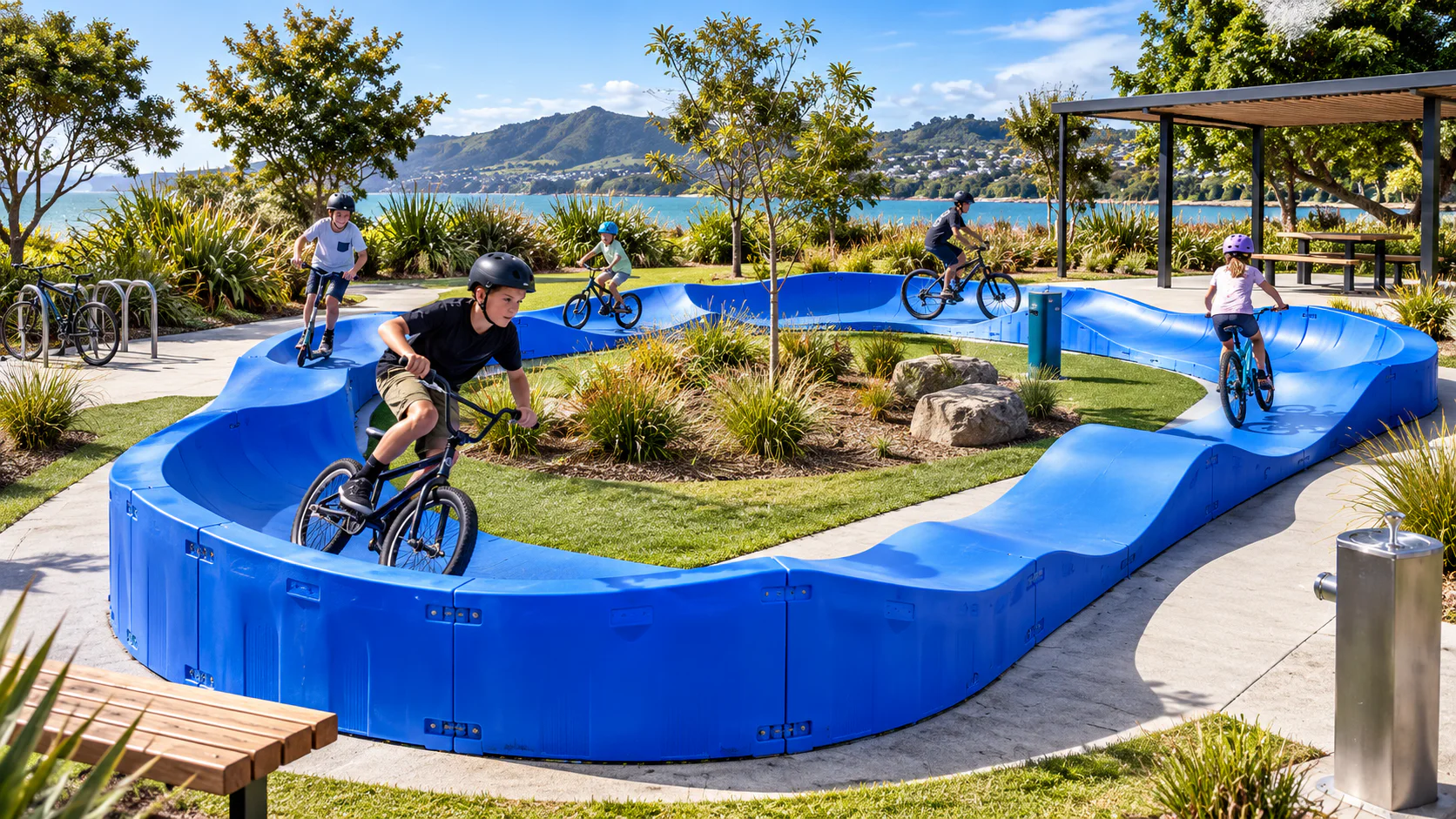
A pump track creates a repeatable riding circuit where riders use body movement, balance and line choice to maintain momentum.
Who will use the track?
Which wheeled activities are expected?
What level of progression is appropriate?
02
Why rider flow matters
The track, waiting zone and surrounding paths need to work as one movement system.
Is the riding direction obvious?
Where do riders wait?
Can entry and exit operate without crossing flows?
03
Track envelope vs project envelope
The catalogue footprint is not the whole site requirement.
What clear space is needed around the track?
Where are paths and viewing areas?
What room is needed for future changes?
04
Base + drainage
The modular track depends on a suitable supporting site and controlled water movement.
What surface exists now?
Are levels suitable?
Where does water go after rain?
05
Modular vs permanent
Modularity is valuable when relocation, staged investment, component replacement or future reconfiguration matter.
Could the site or programme change?
Is staged expansion useful?
Is bespoke permanent terrain more important than adaptability?
06
Operate + maintain
A public or school facility needs inspection, cleaning, drainage care and a fault-response process.
Who inspects it?
How are faults recorded?
Who controls reopening after repairs?
Working checklist
Pump Track 101 project checklist
Use this as an early-stage discussion sheet. It does not replace local design, engineering, safety, accessibility or approval requirements.
01Target riders are known02Operating model is defined03Usable site envelope is measured04Entry and exit can be separated from waiting areas05Base condition is understood06Drainage route is considered07Supervision / passive surveillance is considered08Surrounding amenities are planned09Expansion / relocation need is understood10Supply scope is separated from local works11Inspection ownership is defined12Project-specific technical information will be confirmed before supply
Practical activities
Use these exercises before requesting a quote.
Draw the whole site
Sketch the track, paths, waiting, viewing, seating, shade, hydration and bike parking. This quickly exposes circulation conflicts.
Compare two operating models
Compare supervised school use with open public use and list what changes in signage, inspection, access and supervision.
Map water movement
Mark high points, low points and likely runoff routes so drainage is treated as a site issue rather than an afterthought.
Test future change
Ask what happens if the project doubles in popularity, needs to move or gains new surrounding recreation uses.
Write the five-line brief
Summarise users, site, preferred scale, delivery region and local works. If that is unclear, the project is not ready for detailed layout selection.
Choose the next pathway
Move into the school, council or developer learning centre depending on who owns the next decision.
Essential site functions work without analytics. With your permission, Apollo uses analytics to understand which products, guides and project pathways are useful. Analytics stays off until you allow it.