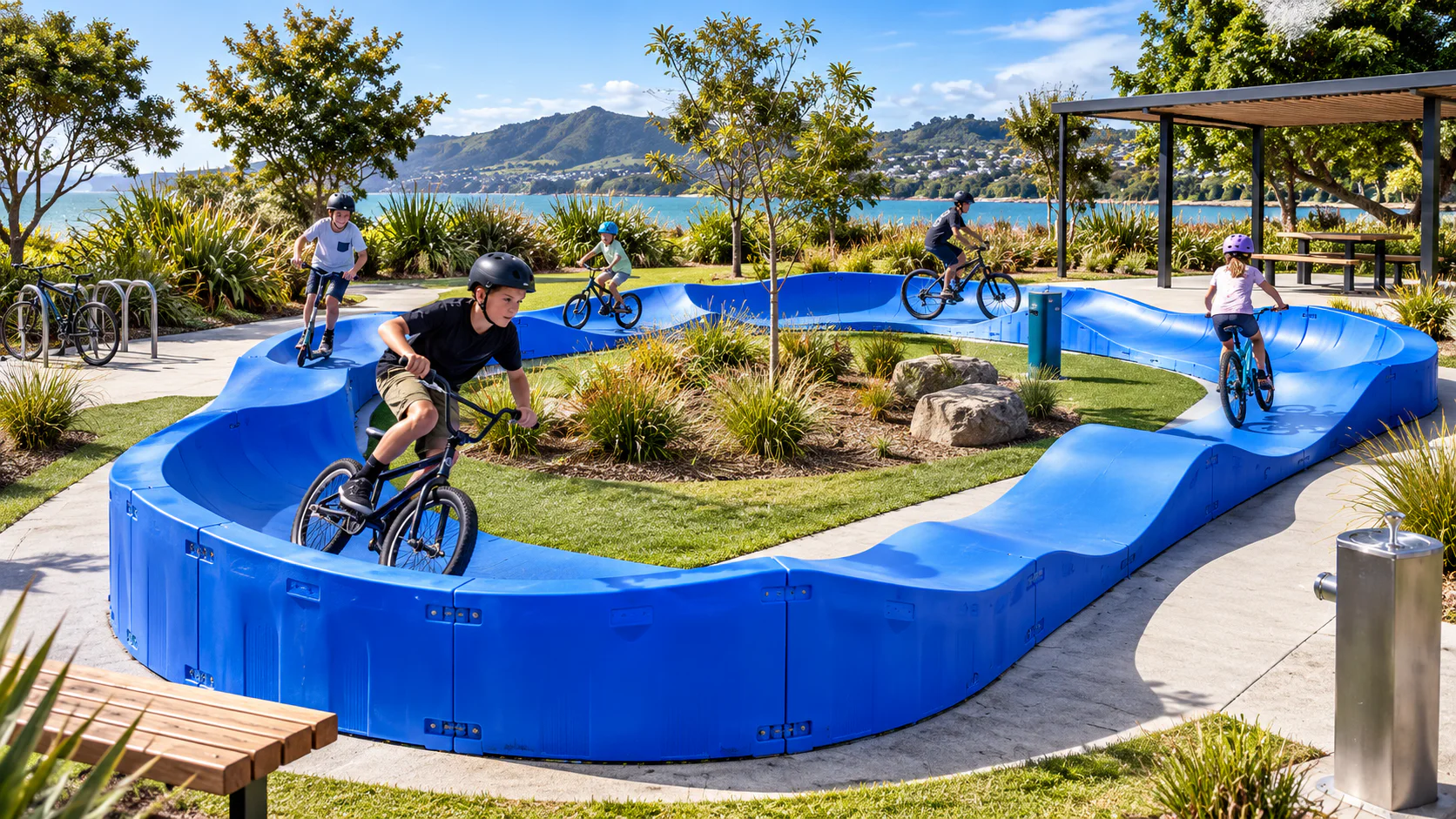
A council guide to need, site fit, procurement and whole-of-life ownership.
A pump track should solve a recreation need, fit its public-space context and remain manageable after opening. This guide helps council teams structure the early business case before detailed design or procurement begins.
Built forCouncils · parks teams · recreation planners · asset managers · procurement teams
Learning modules
Work through the decisions before the project reaches procurement.
01
Define the recreation need
Clarify what problem the project is intended to solve before selecting a layout.
Which users or age groups are currently underserved?
What wheeled recreation already exists nearby?
Is the goal neighbourhood, community or destination recreation?
02
Score candidate sites consistently
Use the same questions across every possible location.
Is the usable footprint sufficient after constraints?
How visible and connected is the site?
What are the drainage, access, neighbour and service issues?
03
Test community demand
Use engagement to understand operating needs, not only support or opposition.
Which activities are likely to use the facility?
When would people use it?
What concerns exist around access, parking, noise or supervision?
04
Choose modularity deliberately
Relocation and expansion only add value when the project plan preserves those options.
Could the asset need to move in future?
Is staged funding realistic?
Is there room to extend without rebuilding the precinct?
05
Write a comparable procurement brief
A strong brief helps suppliers respond to the same project problem.
What exact supply scope is required?
Which site works remain local?
What warranty, maintenance and technical information must be provided?
06
Plan asset ownership after opening
Inspection, maintenance and replacement should be assigned before handover.
Who owns routine inspections?
How are damaged components isolated and replaced?
How will utilisation and maintenance history be recorded?
Working checklist
Council project-screening checklist
Use this as an early-stage discussion sheet. It does not replace local design, engineering, safety, accessibility or approval requirements.
01Recreation need is documented02Likely rider groups and activities are identified03Candidate site footprint is measured04Access and passive supervision are reviewed05Neighbouring uses and circulation conflicts are considered06Base and drainage risks are identified07Future expansion or relocation need is considered08Community engagement questions are prepared09Supply scope is separated from local works10Maintenance ownership is assigned11Post-opening success measures are defined12Technical information required for procurement is listed
Practical activities
Useful exercises for the project team.
Three-site comparison
Score three candidate sites against usable area, access, visibility, drainage, surrounding amenities, neighbours and future expansion.
User-map workshop
Map likely riders—children, teens, families, BMX, scooters, balance bikes—and identify how each reaches and uses the site.
Precinct gap review
List what exists around the proposed track: paths, toilets, seating, shade, bike parking, hydration, lighting and public transport.
Whole-of-life responsibility map
Assign who inspects the track, who maintains the surrounding site, who manages faults and who approves replacement components.
Procurement brief test
Ask whether two suppliers could read the brief and price the same scope. If not, the brief still needs work.
Post-opening KPI plan
Define simple measures such as repeat use, rider mix, peak use, maintenance events, complaints and demand for expansion.
Essential site functions work without analytics. With your permission, Apollo uses analytics to understand which products, guides and project pathways are useful. Analytics stays off until you allow it.