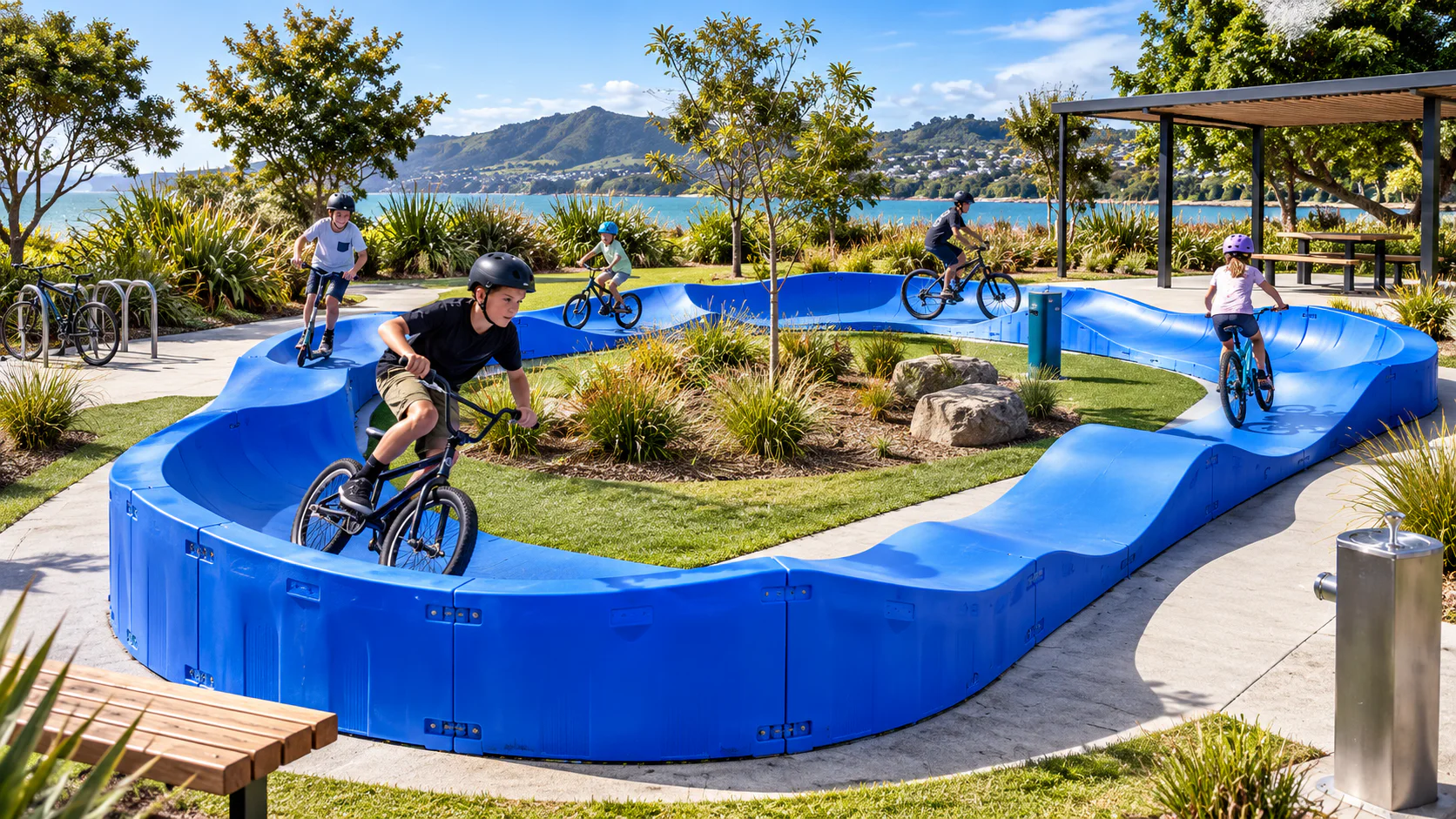
Plan the pump track as part of the neighbourhood, not leftover recreation space.
For developers, landscape architects and masterplanners, the track should sit inside a connected recreation and public-realm plan. This guide focuses on location, staging, temporary activation, amenity integration, handover and long-term ownership.
Built forDevelopers · landscape architects · masterplanners · resorts · community developers
Learning modules
Work through the decisions before the project reaches procurement.
01
Give the track a role in the masterplan
Decide whether it is a local amenity, community destination or part of a larger recreation precinct.
Who is expected to walk or ride to it?
What other recreation sits nearby?
Is it serving one stage or the wider development?
02
Protect the usable envelope
Do not reduce the project to the track footprint alone.
Where are clear zones and circulation?
Where do spectators and waiting riders sit?
Is there room for shade, seating and bike parking?
03
Use staging strategically
Modularity can support a first-stage asset without losing a future growth pathway.
What is delivered in the first release?
Where could later modules extend?
Can the facility move as the development progresses?
04
Consider temporary activation
A relocatable system may help activate completed but not yet permanently developed land where the site conditions suit.
Is the temporary base appropriate?
Can safe public access be provided?
Who owns inspection and operation during the temporary stage?
05
Coordinate the public realm
The best result is a precinct rather than an isolated recreation object.
How do paths and cycle routes arrive?
Where are seating, shade, hydration and lighting?
Are landscape elements outside sightline and rider-conflict zones?
06
Plan handover and ownership
Define what is transferred, to whom, and with what maintenance information.
Will the developer, body corporate, operator or council own the asset?
What inspection records are required?
What spares, warranty and maintenance information follow the handover?
Working checklist
Developer masterplanning checklist
Use this as an early-stage discussion sheet. It does not replace local design, engineering, safety, accessibility or approval requirements.
01Facility role in the masterplan is defined02Catchment and likely users are identified03Walking/cycling connections are mapped04Track plus clear-zone envelope is protected05Waiting, viewing and amenity space is allowed06Drainage and base strategy are coordinated07Future stages and expansion are considered08Temporary activation potential is reviewed where relevant09Lighting, shade, seating and hydration are coordinated10Ownership at each development stage is defined11Handover documents and maintenance responsibilities are identified12Supply scope is separated from local civil and landscape works
Practical activities
Masterplanning exercises that improve the outcome.
Catchment sketch
Draw the five-minute walking and riding catchment and show how users reach the site without unnecessary road crossings or conflict points.
Amenity adjacency test
Place seating, shade, hydration, bike parking and paths around the track, then check that none create blind spots or rider conflicts.
Stage-one / stage-two plan
Show the first deliverable layout and a credible future expansion route rather than simply stating that expansion is possible.
Temporary activation scenario
Test whether an early-stage parcel could host the facility temporarily, including access, base, drainage, supervision and eventual relocation.
Handover map
List every responsibility that moves from developer to operator, body corporate or council, including inspections, maintenance and fault reporting.
Precinct value review
Assess whether the track is integrated with other recreation and public-realm uses strongly enough to create a destination rather than an isolated feature.
Essential site functions work without analytics. With your permission, Apollo uses analytics to understand which products, guides and project pathways are useful. Analytics stays off until you allow it.