01Define who will use the field and how often
Record training hours, match use, age groups, school or community access, tournament requirements and whether the field must share with rugby or another sport.
High utilisation can justify a different system and maintenance plan from a lightly used school or club training field.
Compare filled, reduced-infill and non-infill pathways as complete systems
The turf, infill, shockpad and maintenance regime are interdependent. A non-infill construction should not be treated as a universal replacement for every filled football system.
Ask how the exact system responds to traction, ball behaviour, wear, heat, maintenance and local repair rather than comparing one isolated product number.
Treat base and drainage as part of the sports system
Stable levels, suitable falls, sub-surface drainage and perimeter water management are essential to the finished field. The turf layer cannot solve civil defects underneath it.
Local rainfall, heat and UV exposure should be included in the field and maintenance brief.
Coordinate goals, fencing, lighting and spectators early
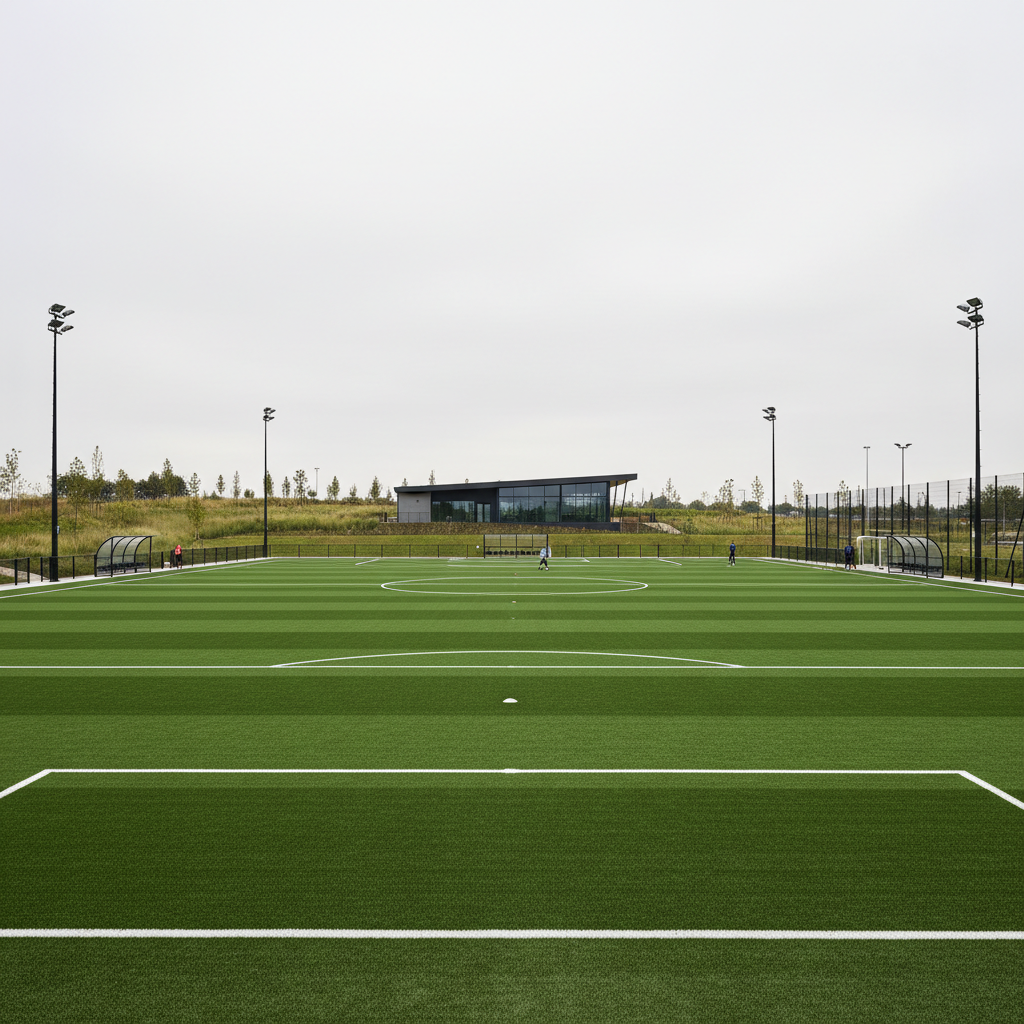
Goal anchoring, maintenance access, high ball-stop zones, lighting poles, team benches and spectator circulation all affect the total site footprint.
Where one field supports different codes or training formats, equipment storage and changeover should be designed into the facility.
Keep FIFA-related claims exact-system specific
Where FIFA Quality or FIFA Quality Pro is required, the project should confirm the exact supplier system, current evidence and completed-field certification process. A brand-level statement is not a substitute for that evidence.
Apollo coordinates supply and product documentation; local testing, installation and approvals remain project-specific.