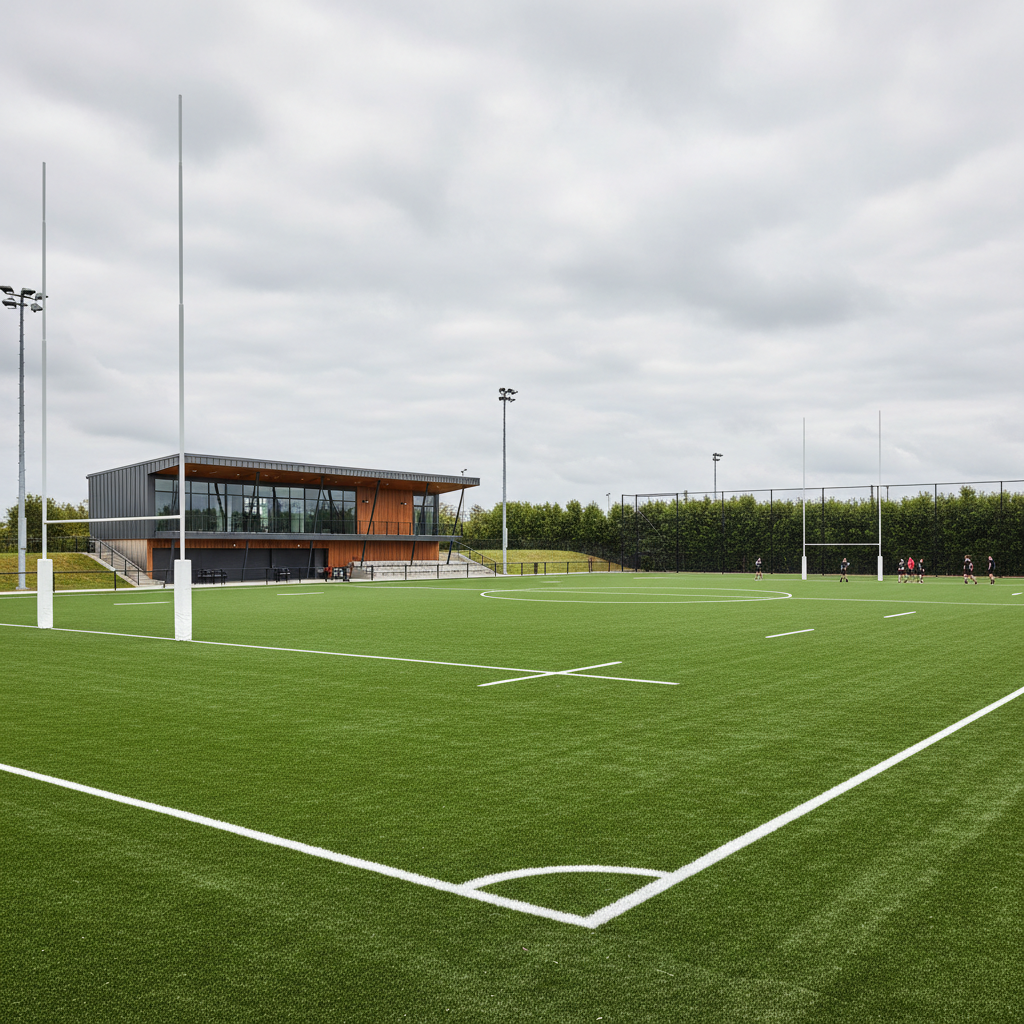
01Start with the rugby programme and player group
Record age groups, training volume, competition level, school or community access and whether the field will also support football. Those decisions affect the complete-system pathway and maintenance regime.
A shared-code field should be selected around the more demanding impact and safety requirements rather than assuming one general football turf is suitable.
Treat shockpad and impact performance as system-level properties
Shock absorption, deformation, traction and head-impact characteristics depend on the tested combination of turf, infill and underlying layers. Choosing a turf product independently from the impact system can break the evidence chain.
The exact shockpad material and thickness should therefore follow the selected tested construction rather than be chosen as a generic add-on.
Resolve base and drainage before the impact system is installed
Levels, compaction, stability, water movement and tolerances affect both player performance and long-term durability. Poor civil work cannot be corrected by the surface layer.
Maintenance access, heavy equipment routes and repair access should be planned around the field from the start.
Coordinate posts, perimeter, lighting and venue infrastructure
Post sleeves, padding, gates, fencing, team areas, lighting poles and spectator zones all interact with the field envelope and safety clearances.
Schools and clubs should also define storage, medical access, maintenance equipment and emergency routes before construction.
Keep Regulation 22 evidence exact and current
Where World Rugby Regulation 22 applies, the exact product/system documentation and finished-field testing pathway must be confirmed. Do not treat a manufacturer name or an unrelated field certificate as evidence for another construction.
Apollo supplies the agreed products and documentation; local civil work, installation, testing and approvals remain project-specific.