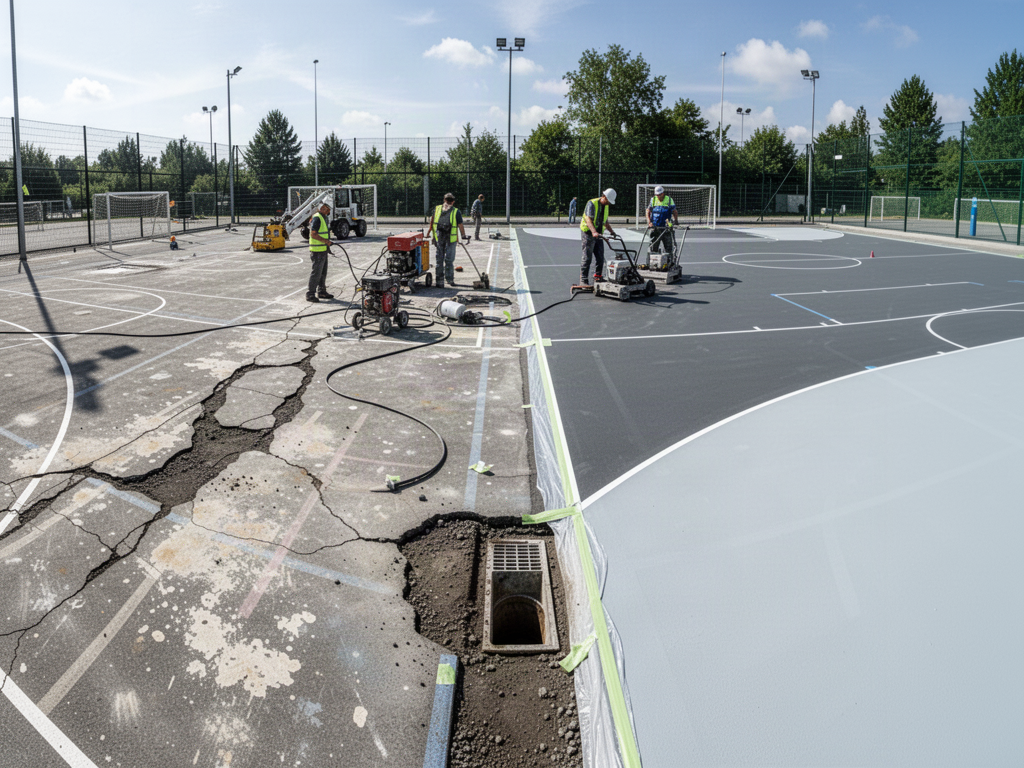
| Stable court, worn finish | Base is broadly sound; finish is aged, faded or no longer suitable. | Document levels, drainage, coating condition and intended new sport before final preparation. | A broader range of replacement surface pathways may remain open, subject to the exact base and product requirements. |
|---|
| Cracking or failed patches | Cracks, patch repairs or local movement are visible. | Establish whether defects are inactive/local or evidence of continuing movement before surfacing. | Do not select a surface on the assumption it will repair structural or active substrate movement. |
|---|
| Ponding / drainage failure | Water remains after rain or collects at edges and low points. | Identify low spots, falls, outlets and surrounding discharge before choosing the finish. | Through-draining tile can pass water to the base but cannot make a poorly drained slab drain correctly. |
|---|
| Old painted / coated court | Existing coating remains but may be worn, peeling, contaminated or uneven. | Check adhesion, contamination, thickness, repairs and compatibility with the proposed installation method. | Loose-laid modular and bonded/continuous systems can require different preparation; the exact product controls the final method. |
|---|
| Major level or base failure | Settlement, widespread movement, severe deformation or unsuitable base condition. | Treat the project as repair-first or partial rebuild until the supporting court is suitable. | Freeze the sports surface only after the local civil/structural pathway is resolved. |
|---|