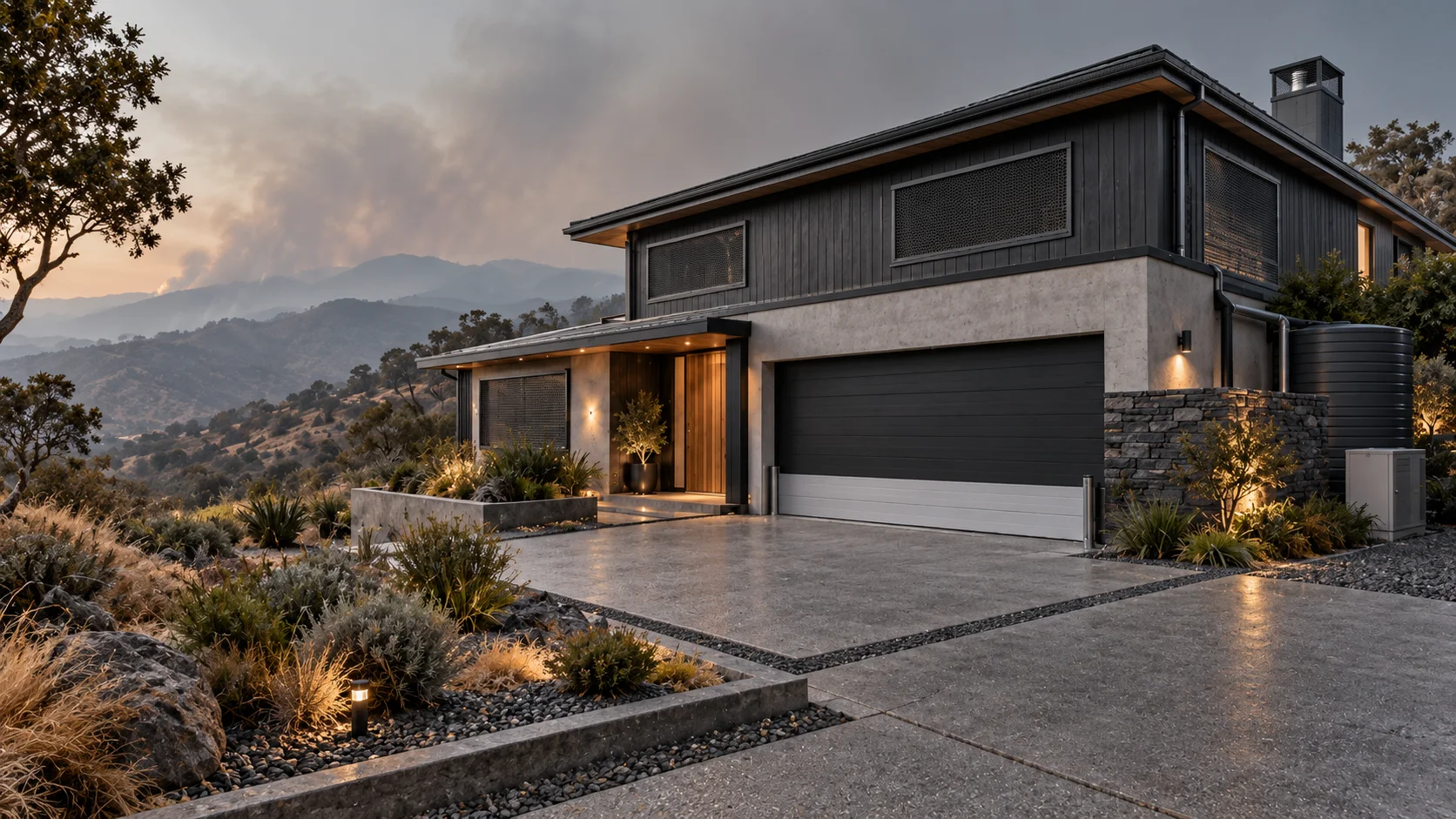
Wildfire resilience starts at the home and works outward. Research and fire-prevention guidance consistently show that wind-blown embers and small flames can ignite vulnerable materials on or immediately around a building before the main flame front reaches it.
Planning guidance — final supplied configuration remains project-specific.
01
Think in ignition zones rather than one property boundary
The NFPA Firewise Home Ignition Zone framework looks at the building itself and the surrounding area out to roughly 100 feet where site conditions allow. The immediate area closest to the building deserves the most attention because a small ignition there can transfer directly into the structure.
This is a planning framework, not a substitute for the exact local wildfire, WUI or bushfire rules that apply to the project.
02
The first few feet are disproportionately important
Combustible mulch, leaves, stored timber, dry vegetation, furniture, mats and debris immediately beside walls, decks or attached structures can create a bridge from ember to flame to building.
Where the local guidance supports it, use a low-combustibility or noncombustible near-building zone and keep it maintainable rather than relying on a one-time clean-up.
03
The home itself is part of the fuel path
Roofs, gutters, vents, eaves, decks, fences, attached structures and gaps where embers can lodge all need inspection. A well-spaced landscape does not compensate for a debris-filled gutter or an opening that admits embers.
Home hardening and defensible space work together; neither should be treated as a complete solution on its own.
04
Move outward by reducing continuity
Beyond the immediate zone, the goal shifts from eliminating every combustible material to reducing fuel continuity, ladder fuels, dead material and dense vegetation that can carry fire toward the structure.
Spacing, pruning and maintenance depend on site slope, vegetation type, jurisdiction and climate. Use local fire-authority guidance for the actual distances and vegetation prescriptions.
05
Maintenance is the operating system
Leaves return, branches grow, mulch moves, outdoor furniture changes and firewood piles migrate. Wildfire resilience therefore depends on recurring inspection, especially before and during the local fire season.
A useful property plan assigns responsibility for roof and gutter cleaning, deck checks, vegetation maintenance, stored-fuel control and seasonal re-inspection.
Reference sources
Official guidance behind this resource.
Use these sources alongside the exact product instructions and the rules that apply at the project location.
Essential site functions work without analytics. With your permission, Apollo uses analytics to understand which products, guides and project pathways are useful. Analytics stays off until you allow it.