Start with level of play
Training, community competition, higher-level competition and broadcast use can have different illuminance and uniformity requirements.
 International
 Decision Centre / Global
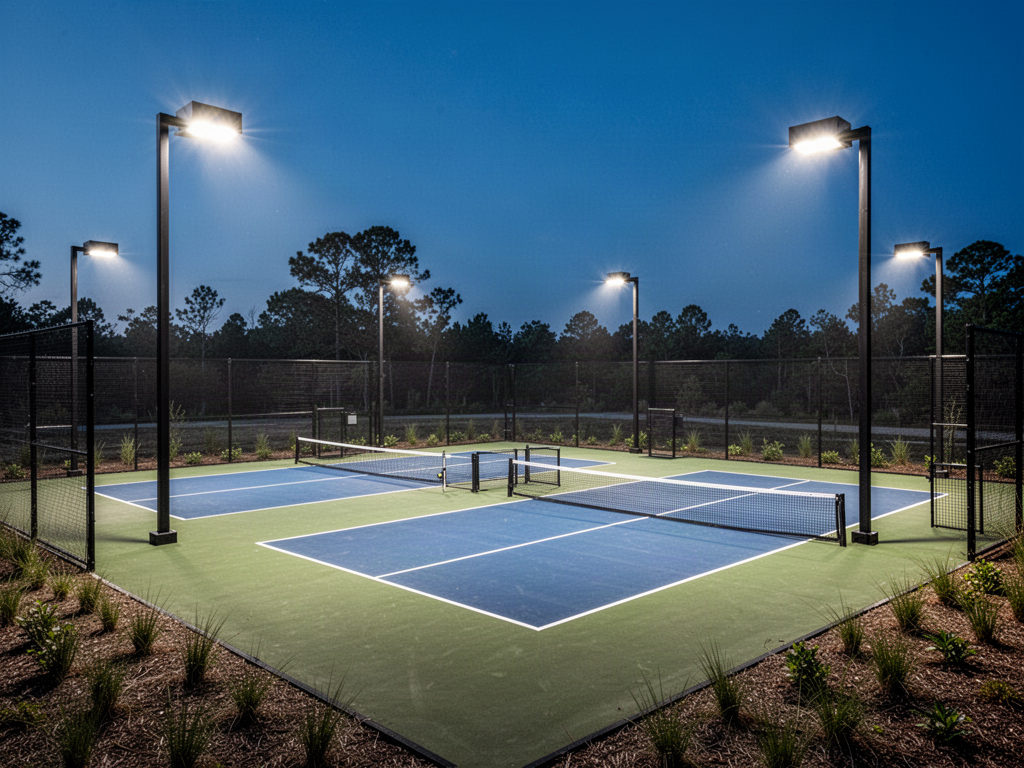
Lux alone is not enough. The sport, level of play, uniformity, glare, vertical illumination, broadcast requirements and light-spill limits all shape the final design.
Direct answer
Use the governing sport and facility standard for the exact competition level, then design and verify the lighting photometrically. Recreation and training generally need less light than higher-level competition or broadcast environments, but exact values must come from the applicable current standard.
Project decision
Use these points to structure the first project conversation. Final suitability stays tied to the actual site, selected system and local project team.
Training, community competition, higher-level competition and broadcast use can have different illuminance and uniformity requirements.
A high average lux level can still produce a poor playing environment if dark zones, glare or uneven vertical illumination remain.
Pole height, aiming, spill light, curfew, neighbours, power and maintenance access all need project-level coordination.
Comparison matrix
This matrix explains the decision layers rather than replacing a lighting standard.
| Input | Why it changes the design |
|---|---|
| Sport | Ball speed, trajectory and visual task differ |
| Level of play | Competition class changes target performance |
| Indoor / outdoor | Mounting, reflections and spill-light differ |
| Broadcast | Vertical illumination and camera needs increase |
| Neighbours / boundary | Obtrusive-light limits affect aiming and controls |
Project brief
Frequently asked
No. Site conditions, scale, permanence, local works, operating expectations and documentation requirements change the right starting point.
No. Apollo uses a manual project-brief process so the selected system, quantities, destination, freight and project interfaces are checked before pricing.
Apollo is primarily a supply-only project-supply specialist. Local engineering, approvals, foundations, services, installation and other site work remain with the appointed local project team unless a written project scope states otherwise.
Next step
Send the site, dimensions, intended use, quantities and known local requirements. Apollo will review the relevant product pathway and keep local engineering, approvals and site-work responsibilities explicit.