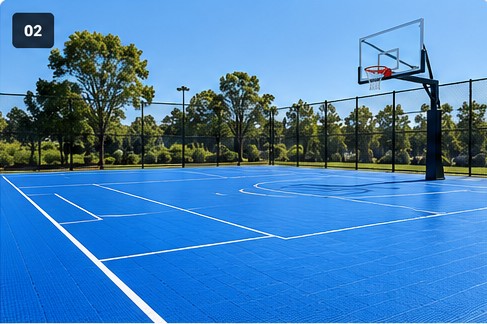
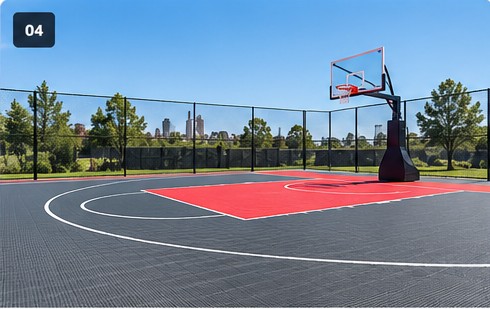
01Project context
For Pacific Island schools, council courts and community sports projects, preparation and logistics can be as important as material choice. The best surface is one that matches the intended sport, site drainage, environmental exposure and realistic local maintenance capacity.
Start by identifying the sports and intensity of use
A multi-use school court may host basketball, netball, volleyball and community events. A dedicated outdoor pickleball court may prioritise a different ball response and surface feel. Make a schedule of primary and secondary sports, ages, footwear, expected hours and whether the facility supports organised competition.
Ask for evidence specific to the playing surface and sport rather than relying on 'professional' or 'FIBA' as generic labels. Manufacturer or federation affiliations do not automatically certify every product for every climate, application or competitive category.
Understand open-grid modular surfaces
Some outdoor modular PP tiles have openings designed to allow water to pass through. That can be useful where rainfall is frequent, but it does not remove the need for a correctly graded, structurally sound underlying base and an effective discharge route. Water trapped beneath a tile system can create hygiene, movement or substrate problems.
Ask about expansion joints and perimeter movement in heat, connection design, local replacement and tile compatibility. The supplier should verify product-specific dimensional behaviour at the actual operating temperatures rather than relying on a generic description of interlocking tiles.
Assess the existing slab or asphalt
An existing court is often the greatest unknown. Cracks, differential settlement, standing water and uneven joints may be hidden beneath old paint. The chosen modular surface or coating will not necessarily correct those defects. A site survey should record levels, drainage paths and areas requiring repair.
If a new base is planned, local engineers should confirm subgrade, construction approach, falls and stormwater disposal for the climate and available materials. Imported floor products cannot compensate for foundations that move or flood.
Sun, heat and colour matter
Dark materials exposed to tropical sun can become uncomfortably hot. Colour selection should therefore be considered alongside shading, playing hours, site orientation and measured surface temperature where possible. The visual appearance of a bright blue or green surface does not by itself prove lower heat build-up.
Obtain documented UV and colourfastness information where available, plus the manufacturer's cleaning and inspection guidance. Be cautious about supplier statements that all outdoor plastics are equally stable over long periods. Exact formulations, additives and installation conditions differ.
Coastal conditions require interface care
Near the ocean, salt exposure affects metal fence fittings, hoop structures, fasteners, hardware and electrical systems in addition to flooring. Specify relevant corrosion protection and maintenance for those associated components. A durable playing tile does not solve a corroding net post or lighting pole.
Sand and debris also need a cleaning strategy. Court edges, drains and tile openings can trap material; maintenance teams should have safe methods and access to remove it. Ensure the system can be locally serviced and spare tiles obtained if needed.
Safety extends beyond the marked court
Clear run-offs, accessible routes, surrounding fences, lighting and seating are part of a functioning sports facility. A dense multi-sport layout can create dangerous overlaps or paths through active play. Plan court orientation and circulation with the actual use in mind.
For international projects, confirm the appropriate local requirements and sporting standards. New Zealand documents should not be assumed to cover another jurisdiction. The buyer's local team must verify construction and operational compliance.
Freight and receiving deserve an early plan
Island logistics can change the economics and timeline of a flooring package. Consider packaging, container utilisation, port handling, customs, inland transport, storage, humidity exposure and the ability to unload safely at the destination. The quantity calculation must include spare tiles and necessary edge pieces where specified.
Apollo supplies wholesale products and can support international project sourcing, but local installation and approvals remain with the destination team. A complete product-and-logistics schedule should make each of those responsibilities explicit.
Ask for a climate-specific supply proposal
Provide location, distance from coast, sport mix, court count, dimensions, rainfall and drainage characteristics, base photographs, expected users and delivery destination. Request the exact model construction, documented outdoor suitability, installation method, maintenance, warranty exclusions and replacement-part process.
An attractive render can demonstrate potential but should never be treated as test evidence. Ask for manufacturer-issued technical documentation applicable to the proposed system, and confirm that it matches the quotation.
Frequently asked questions
Do perforated tiles remove rainwater automatically? They may allow water through but still require a correctly drained base.
Can indoor PVC sports flooring be used outside? Not unless the exact product is explicitly supported for that application by its manufacturer.
Does tropical weather affect installation gaps? Potentially. Use product-specific installation guidance for heat and movement.
What should an island council include in its quote? Site and base details, sports, dimensions, environment, unloading arrangements, technical documentation and local installation responsibilities.
Create a climate exposure record for the exact court
A country name is not a sufficiently precise environmental specification. Record whether the site is inland or exposed to salt-laden air, its known rainfall behaviour, direct sunlight, existing shade, flooding history and maintenance resources. If possible, collect photographs after heavy rain, when low spots and blocked outlets are visible. This record helps suppliers distinguish a well-drained hard court from a chronically wet site that first needs civil work. It also prevents a generic tropical product recommendation from ignoring differences between a school in a sheltered valley and a beachfront recreation facility. Local designers should translate the observations into any formal environmental and structural requirements before the product is selected.
Choose the court surface through a decision matrix
Compare the shortlisted systems against the sports to be played, outdoor-use approval, substrate requirements, drainage approach, wet and dry grip evidence, heat behaviour, UV durability, repairability and local supply of replacement material. Mark items as manufacturer-confirmed, site-dependent or not yet evidenced. A bright catalogue photograph does not prove any of these properties. Some facilities may favour a traditional sports coating on a properly prepared base; others may find a suitable perforated modular tile practical for ongoing repairs. A decision matrix helps councils explain why they chose a particular assembly and gives the supplier a structured list of unanswered questions. The final recommendation must be made for the actual quoted model.
Plan for heavy downpours rather than normal drizzle
Tropical storms can produce rapid surface water flow. The civil designer should examine the court's surface falls, nearby catchment, perimeter drains and discharge route. If a perforated tile system is used, consider how water moves through the tile and across the substrate beneath it, and how debris is removed from outlets. If a continuous finish is used, plan safe water runoff without persistent ponding. The operator should also have a sensible wet-weather playing policy. Describing a tile as 'quick draining' without verifying the supporting base can create false expectations. Proper water management includes both the playing surface and the surrounding site.
Account for expansion and edge detailing
Outdoor court materials experience daily temperature cycles and direct solar heating. Some modular systems require particular movement gaps or installation sequences; other surfaces require control of joints and substrate condition. The correct rules must come from the exact manufacturer's instructions. A common procurement error is ordering only the apparent square metre playing area, without edge pieces, spare components, expansion provisions or the interface to fencing and drains. The layout should show the full usable court, edge conditions and any net or post foundations, with the necessary accessory quantities. An experienced local installer must understand the manufacturer method rather than applying assumptions from a different surface product.
Make colour, marking and heat part of the same choice
Colour determines more than the court's visual identity. Strong tropical sunshine may increase surface temperature and glare, and line visibility can change with contrast, wear and wetness. Before selecting an unusual palette, review actual manufacturer colour choices and their suitability for outdoor use. If samples can be examined locally, consider how they appear in direct sun and shaded conditions. Court markings must be appropriate to the designated sports and should not confuse users of a multi-sport layout. Do not make unverified claims about surface temperature reductions from one colour. A good colour schedule balances play visibility, expected upkeep and heat-management planning.
Plan replacement stock and island logistics together
A modular sports surface may be easier to repair locally if spare pieces are held on site, but only if the installation system permits individual replacement and the same profile remains available. Ask the supplier for a recommended spare inventory appropriate to the project size and expected use. On islands, delays in re-ordering, inland transport and customs clearance can be greater than on a mainland project. Store spare material according to manufacturer guidance and maintain a record of installed batch or colour. A flooring procurement plan should also account for handling, unloading, suitable short-term storage and the tools required by local installers. These practical details can have a substantial effect on long-term usability.
Include perimeter components in the climate specification
Posts, fences, gates, nets, hoops and lighting may fail sooner than the sports floor if their exposure and maintenance requirements are ignored. Coastal salt can affect metal hardware and electrical interfaces, while heavy rainfall can undermine paths or foundations near the court. The sports project team should review the entire environment instead of buying a durable tile package surrounded by unsuitable accessories. Specify appropriate drainage, corrosion systems and service access for the associated components. For remote sites, the capability to inspect and repair these assets safely should influence product choice. A complete project delivers a usable sports facility, not just a resilient playing rectangle.
A useful tropical court procurement checklist
The first enquiry should include a site plan, dimensions, chosen sports, photographs of base and drains, environmental exposure, expected user level, preferred colours and delivery destination. Ask for product-specific data, outdoor-use evidence, installation details, suitable substrate conditions, warranty and spare-part availability. Request a responsibility schedule covering local civil works, surface laying, equipment installation and handover. Where a federation performance standard matters, verify its actual scope. Apollo's sports supply programme can help shortlist products and coordinate wholesale supply, while local professionals remain responsible for site engineering and installation. That division of responsibilities should be visible in every quotation and project document.