
Start with the people using the court
Consider the school hall that hosts basketball before lunch, physical education in the afternoon and community sport at night. The floor is expected to perform in different ways, and the people buying it may not be the people cleaning it every day. That gap between procurement and operation is where a superficially attractive flooring decision can become difficult to live with.
Begin with a realistic schedule of primary sports, training, school use, tournaments and non-sport events. Identify age groups, footwear, wheeled equipment and how often equipment or seating will be moved.
A basketball-first indoor hall may have different priorities from a community venue used for netball, badminton, fitness and assemblies. The primary programme should guide surface performance and court-marking decisions.
Indoor resilient floors, outdoor modular tiles, synthetic turf and portable event surfaces are different product families. Drainage, exposure, slip behaviour, ball response and cleaning requirements should not be assumed equivalent.
Ask suppliers to identify the intended use and limitations of the exact proposed system. Avoid selecting a surface on the basis of a photograph that does not show its technical build-up.
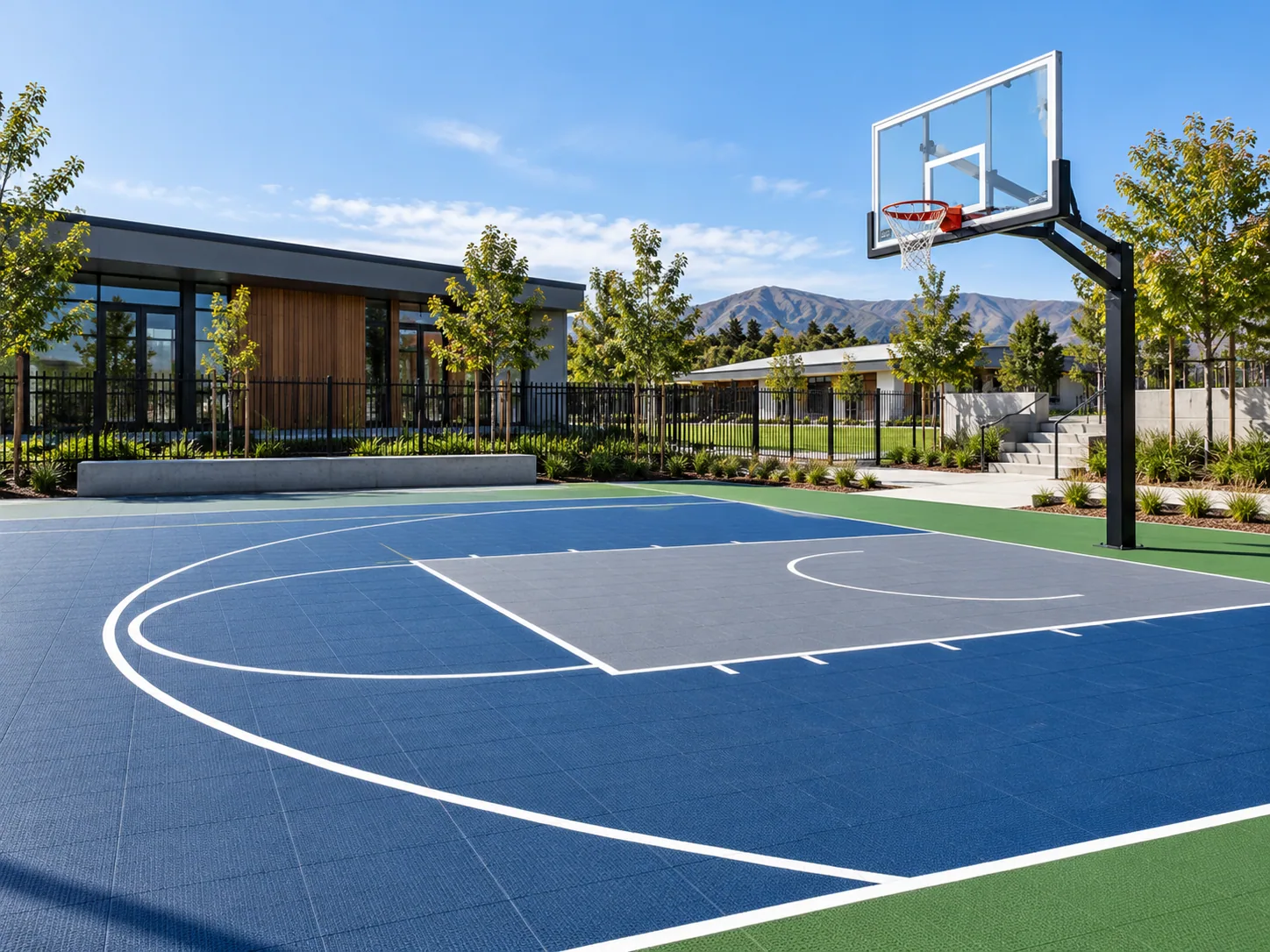
An outdoor community court illustrates the importance of site context. A modular playing surface may look like a quick route to reopening a tired court, yet poor drainage or irregular falls in the existing base can still create puddling and inconsistent play. Before choosing a surface, the owner should understand where water goes, whether the base moves or cracks, and how the selected system handles temperature and weather exposure. The local groundwork may ultimately determine the project budget more than the visible tiles.
An indoor school refurbishment has different trade-offs. The hall could host badminton as well as basketball, with temporary equipment rolled out of storage several times each day. Operators need to think about markings, ball visibility, storage access and the effect of equipment movement on the surface. Choosing a visually dramatic pattern that crowds the floor with competing lines might make the room less usable, even if the material itself performs well.