
Apollo NZ Global

Built Intelligence · Sports & Recreation · Sports facilities

Portable Force Plates: A Guide to Athlete Performance Testing

The most important part of athlete force testing is not the sophistication of the dashboard. It is how clearly the measurement answers a decision that a coach or practitioner is prepared to act on.

Apollo NZ Global EditorialPublished 2026-11-18Project intelligence
Final product selection, technical documentation and local approval requirements are assessed for each project.
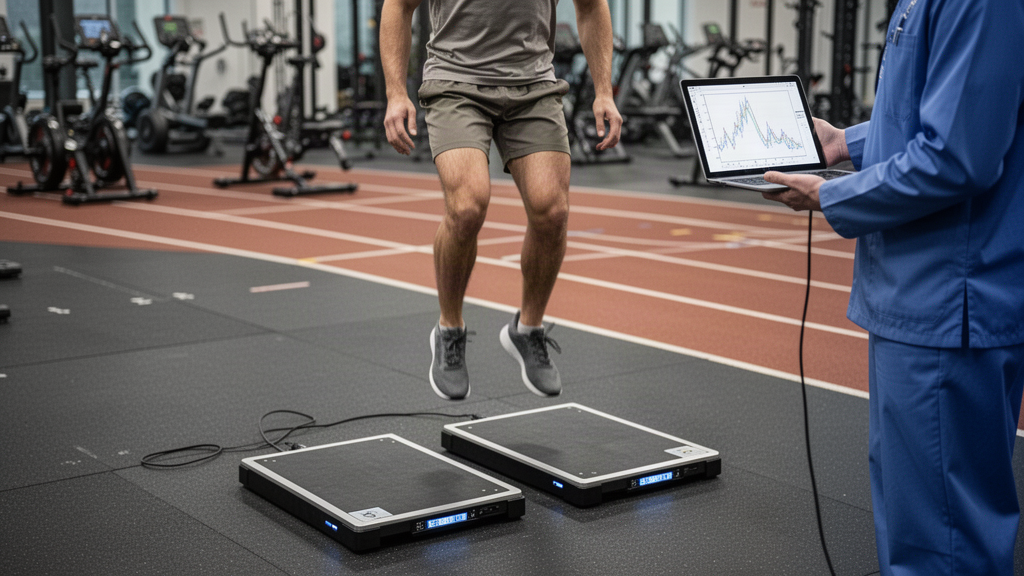
Portable force plate athlete testing in a performance facility
01

Understanding the project

Portable force plates are measurement devices that record forces applied to their sensing surfaces over time. In athlete testing they support controlled jump, isometric and balance assessments, but useful results depend on validated hardware, consistent protocols, secure placement and expert interpretation.

Force plates have moved from specialist laboratories into training centres, performance clinics and increasingly portable field settings. They offer a direct way to measure external forces during selected movements, helping practitioners study patterns that cannot be reliably inferred from a video of the movement alone. But a valuable measurement is not automatically a valuable decision.

This guide explores what a portable force plate does, the information it can supply, how to make athlete testing repeatable and what to request from a supplier. It is intended for sports-performance practice, not medical diagnosis or a claim that any particular Apollo product has been independently validated.
02

What a force plate actually measures

A force plate contains sensing components that respond to applied load and convert it into time-series measurements. Depending on the device and the manufacturer's specification, a system may measure primarily vertical force or multiple force components and moments. Software transforms those data into selected outputs. Different sensor designs, sampling rates and processing algorithms may create different capabilities even when the hardware looks similar.

Start by identifying the measurement your organisation needs. If the goal is to track general countermovement jump output over a season, the requirements may differ from a research laboratory quantifying multi-axis kinetics. A device's portability should not distract buyers from checking what it actually measures and with what documented accuracy.

04

Single-plate and dual-plate systems

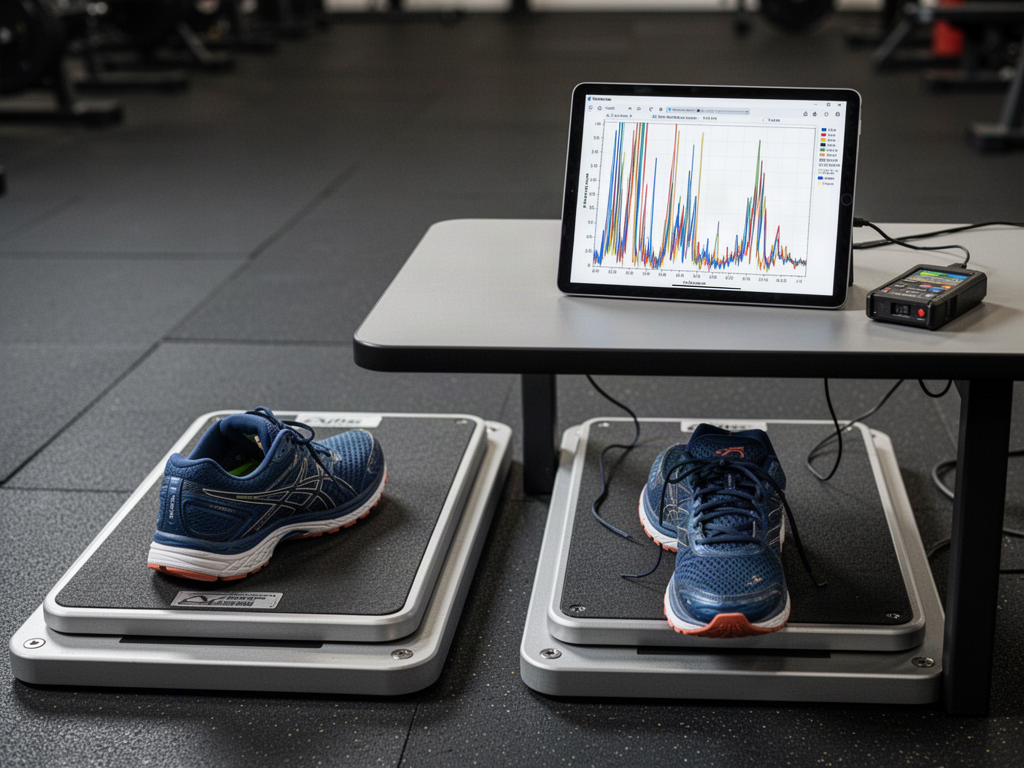
A single sensing surface can be useful for many total-force tests. A dual system, where each foot is positioned on its own plate, can offer side-specific data where the hardware and software support that separation. However, an apparent left-right difference is only meaningful within a valid protocol and the measurement uncertainty of the system.

Dual plates introduce additional setup requirements: feet must be placed on their intended sensing surfaces, device synchronisation must be correct where applicable and the athlete should be familiar with the task. Do not assume every pair of portable plates has identical capabilities or analysis methods.

Two portable force plates beside a tablet showing a force-time graph
05

Portability brings real practical compromises

Portable devices can move between a training facility, rehabilitation space or field testing session, reducing dependence on a fixed lab. In exchange, the operator must ensure a stable, flat and sufficiently rigid surface. Moving the equipment between floor types, testing in wet conditions or setting plates on unstable bases may change measurement quality.

Transport cases, battery endurance, wireless connectivity, calibration procedures and environmental limitations all belong on the purchase checklist. A portable product that requires an unsuitable setup may create a false sense of measurement precision.

06

Build a repeatable testing protocol

A valid comparison requires repetition under similar conditions. Standardise warm-up, footwear where feasible, equipment positioning, arm-swing instructions, depth or movement cues where relevant, number of attempts, rest period and which trials are retained for analysis. Record significant exceptions rather than silently mixing incompatible sessions.

Australian Institute of Sport guidance emphasises quality assurance, measurement proficiency and protocol control. Practitioners should follow the chosen device's calibration and zeroing procedures and use recognised professional guidance for test design. This is especially important when the data influence athlete selection or return-to-play decisions.

07

Know what data quality can and cannot prove

Accuracy concerns agreement with a suitable reference; reliability concerns consistency when the underlying condition is stable. Sensitivity asks whether a system can detect a change large enough to matter. Software dashboards may display values to several decimal places, but decimal precision on a screen should never be mistaken for measurement certainty.

Before using scores to influence training load, determine typical variation for your own athletes and protocol. Compare like with like, track unusual readings for review and understand whether vendor processing is transparent. Automated readiness interpretations should remain decision support rather than replace a qualified practitioner.

08

Consider software, exports and data governance

Hardware is only half the purchase. Confirm which metrics the software calculates, which remain available without an ongoing subscription, how athlete records are organised and whether raw data can be exported. Clubs may need multiple user accounts, shared dashboards or an offline workflow when travelling.

Treat athlete testing information as potentially sensitive personal data. Define who may access results, how long they are retained and how consent and data protection obligations are met. Where the platform is cloud-based, check applicable privacy requirements, security and backup arrangements before onboarding a team.

09

Procurement questions that reveal differences

Request the sensor type, directions measured, sampling and filtering details, accuracy evidence, calibration process, surface requirements, supported tests, data export format, battery/runtime limits and maintenance plan. Clarify whether included accessories and software licences cover the intended number of users and devices. Where researchers will compare results, request method documentation sufficient to understand how each metric is derived.

Ask the supplier for product-specific evidence rather than generic claims of being 'lab grade'. A club buying a compact portable system may not need every laboratory function, but it should know the difference between the functions it receives and the functions it does not.

10

Make each test answer a practical question

A testing programme should begin with an operational objective: tracking a training block, understanding a movement strategy, informing a rehabilitation discussion or supporting an athlete-development review. Choose the protocol and outputs that are appropriate to that question. If the results never influence a meaningful decision, increasing testing frequency adds burden without value.

Apollo can help qualified commercial buyers explore sports measurement equipment. Specific device availability, evidence, certification and compatibility require confirmation against the selected product. Test procedures and athlete interpretation remain with competent sports-science or healthcare professionals as appropriate.

  • State the test purpose and approved protocol
  • Check surface, power and connectivity requirements
  • Request measurement and calibration evidence
  • Confirm raw data, privacy and subscription terms
  • Run a repeatability pilot before operational rollout
11

Set a baseline before you interpret any change

Suppose a club adopts weekly countermovement jump testing. In the first session, athletes vary how deeply they dip, whether they use an arm swing and how carefully they position themselves on the plates. Those differences may affect the values before any meaningful training adaptation has occurred. A baseline is only useful if the protocol is repeatable, the devices are set up correctly and athletes understand the movement. A familiarisation period can reduce confusion between learning the test and changing physical performance.

Staff should record contextual information such as recent training load, injuries or restrictions where appropriately handled, sleep-related circumstances only when relevant and consented, and any protocol deviations. The aim is not collecting every possible personal detail; it is preserving enough context for qualified people to interpret trends. Where the club lacks trained staff, begin with a narrow assessment programme supported by a competent practitioner rather than opening an automated ranking dashboard to everyone.

12

Understand force-time outputs without overselling them

A vertical force-time curve can reveal changes in force across parts of a movement. Depending on the test, analysis may derive net impulse, movement duration, phase-specific measures or estimated take-off velocity. The meaning of each output depends on definitions and processing. Two software products may use different thresholds to identify movement onset or take-off, so results should not be assumed interchangeable simply because the metric names match.

Choose a limited set of measures linked to a clearly stated performance question. If the team tracks every available number, normal fluctuations can look like actionable changes. Staff should understand within-athlete variation and the consequences of measurement error. A single disappointing jump does not prove fatigue, and an improved jump does not automatically establish readiness for competition. Force plates contribute evidence; decisions still require the broader sports-science and coaching context.

13

Practical field testing and quality assurance

Field testing raises problems a fixed lab can control more easily. Surface stiffness, plate stability, wireless interference, low battery charge and hurried athletes can compromise a session. A suitable operating procedure should cover inspection, positioning, manufacturer-specified zeroing, a controlled warm-up, consistent instructions, acceptable trials, data backup and clear stop conditions when a setup is unreliable.

Where dual plates are used, ensure the system can properly separate each side and that the intended movement is valid for comparison. Do not make a clinical judgement from asymmetry alone. If the manufacturer's supporting evidence is incomplete, ask for the limits rather than inventing confidence. A sport performance programme can be practical and scientifically cautious at the same time. Good quality assurance prevents sophisticated-looking charts from masking avoidable setup errors.

14

A hypothetical purchasing decision for an academy

Imagine an academy with four coaches, ninety athletes and multiple training sites. The buyer may prefer compact devices that can be packed in a case, but the practical questions involve staff training, setup time, account management, charging, connectivity and how measurements are combined across sessions. If one coach uses different instructions or filtering settings, the data may not remain comparable. A central protocol and staff competency plan are therefore purchase requirements, not optional extras.

The academy should pilot the equipment with a manageable group, check its daily workflow and confirm that the vendor's software supports the data access it needs. It should budget for any subscription, transport, replacement parts and practitioner time. If the pilot cannot produce consistent and interpretable results, buying more units is unlikely to solve the underlying process problem. The same purchasing framework can be adapted to academies of different sizes and staff capabilities.

15

Frequently asked buying questions

Can a portable force plate replace a full biomechanics laboratory? For some well-defined tests it may be a practical option, but laboratory capability depends on sensing axes, calibration, integration, environment and the research question. Is a dual-plate configuration always better? It offers different information when supported but adds setup requirements. Can results from two brands be combined? Only after considering methods, device agreement and software processing; metric names alone are insufficient. How frequently should athletes test? The answer follows the programme purpose, burden and reliability, not a universal daily schedule.

Does the equipment diagnose injury or prove recovery? Force-time measurements alone should not be treated as a diagnosis or medical clearance. Should clubs buy the model with the most dashboard metrics? Not necessarily; validated measures, a repeatable workflow, data access and service support may be more useful. What belongs in a purchase enquiry? State participant numbers, intended tests, use environment, staff skills, data needs, acceptable evidence and operating budget. That produces a technically meaningful discussion rather than a generic quote request.

16

A force-plate implementation checklist for professional teams

A practical deployment should start with the question the performance staff want to answer and the tests that can address it. Select equipment only after agreeing the measurement requirements, intended environment, users and expected reporting frequency. Name a trained programme owner responsible for checking setup, zeroing or calibration, consistent instructions and data review. If testing will occur at several venues, define acceptable floor conditions, equipment transport and methods for dealing with data collected outside the standard protocol.

Then conduct a pilot. Test a small group on repeated occasions under reasonably similar conditions, record any failed trials and compare whether results are reliable enough to guide the intended decisions. Check that the club understands the software processing and can export or archive the data it needs. Protect athlete privacy and limit access to appropriately authorised staff. Test the vendor support process before the system becomes essential to weekly operations.

Only after this should the team expand testing across its full roster. Write a short protocol sheet for coaches and a more detailed method document for qualified practitioners. Set sensible rules for interpreting changes and avoid treating the dashboard as an automated medical or selection verdict. A successful purchase is one that produces repeatable, interpretable measurements without creating disproportionate athlete burden or unsupported confidence in a particular performance number.

Move from intelligence to project

Apply the thinking to the actual brief.

Open Sports Force Plates Send a project brief
FOR ESTABLISHED TRADE COMPANIES

Already supply sports clubs, schools or courts?

Established court contractors and sports-facility distributors can discuss direct wholesale purchasing for their own projects and customers.

Read our technical wholesale sourcing checklist

Supply-only B2B · No automatic agent appointment or exclusivity · Product and country eligibility checked individually
Project