01Project context
Schools and councils should first identify the intended user mix and operational model. A track for beginners inside a primary school has different needs from a permanent regional recreation destination with heavy weekend use. Neither construction method should be selected before those needs are known.
The core difference is construction strategy
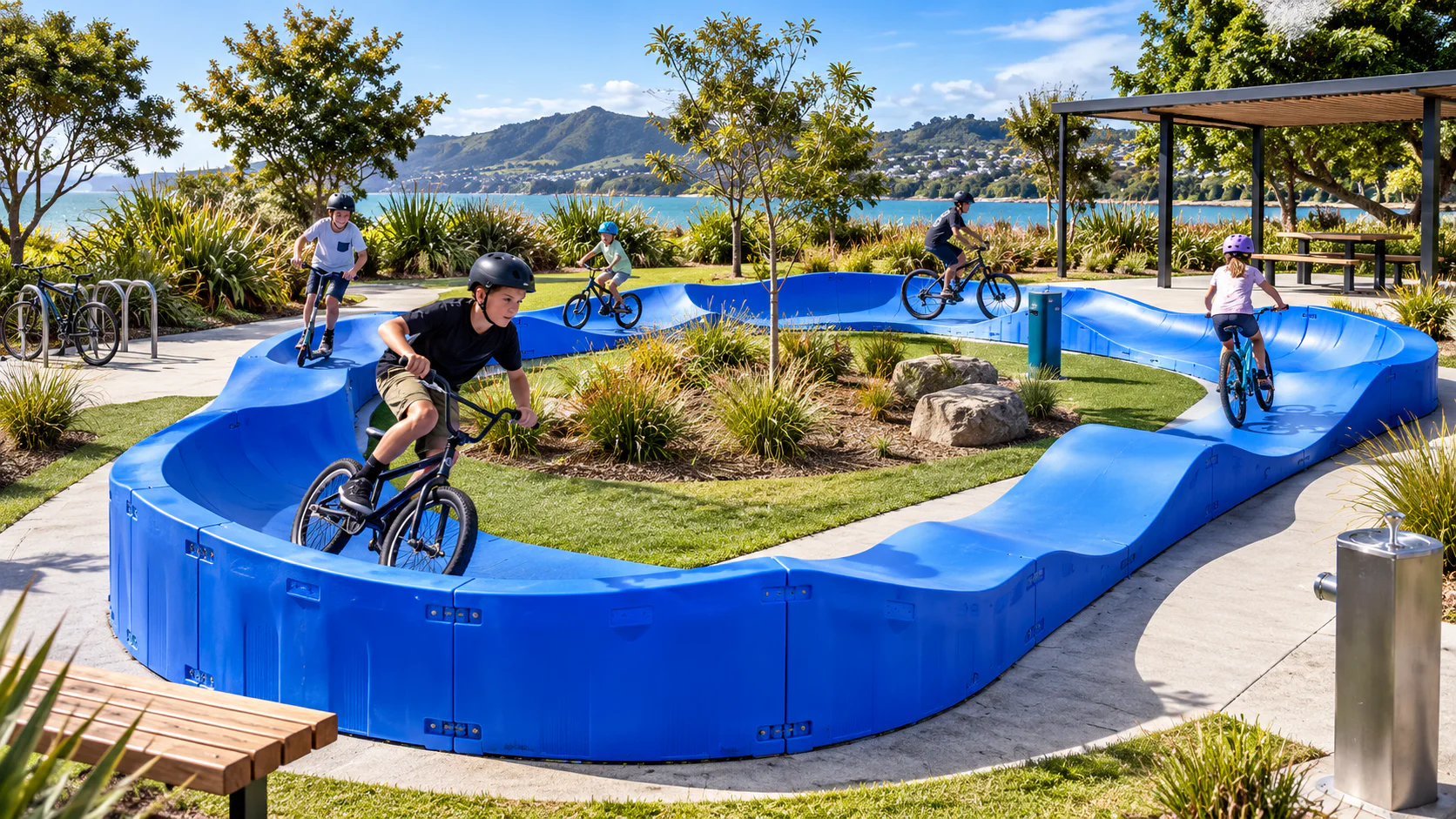
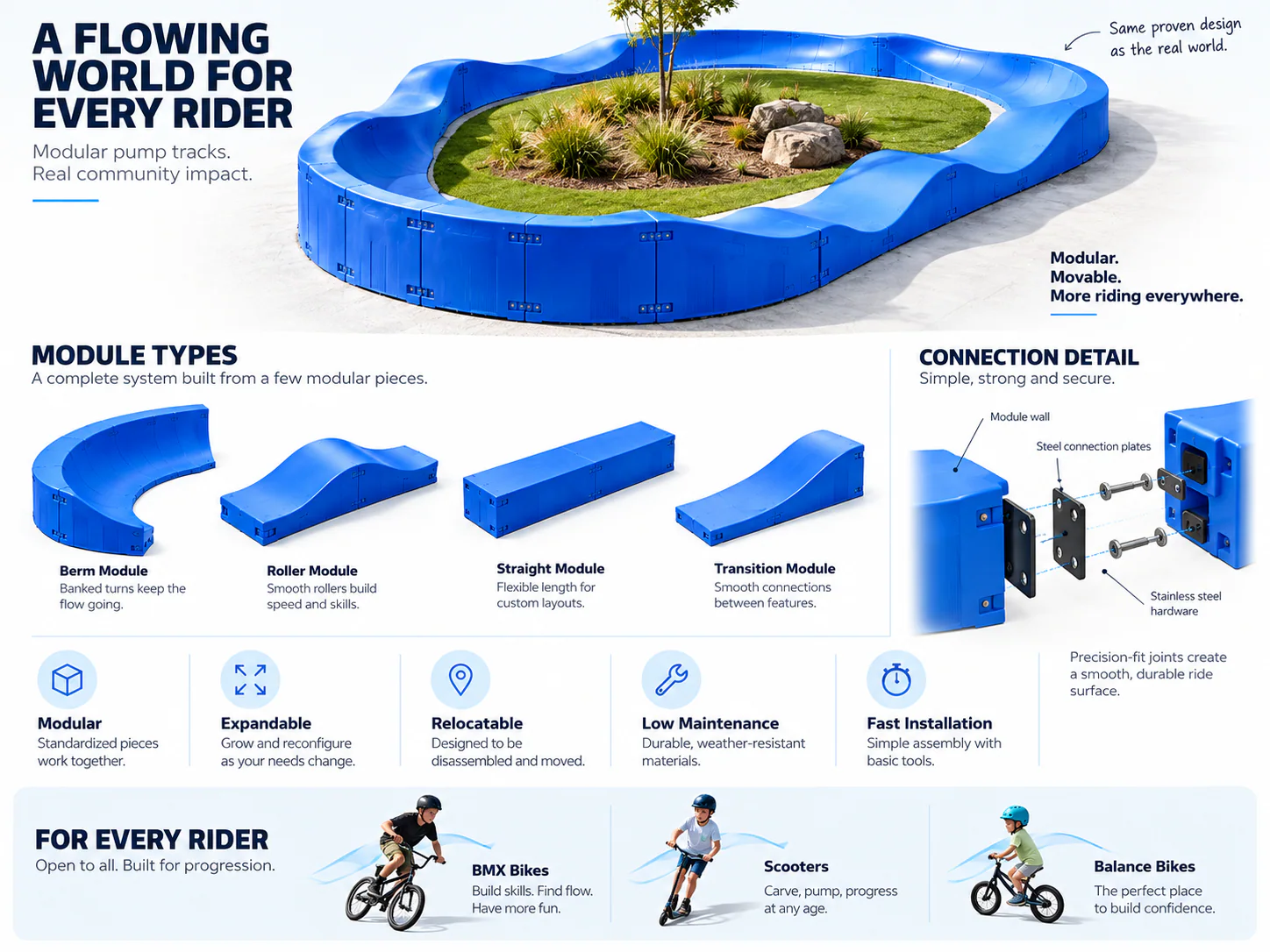
A modular pump track comprises factory-made components assembled into a specified layout on a suitable prepared surface. Its appeal can include predictable manufactured geometry, a staged installation process and the possibility of future disassembly or relocation, subject to the exact system and its anchoring details.
An asphalt pump track is formed and surfaced as a largely permanent site-built feature. Its final geometry depends on the earthworks, shaping, compaction, drainage, surfacing and construction quality on that site. This approach can support bespoke landscapes and site-specific riding experiences, but it generally commits the space more permanently.
Site suitability comes before the product
For a modular route, ask the supplier what base condition, flatness, drainage and anchorage the actual modules require. A level sealed area may be a promising starting point, but 'modular' does not mean 'place anywhere'. Ground movement, slopes and water trapped below modules can still cause operational problems.
An asphalt project requires geotechnical and civil planning for the substrate and contour shaping. Imported fill, compaction, drainage and erosion control can be important. On either route, map nearby trees, underground services, vehicle access and the destination of stormwater before committing to a track footprint.
Geometry must match riders and available space
A track should have predictable rollers and berms appropriate to the users, with safe transitions and clear separation from pedestrians and other park activities. More difficult features are not automatically better. Beginners and young riders may benefit from a layout that enables confidence and repeatable progress without forced speed.
Request a plan showing total track envelope, recommended use direction, circulation, queueing and rest space, along with the setback or separation requirements of the specific manufacturer and governing site policies. Don't confuse the footprint of the ride line with the entire land area needed for a usable public facility.
Compare actual installation disruption
Modular elements can sometimes reduce the duration of work on the riding surface, but delivery, base preparation, unloading, assembly, fixings and safety verification still require a programme. The school may need to manage restricted access while this is occurring, and modules may need adequate storage before assembly.
An asphalt build can involve extensive earthworks, weather-sensitive surfacing operations and restoration of disturbed ground. That may be appropriate for a permanent flagship park, but it brings a different construction risk profile. Tender comparisons should state what is included, rather than relying on generic installation-time claims.
Relocation is a strategic advantage only when credible
The potential to move or expand a modular track is valuable for temporary recreation activations, changing school campuses or masterplanned areas awaiting a later stage. Yet relocation can incur dismantling, transport, new base work, reassembly and inspection. It is not a zero-cost feature.
Ask the supplier to document whether the exact track model is relocatable, which joints or parts can be reused, required handling equipment and any limitations on repeated assembly. If the council has no realistic relocation scenario, this advantage may be less important than custom geometry or integration with permanent park works.
Think about inspection and replacement
Modular systems may allow individual components to be replaced, subject to spare part availability and installation method. Their inspection plan should address connections, surface condition, edges, movement, weathering and drainage. A claimed warranty period does not remove the need for routine checks.
Asphalt tracks require a different maintenance strategy focused on surface cracks, local movement, drainage, erosion and repairs. The condition of adjoining landscape and pedestrian routes also matters. Ask both bidders for a written maintenance plan, repair availability and the expected responsibilities of the site owner.
Define safety and supervision
The track should be planned as a facility, not an isolated object. Consider sightlines for carers, access for maintenance and emergency response, separation from through-traffic, drinking water and optional seating. Usage guidance and wayfinding should be appropriate for the site without overloading the space with signs.
An operator may need policies for opening hours, mixed wheel types or events. The supplier should provide use and inspection documentation relevant to the exact installed system, while the council or school remains responsible for local operational risk assessment.
Cost is more than the module or asphalt invoice
A fair comparison includes design, groundworks, drainage, track supply or construction, freight, site access, installation, engineering, inspections, landscaping and future repair. For modular tracks, include the base and unloading. For asphalt, include earthworks and long-term surface management.
Evaluate whole-life costs and the value of potential relocation against the actual use case. Neither pathway has a defensible universal cost-per-square-metre advantage. Ask for comparable scopes and clarify exclusions before budget approval.
What should go in the council RFQ?
Supply a measured site plan, indicative users and expected use intensity, existing base information, surface water plan, available footprint, nearby facilities, preferred programme and any future relocation requirements. Request track layout options, a component or construction schedule and a clear statement of installation responsibilities.
Apollo's RIDEspan and sports procurement pathways can support modular project enquiries. Council engineers, independent installers and the operator must confirm site adequacy and local responsibilities before a public facility opens.
Frequently asked questions
Can a modular pump track sit directly on grass? Do not assume so. Base requirements vary by product and must be confirmed by the supplier and site designer.
Which type is easier to move? A documented relocatable modular system may be moved; asphalt tracks are generally permanent site works.
Does a modular track need drainage? Yes. Both the ground beneath and surrounding surfaces must manage water appropriately.
Which costs less? It depends on track dimensions, civil works, location, freight and the intended lifecycle. Compare fully scoped quotations instead of one headline price.
Build two truly comparable project budgets
Start with a common site, the same intended rider population and equivalent safe circulation area. Then prepare separate budget columns for the modular and asphalt approaches. Include planning, surveying, civil design, site preparation, drainage, freight, construction or assembly, professional checks, landscaping, signage, operational handover and ongoing maintenance. A quoted modular track price may exclude its required base; an asphalt contractor's number may exclude earthworks or erosion controls. Keep those exclusions visible. To compare value fairly, consider the user experience and expected service period, not merely track length. If the site is temporary or redevelopment is likely, include a realistic relocation scenario only if the modular product actually permits it.
Include the rider learning journey
Track design should provide a coherent progression. Beginners need readable rollers, predictable corners and enough space to recover from mistakes, while more confident riders may seek different sequences and speeds. It is important that the intended track's geometry and use guidance match its target community. Ask the manufacturer or specialist designer for actual layout information and recommended operating conditions. Consider whether scooters, skateboards, balance bikes and bicycles will share the facility, and whether that mix is permitted. A council might decide to provide a beginner loop or adjacent practice area instead of increasing the difficulty of one track. The best outcome is repeatable enjoyment, not simply maximum apparent complexity.
Design the site outside the ride surface
The space around the track needs as much attention as the riding line. Provide sensible access from paths or carparks, a place to wait without blocking circulation and clear separation from unrelated pedestrians. Think about passive supervision, nearby seating, shade, drinking water, drainage and safe maintenance vehicle access. Avoid positioning a track so that riders naturally exit into a road or steep drop. Where practical, include room for future recreation additions without forcing a complete rebuild. These decisions should be visible on the site plan and considered in the local safety assessment. An excellent track surface cannot compensate for a poor setting that creates repeated conflicts.
Specify inspection responsibility for the actual construction
Modular tracks may need connection, anchor, surface and alignment checks; asphalt tracks may need attention to cracking, rutting, drainage and surface deterioration. The site operator should obtain inspection instructions matched to the exact supplied or built facility. Define who performs routine checks, who is qualified to repair significant defects and what events trigger temporary closure. Record incidents and surface defects so maintenance can be proactive rather than purely reactive. For remote facilities, confirm availability of spare components or local repair expertise. A warranty should describe what is covered and excluded, while the operating plan should still assume regular inspection and eventual servicing.
Model the programme around weather and access
A project with difficult ground conditions may spend most of its time on base work regardless of the selected track method. Ask bidders for a sequence showing survey, civil work, material delivery, construction or assembly, inspection and opening. For asphalt, weather and curing constraints may influence scheduling; for prefabricated modules, freight, storage and fixing can govern the programme. School holiday timing, council funding periods and site access limitations may make some construction methods more practical. The programme should include weather contingencies and identify what happens when base conditions are worse than expected. Avoid relying on a supplier's best-case installation claim without reviewing those dependencies.
Create a decision record before issuing the tender
The project team should record the facility objective, assessed site, intended users, safe track envelope, options considered, comparative costs, maintenance model and why the chosen route suits the site. Attach the agreed technical and safety evidence to the tender evaluation. If modular relocation is valued, state the future scenario and estimated work required to achieve it. If asphalt permanence is valued, explain how the design integrates with the surrounding landscape and long-term park investment. A short decision record protects continuity when council staff or school boards change. It is also useful when funders or residents ask why one construction method was selected over another.