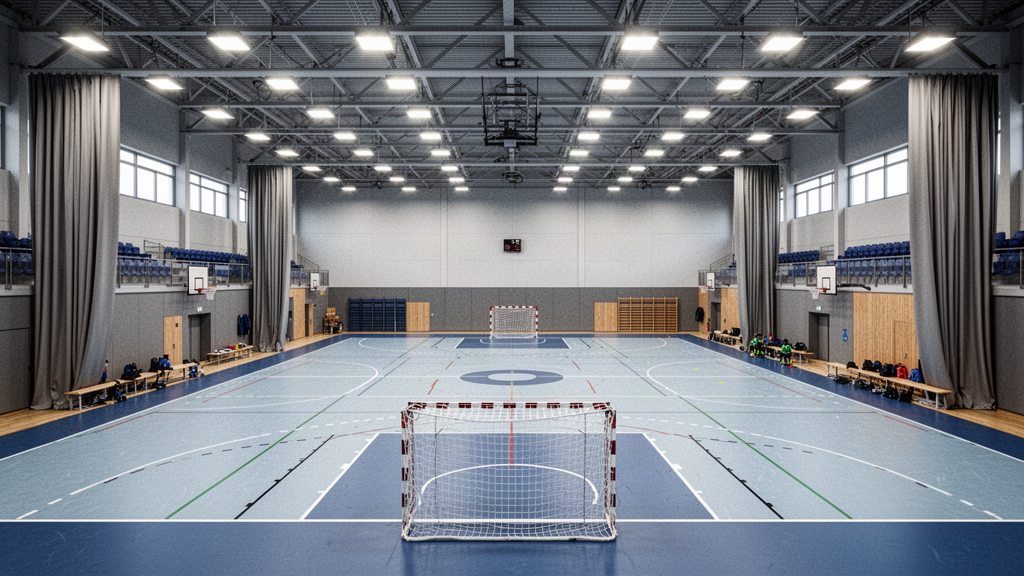
A standard indoor handball court is 40 × 20 m, but the real facility is larger. Safety zones, goals, team benches, officials, wall protection, spectator circulation and building clearances all need to be planned around the court before equipment and floor systems are frozen.
Planning guidance — final supplied configuration remains project-specific.
Reviewed September 2026 · Current live planning resource
01
Start with the court and safety envelope
Current IHF references use a 40 × 20 m playing court. The playing area should also be surrounded by at least 1 m along the sidelines and 2 m behind the outer goal lines before additional operational and spectator space is considered.
A school or shared hall may use reduced training formats, but the project should preserve a clear path toward the intended level of play.
02
Select goals and anchoring as one safety system
The current IHF internal goal reference is 3 m wide by 2 m high. Frame construction, nets, anchoring, stability and any approval status must be checked against the exact selected goal.
Goal anchoring should be coordinated with the finished floor and building structure rather than improvised after the sports surface is installed.
03
Coordinate flooring, wall protection and hall interfaces
The floor needs suitable traction, ball response, comfort, markings and cleaning performance for Handball and any secondary sports.
Goal-end walls, doors, glazing and fixed building equipment should be reviewed for impact protection, while divider curtains and retractable seating need compatible operating clearances.
04
Plan team zones, officials, lighting and spectators
Benches, substitution areas, scorer and timing positions should be resolved alongside the court and safety zones.
Lighting needs good uniformity and glare control for fast play. Spectators should remain outside the active team and playing envelope with suitable sightlines and circulation.
05
Tie competition claims to current model-specific evidence
IHF technical regulations cover goals and floors, but approval applies to qualifying systems rather than every product that looks similar.
Apollo therefore keeps school, club and competition-oriented pathways separate and only makes IHF approval or compliance claims where the current evidence applies to the exact supplied system.
Essential site functions work without analytics. With your permission, Apollo uses analytics to understand which products, guides and project pathways are useful. Analytics stays off until you allow it.