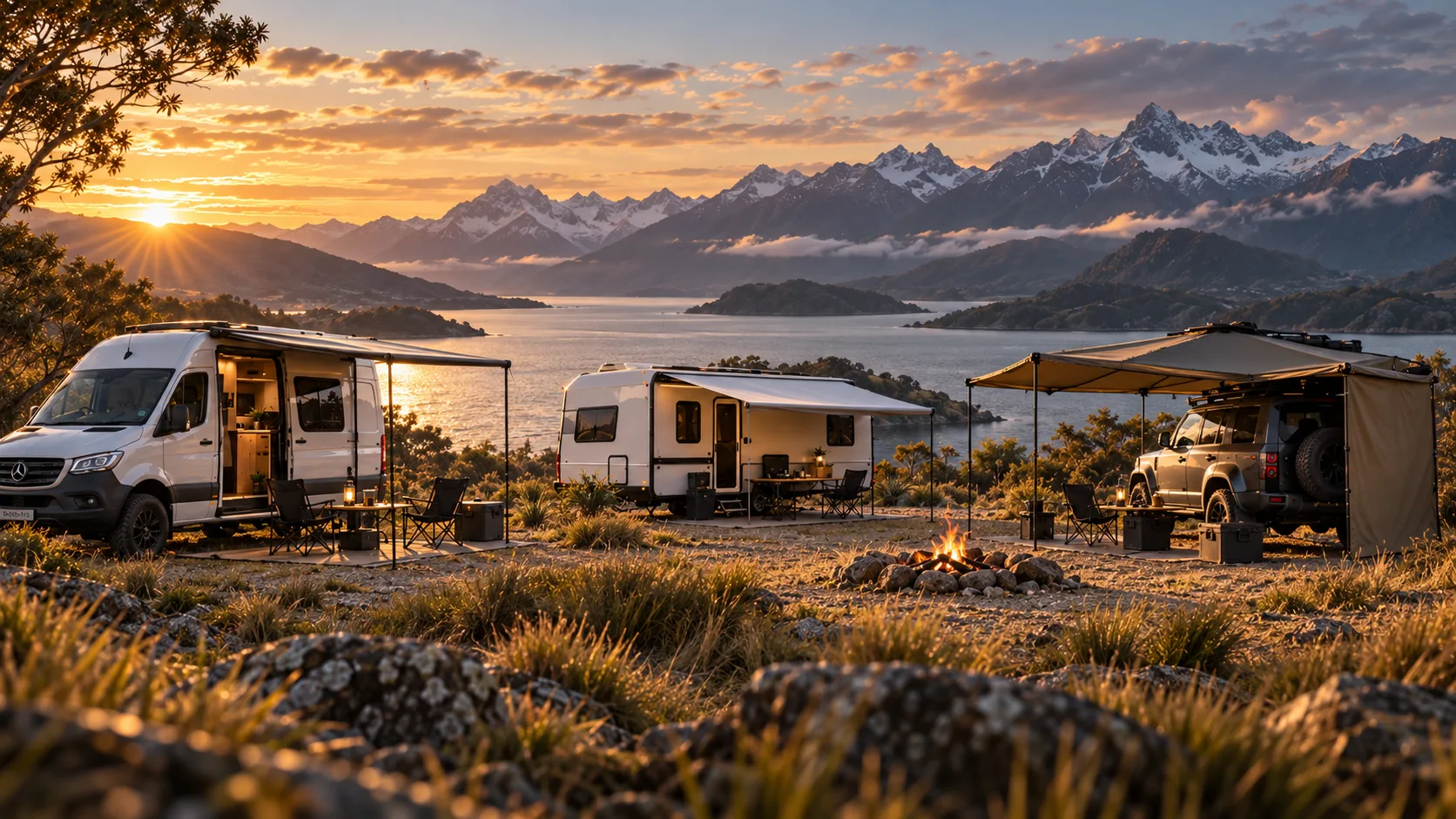
Campervan & Motorhome Awnings in New Zealand: Buyer’s Guide
The right awning is determined by the vehicle, the way you use the outdoor space and the conditions in which it will be deployed. This New Zealand buyer’s guide focuses on real selection decisions rather than assuming a particular awning suits every camper or motorhome.
Planning guidance — final supplied configuration remains project-specific.
01
Choose between the four main shelter jobs
A straight side-mounted awning creates a straightforward shaded zone for brief stops. Roof-mounted and cassette systems can suit vehicles where the sidewall mounting position is restricted. Roll-out formats can be appropriate for suitable caravans or larger motorhomes. Screen rooms are an enclosure decision rather than simply an increase in roof shade.
Start by measuring the usable area beside the vehicle, its door and hatch movement, how many people will sit underneath, and whether outdoor furniture or an entry step needs clearance. Then decide whether the shelter must be quick to deploy daily or remain up at a campsite for several days.
02
Check the exact model and roof arrangement
Give the supplier the vehicle make, model, year, body style and photographs of the proposed mounting location. Roof vents, solar panels, roof racks, pop-top roofs, doors, rear access and existing rails can change what fits. A similar-looking camper is not evidence of compatibility.
Confirm the proposed awning length and projection against the vehicle structure and the manufacturer's supported mounting hardware. Weight, support brackets and loads must be checked by the appointed qualified fitter. Do not assume an awning mounts safely to decorative exterior panels.
03
Understand coastal wind and changing weather
New Zealand conditions can change quickly, particularly at exposed beaches, headlands and alpine campsites. A deployed campervan awning is not a permanent cyclone-rated structure; wind and heavy-rain operating limits depend on the exact model and support arrangement. Follow the supplied instructions for bracing, drainage, care and pack-down.
Ask how the product should be used in unattended conditions, whether legs or storm straps are supported, and what exclusions apply to weather damage. A projected wind rating for one model must not be applied to another model or to an installed vehicle assembly.
04
Manual, electric and legless awnings
Manual operation is often easier to maintain away from mains power. Motorised operation can simplify deployment on compatible vehicles but introduces wiring, isolation and control requirements. Legless systems must be reviewed carefully for structural support and operating limitations; removing the legs does not remove loads from the mounting points.
Compare not only purchase price but also freight, mounting accessories, installation costs and replacement parts. For electrical models, confirm voltage, current, emergency operation and who is responsible for the vehicle electrical connection.
05
How Apollo's supply-only process works
VÆRDR is Apollo NZ Global's dedicated campervan, motorhome and caravan touring-shelter pathway. RIGVAR covers dedicated 4WD, SUV and pickup overland systems. Apollo supplies products and available product information; an appointed local professional handles vehicle inspection, fitment, installation and applicable road-use requirements.
A useful enquiry includes vehicle details, photographs, desired shelter size, destination, anticipated use, and manual or powered preference. This allows an initial suitability review and a project-specific quotation instead of relying on a generic fitment claim.
06
Buyer’s checklist
Before committing, confirm the exact product model, roof or wall mounting arrangement, shade footprint, packaged dimensions, support method, operating limits, material and fabric care, warranty scope, availability of spare parts, freight and local installation responsibility.
Read the existing touring-shelter planning guide for a deeper comparison, and use the product pages to shortlist a model before requesting a fitment review.
Essential site functions work without analytics. With your permission, Apollo measures which products and project pages are useful. Analytics stays off unless you allow it.