011. How open do you actually want the roof to become?
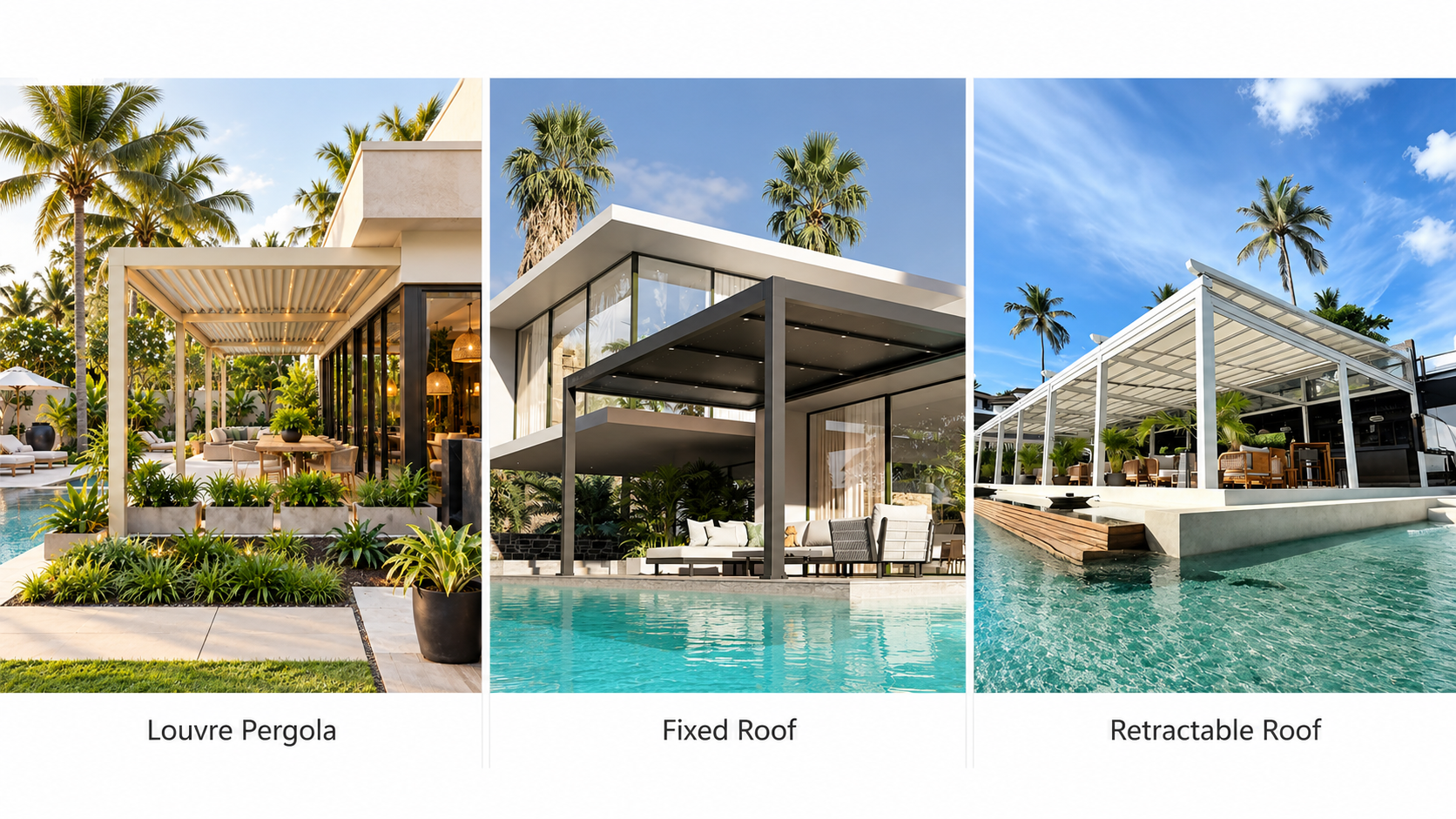
This is the quickest way to separate the three pathways. A rotating louvre roof changes the angle of the blades but normally keeps the roof plane in place. A retractable roof physically moves the covering away to create a much stronger open-sky condition. A fixed roof does not move at all.
If adjustable shade and ventilation are enough, a louvre system may be the natural fit. If seeing a large area of open sky is central to the experience, a retractable system deserves closer attention. If opening the roof adds little value, permanent cover may be the better answer.
2. Is permanent weather cover more important than flexibility?
A fixed roof gives the most straightforward operating condition: the space is covered all the time. That can be ideal for outdoor dining, circulation, poolside areas and projects where dependable shelter matters more than changing the roof position.
Louvres and retractable roofs introduce movement because the project values flexibility. That flexibility can be worthwhile, but it should solve a real use case rather than simply add another feature.
3. How much control do you want over sun, shade and ventilation?
Louvre roofs are particularly strong when the space needs fine control over light and airflow. The blades can be angled to admit winter sun, create shade or encourage ventilation, then closed when overhead protection is required.
A retractable roof offers a more binary form of control: cover the space or open much of it to the sky. A fixed roof provides consistent shade and shelter, with daylight depending on the roof material, geometry and surrounding architecture.
4. Where will the rainwater go?
Every roof choice still creates a drainage problem that has to be solved. Louvre roofs collect water when closed and route it through gutters and the supporting structure. Fixed roofs need adequate fall, gutters and discharge. Large retractable membrane roofs can move significant volumes of water when extended.
The right question is not whether the roof has drainage; it is where that water goes after it reaches the system. Downpipes, post drainage, paving falls, stormwater connections and overflow behaviour should be coordinated with the site before the roof is ordered.
5. How much mechanical complexity and maintenance are you comfortable with?
A fixed roof has no roof-opening mechanism, which usually gives it the simplest operating logic. Louvre systems add blade pivots, linkages and manual or motorised controls. Retractable systems add drive components, rails, movement zones and the need to keep the retracting path operating correctly.
That does not make moving roofs a bad choice. It means the additional movement should earn its place by improving how the space is used. Access for cleaning, inspection, motors, controls and future service should be considered during design rather than after installation.
6. What does the structure need to connect to?
Freestanding, wall-mounted, roof-only and built-in systems place different demands on the project. Post positions, existing walls, slabs, decks, waterproofing interfaces and available fixing structure can narrow the roof options before aesthetics are considered.
Large spans and fewer columns can also move the project from a modular pathway into a more bespoke architectural system. Apollo's louvre pathways range from CADARN modular kitsets to ARKEN bespoke systems, while fixed and retractable roofs have their own project-specific structural requirements.
7. How will the space really be used on an ordinary day?
The final decision should follow the operating pattern. A home may value adjustable shade and ventilation. A restaurant may need dependable cover but also want to open the terrace in good weather. A resort may use different roof types across different zones. A circulation canopy may simply need permanent shelter.
Write down what should happen on a hot day, a wet day, a calm evening and during normal cleaning or maintenance. That simple exercise often makes the correct roof pathway obvious. If the project still sits between two options, use Apollo's roof-type Decision Centre before freezing the specification.