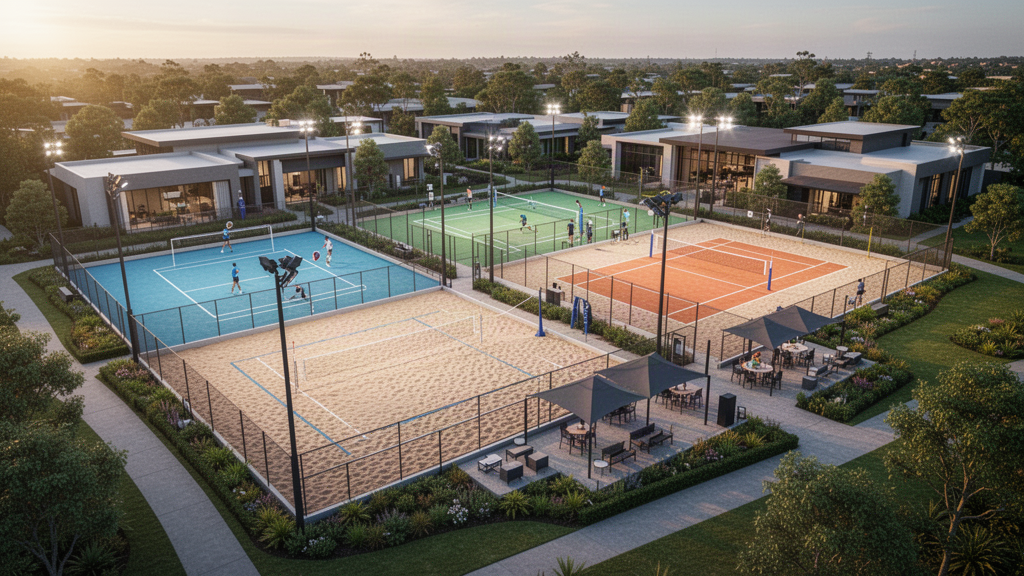
The strongest sand-sports projects start with the sports mix and civil platform, then select posts, sockets, nets and venue infrastructure around that brief. One well-planned sand court can support several activities, but only if the changeover and site systems are considered before construction.
Planning guidance — final supplied configuration remains project-specific.
Reviewed September 2026 · Current live planning resource
01
Define the sports mix before fixing the hardware
Record whether the court is dedicated to Beach Tennis, Beach Volleyball, Footvolley or intended to switch between several sports.
That decision affects post sockets, net adjustment, boundary systems, equipment storage and the way the venue handles changeovers.
02
Treat sand and drainage as civil design
Playing sand, grading, depth, drainage, sub-base and edging are site-specific. They should not be treated as generic imported kit components.
Local rainfall, groundwater, surrounding levels and maintenance access all influence the correct build-up.
03
Coordinate posts, sockets and tensioning as one system
Permanent commercial courts should resolve sleeves, anchors, post profile, tensioning hardware and corrosion protection together.
Where several sports will share a court, use a compatible adjustable platform rather than adding separate independent post foundations after the fact.
04
Plan lighting and containment around the full site
Lighting poles, glare, spill light, ball-stop netting and gates need to work with run-off, circulation, spectators and neighbouring uses.
Resort and public sites should also consider how sand migration, cleaning and pedestrian traffic affect the surrounding landscape.
05
Design the commercial and social layer early
Benches, shade, bag storage, hospitality edges and spectator areas can make a sand court much more usable without changing the playing rectangle.
Multi-court venues should plan arrival, waiting, changeover, maintenance and future expansion before the first court is built.
Essential site functions work without analytics. With your permission, Apollo uses analytics to understand which products, guides and project pathways are useful. Analytics stays off until you allow it.