01Start with the water-management question
A freshwater reservoir concerned with algae needs a different measurement programme from a coastal aquaculture operation monitoring salinity and dissolved oxygen. Define decisions first: detecting low-oxygen events, tracking temperature layers, assessing turbidity or documenting long-term trends.
The data collection interval should match how quickly the condition changes. A useful deployment also specifies alert thresholds, who responds, and how measurements will be validated against field samples or a reference instrument.
How a smart monitoring buoy works
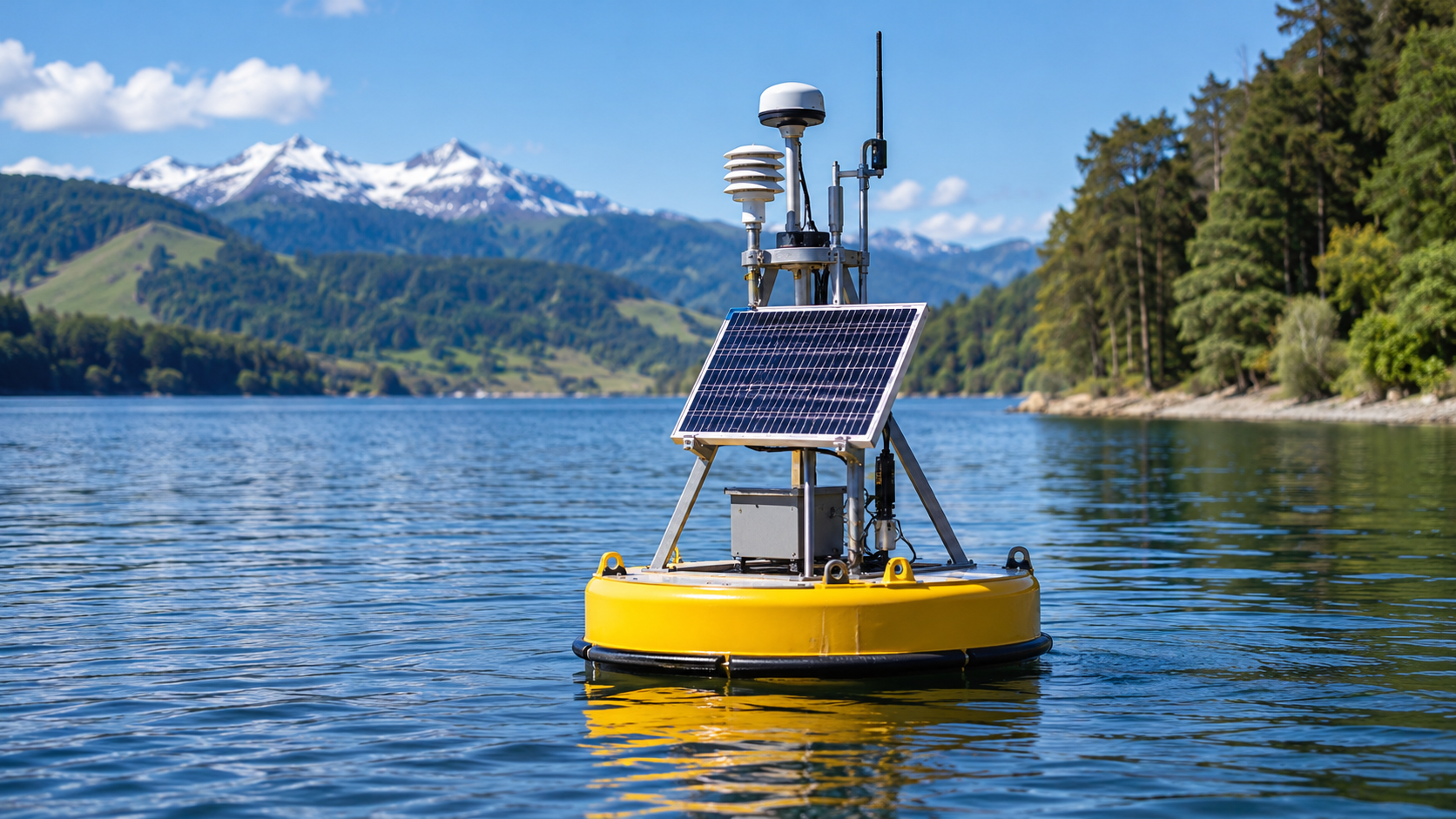
A typical system includes buoyancy, a frame, mooring hardware, a solar panel, battery, charge controller, data logger, telemetry module and deployed sensors. These components must function as one marine or freshwater system. Solar generation varies with location, season and shading; designers should allow for extended poor-weather periods.
Look beyond the photograph. Ask about stability in waves, structural materials, cable protection, enclosure sealing, biofouling control, physical access and serviceability. The appropriate platform differs for a sheltered lake, tidal estuary or open-water location.
Choose sensors deliberately
Water temperature is fundamental and can be measured at one or several depths. Dissolved oxygen is particularly important for aquatic life and aquaculture. Conductivity can support assessment of dissolved ions and salinity; pH relates to acidity; turbidity indicates light scattering caused by particles; ORP provides a useful but context-dependent redox measurement.
Sensors may differ in optical or electrochemical design, accuracy, required flow, calibration method and vulnerability to fouling. Specify ranges, reference methods, expected service intervals and consumables. Multi-parameter capability is valuable only when each measurement serves a defined purpose.
IoT telemetry and the data pipeline
Cellular or 4G telemetry can be practical where coverage exists. Other locations may require radio links, satellite communications or local storage with scheduled retrieval. A monitoring solution should define what happens when the connection fails: buffered readings, retry behaviour, time synchronisation and alert recovery.
Check how data are displayed and exported. Consider CSV or API access, dashboards, thresholds, sensor status, battery health and audit history. Ownership of data and future access to the platform matter as much as the hardware cost.
Mooring, maintenance and measurement quality
The anchor, chain or rope, flotation and sensor depth must be suited to water-level changes, currents, waves, boat traffic and bottom conditions. Installation and servicing should be planned by competent local marine or environmental contractors.
Biofouling, sediment, drifting calibration and damaged cables can degrade readings. Include routine cleaning, calibration, comparison samples, spare probes and documented maintenance in the project specification. Remote data is not automatically reliable data.
Build a water monitoring quotation brief
List the location, water body, depth range, wave and current conditions, parameters, intended sensor depths, sampling interval, telemetry availability, dashboard requirements and expected service schedule. Provide access constraints, deployment duration and any applicable data-quality standard.
ABYRVON can consider solar-powered buoy and sensor package enquiries for wholesale and project supply, including relevant configurations such as the shortlisted BSK-PF-2 platform. Final model specifications and availability require supplier confirmation.
Frequently asked questions
Can a monitoring buoy operate without shore power? Yes, suitably designed solar-and-battery systems can operate off-grid. Performance depends on the complete power budget, seasonal sunlight and equipment load.
Can 4G buoys work where mobile service is poor? An instrument can sometimes store data during outages, but live transmission still depends on coverage or another communication path. Coverage should be surveyed before procurement.
How often must water-quality probes be serviced? Intervals vary by sensor type, water conditions and fouling. A maintenance and calibration schedule must be established for the specific site and measurement standard.