
Apollo NZ Global

Built Intelligence · Architecture & Specification · VARNYTH

Industrial Cleaning Drones: A Practical Guide to High-Rise and Commercial Façade Maintenance

Cleaning large buildings is an access problem as much as a maintenance problem. Industrial cleaning drones offer a potential way to reach some glass, cladding and elevated surfaces without placing an operator directly beside every section of the building. But selecting a system requires more than comparing aircraft size or pressure ratings. Buyers must evaluate the complete cleaning method, local flight rules, surface compatibility and realistic operating costs.

Apollo NZ Global EditorialPublished 2026-11-10Project intelligence
Final product selection, technical documentation and local approval requirements are assessed for each project.
Industrial Cleaning Drones: A Practical Guide to High-Rise and Commercial Façade Maintenance
01

Where drone-assisted cleaning makes commercial sense

High-rise façades, curtain walls, warehouse cladding, atrium exteriors and selected solar arrays are examples of surfaces where a drone may improve access. It can be particularly attractive where repeated cleaning makes temporary access equipment expensive or disruptive. A drone is not universally suitable, however: recessed elevations, delicate heritage fabric, congested pedestrian areas and heavy deposits may demand a different technique.

The commercial question is not “Can the drone reach it?” but “Can the team clean it to the specified finish under acceptable conditions?” Build a sample test area into project evaluation and record before-and-after results. Consider runoff, detergents, drainage, weather windows, on-site water access and protection of people and property.

02

Tethered cleaning drones versus onboard tanks

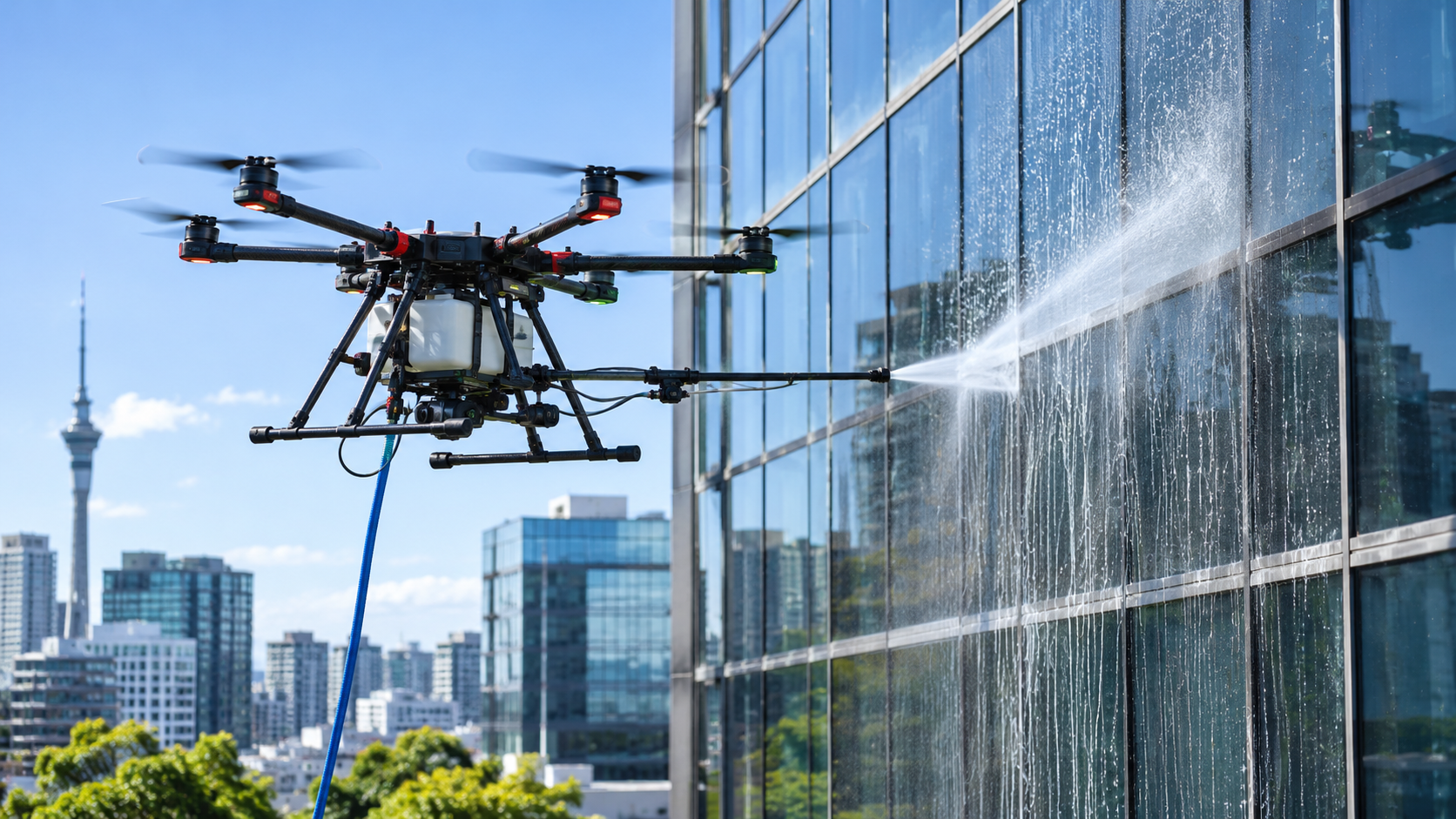
A tank-carrying aircraft has to lift both equipment and cleaning fluid, which can restrict flight duration and usable flow. A tethered or hose-fed arrangement moves much of the water supply to the ground, but adds hose drag, pumping requirements and the need to control tension against a façade. Neither method is automatically better.

A meaningful comparison specifies operating height, water pressure measured at the cleaning head, achievable flow, hose arrangement, intended chemistry, nozzle configuration, aircraft redundancy and how the operator maintains consistent standoff from the surface. Treat headline pressure claims as incomplete until tested at a relevant working height.

03

What an industrial cleaning drone system includes

The aircraft is only one component. An operating package can include the cleaning payload, hose reel, pumps, filtration, water storage, power supply, controllers, observation camera, spares, batteries, transport cases and operator training. Some projects require barriers, spotters, traffic management or exclusion zones.

Maintenance teams should budget for nozzle wear, pump seals, battery health, hose inspections, water quality and consumables. For salt-exposed or harsh industrial sites, material compatibility and maintenance procedures become particularly important.

04

Safety, authorisation and surface protection

Flight approvals depend on jurisdiction, airspace, proximity to people and property, aircraft class and operational method. Safety assessment should consider wind gusts around buildings, loss of communication, emergency landing routes, falling objects and unexpected hose movement. A qualified local operator should establish a compliant method.

High-pressure cleaning may damage seals, coatings, weatherproofing or photovoltaic modules if poorly applied. Agree test procedures with the building owner and surface manufacturer. A cleaning drone should never be described as eliminating all work-at-height or environmental risks.

05

Comparing costs and results

Compare proposals by cleaned area at an agreed finish, mobilisation time, operating crew, water consumption, downtime and quality assurance—not solely by purchase price. A drone may be a productive addition to a contractor’s fleet while rope access or access platforms remain necessary for detailing, repairs and difficult geometry.

For an equipment procurement exercise, request a demonstration with a representative building surface and a documented acceptance standard. Ask for spares availability, technical support, training, warranty scope and evidence supporting stated endurance and payload figures.

06

What to include in an enquiry

Provide building location and height, façade drawings or photographs, surface types, estimated cleaning area, contaminants, available water and power, desired cleaning interval, local operating restrictions and whether you are an established contractor or an in-house facilities team.

Apollo NZ Global can review wholesale and project-supply requirements through VARNYTH. Local aviation permissions, operation, installation and maintenance services remain the responsibility of appropriately qualified providers.

07

Frequently asked questions

Can industrial cleaning drones replace rope access? They can substitute for some repeatable cleaning tasks, but not every surface or task. Hand detailing, repairs, close inspection and complex areas may still require conventional access.

Do cleaning drones carry their own water? Some carry liquid onboard, while others use hose-fed water and ground pumping equipment. The best arrangement depends on working height, flow requirement, operating time and site access.

Can a drone clean solar panels? Some systems can be assessed for solar-panel cleaning, but water quality, approved cleaning methods, safe standoff and module manufacturer guidance must be checked first.

Move from intelligence to project

Apply the thinking to the actual brief.

Open VARNYTH — Industrial Cleaning Drones Send a project brief
Project