
Apollo NZ Global

Built Intelligence · Architecture & Specification · ASTRAVYR

How to Plan a School or University Observatory: Domes, Telescopes, Roofs and Infrastructure

A successful educational observatory is not defined by its dome diameter or telescope aperture alone. It starts with a teaching or research programme, a realistic assessment of the site and a facility that staff can operate safely over many years. Schools and universities should plan the building, optics, mount, controls and training as one integrated observatory project.

Apollo NZ Global EditorialPublished 2026-11-10Project intelligence
Final product selection, technical documentation and local approval requirements are assessed for each project.
How to Plan a School or University Observatory: Domes, Telescopes, Roofs and Infrastructure
01

Define what students will actually do

Visual astronomy sessions, lunar and planetary imaging, spectroscopy, solar observing and precision research require different equipment and supervision. Write down typical class size, observation schedule, curriculum outcomes, accessibility requirements and whether remote operation is needed.

An introductory school observatory may prioritise ease of use and quick setup. A university imaging programme may need a stable mount, cooled camera, filters, repeatable focusing, calibrated data and reliable robotic control. Avoid specifying the largest telescope before defining the observing tasks.

02

Find a viable location

Assess artificial sky brightness, the fraction of useful clear nights, prevailing wind, atmospheric stability, horizon obstruction, local vibration and security. A dark location can help faint-object observation, but a conveniently accessed campus site may still serve lunar, planetary and educational work well.

Check structural load paths, foundations, access, power, network connection, drainage, lightning protection where appropriate and safe egress. Protect a telescope pier from building vibration where required. A site survey should consider future lighting and neighbouring development.

03

Rotating dome or roll-off roof?

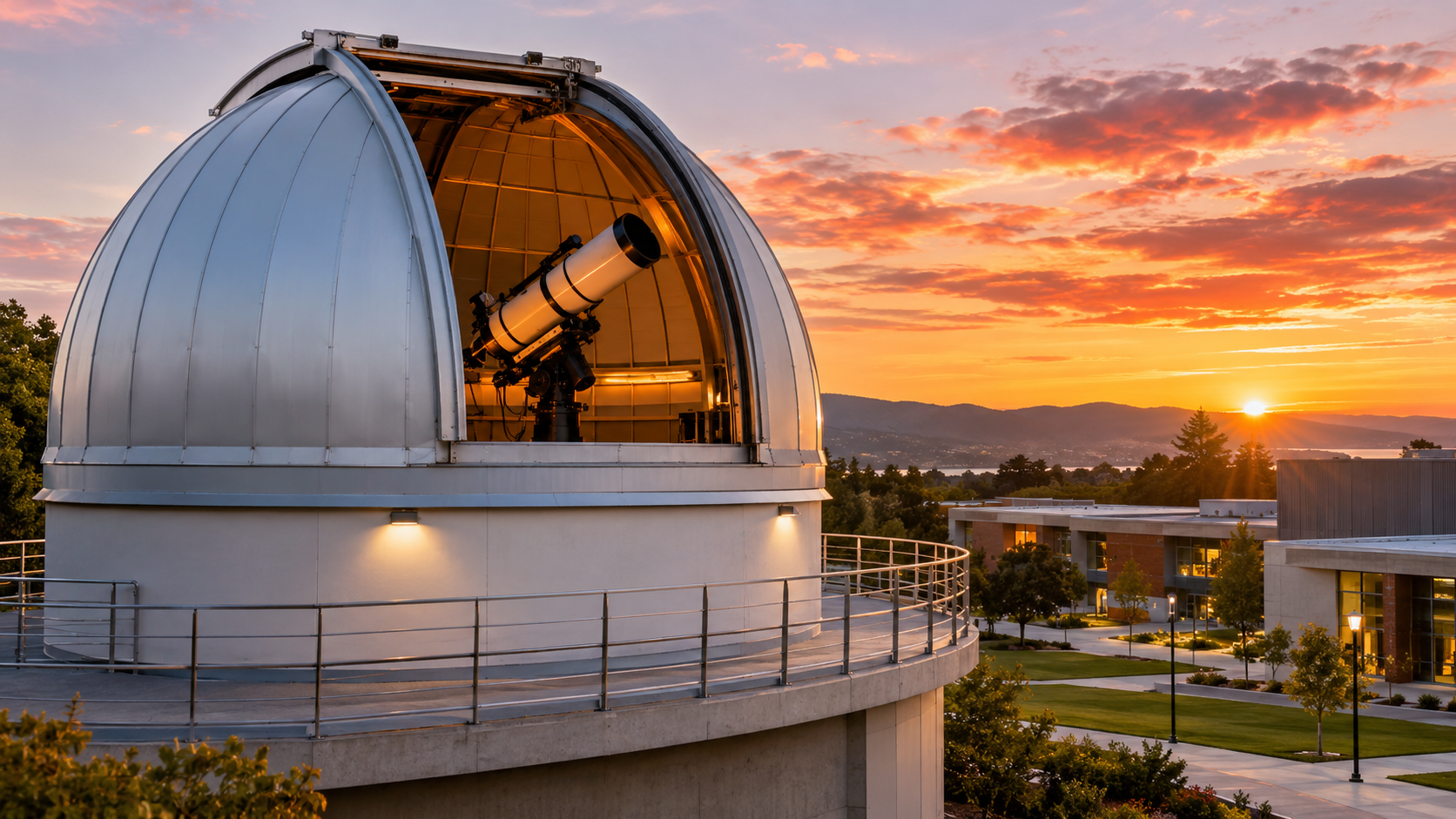
A rotating dome surrounds a telescope with a weather-protected shell and a controlled observing opening. Its slit geometry and rotation system must work with the telescope’s full motion. Dome shutters, seals, emergency closure and the relationship between telescope and building are central design issues.

A roll-off roof can expose a large area of sky and suit several instruments, but it needs clear roof travel space, weather controls and protection against telescope-roof collisions. Compare operational staffing, local climate, maintenance and accessibility before selecting either architecture.

04

Select telescope, mount and detectors together

Aperture determines light collection, but focal length, optical design, field of view and mount performance also matter. An equatorial mount can simplify long-exposure tracking; other mount designs may suit certain institutional uses. The right camera and field of view depend on target objects.

Specify filters, focuser, guiding, computers, cabling, dew protection, power management and instrument mounting. Plan the complete optical and electronic chain. All solar observations require purpose-designed certified solar equipment and appropriate procedures; never point unprotected equipment at the Sun.

05

Remote operation and operating policies

A remotely controlled observatory should have weather sensing, shutter and mount interlocks, safe shutdown behaviour, network security and permission roles. Automatic operation is not a substitute for a tested recovery procedure after a power cut, communications failure or storm.

Schools also need a practical operating model: trained staff, student supervision, inclusive viewing options, maintenance responsibilities, software support and an accessible data workflow for use on cloudy days.

06

Preparing an education-sector RFP

Provide site location, educational objectives, age groups, estimated simultaneous users, roof or foundation plans, telescope applications, power and network access, automation expectations, training needs and intended project phases. Ask bidders to identify who provides structural design, installation and ongoing support.

ASTRAVYR supports observatory and celestial systems project-supply enquiries internationally. Local architecture, engineering, construction, commissioning and required permissions must be arranged with competent providers.

07

Frequently asked questions

Does a school observatory need dark skies? Dark skies help faint-object observations, but an urban or suburban site can still support valuable Moon, planet, Sun-with-proper-protection, and imaging programmes.

Should a school choose a dome or a roll-off roof? Neither is universally superior. A dome offers a concentrated protected opening; a roll-off roof offers wide sky access but needs more clearance and careful automation.

Can students use the observatory remotely? Remote access is possible with suitable controls, cameras, safety interlocks and staff procedures. It should be designed into the requirements rather than added as an afterthought.

Move from intelligence to project

Apply the thinking to the actual brief.

Open ASTRAVYR — Observatory & Celestial Systems Send a project brief
Project