01Start with what the space must do
A school shelter should answer a defined use, not simply fill an attractive shape on a site plan. Outdoor teaching, lunchtime seating, playground supervision and all-weather circulation can have different requirements.
Measure the space, expected occupancy, surrounding buildings, sun path and practical movement routes. Note whether the school needs protection from sun alone, or expects the area to remain useful in rain.
Children spend time in the space in different patterns during teaching hours, breaks and community use. The project brief should explicitly state when each zone is occupied and who will supervise it; this helps avoid posts blocking key sightlines or shelters placed where they do not protect the main activity.
- Indoor and outdoor occupancy schedule
- Marked sun and rain exposure points
- Existing walls, underground utilities and emergency routes
HDPE shade sails: airflow and solar shade
Permeable HDPE shade fabric can suit spaces where shade, airflow and relatively lightweight shelter are priorities. Fabric grade, UV performance evidence, shape, attachment design and tensioning matter as much as colour.
HDPE mesh should not be presented as waterproof. Rain passes through, and wind response depends on the actual engineered configuration. Request the supplier's evidence for the fabric and installed structure.
Select fabric and membrane only after confirming documented properties of the proposed material. Ask how any stated ultraviolet protection value was tested, whether the evidence is for the exact fabric, and how performance may change with age and maintenance.
- Fabric construction and available documented test data
- Climatic and design limitations of the actual model
Waterproof canopies: more than a fabric change
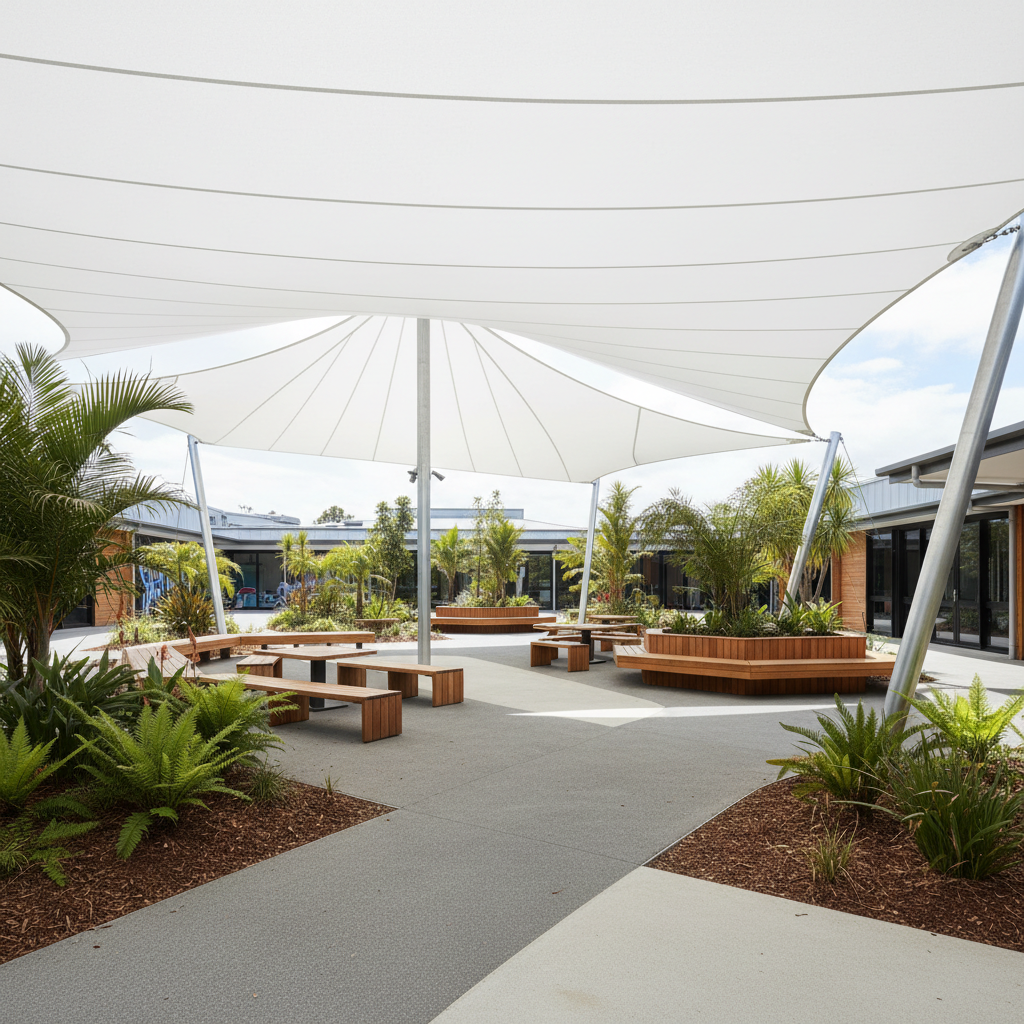
A waterproof membrane canopy aims to provide overhead rain protection as well as shade. It requires a credible drainage strategy: roof geometry, collection points and a route for water to discharge without creating hazards.
The same school site may justify a combination: permeable shade over play zones and a waterproof canopy over an outdoor learning area. Do not assume one treatment is best for every function.
Rainwater collection must be matched to the local site. A membrane may shed water effectively yet still cause a poor outcome if outlets discharge into pedestrian routes, onto play surfacing or against nearby foundations.
- Roof geometry and discharge method
- Ground-level water routing
Engineering and local school requirements
Obtain the wind design basis for the exact site and structural arrangement. Foundations, connection points, vehicle or emergency access, and interfaces with existing buildings require local technical review.
Consider supervision sightlines, accessible circulation, height clearances, lighting, and the way the shelter affects surrounding daylight. Local building and fire requirements are project-specific.
Confirm that school stakeholders, designers and relevant local professionals agree on clearances, access, wind design and any approvals. A generic catalogue assembly is not a substitute for site-specific structural design.
- Local engineering and permission responsibilities
- Applicable access and safeguarding needs
What to request before comparing tenders
Ask for plan dimensions, clear heights, post positions, fabric or membrane product specification, design-load criteria, finish systems, warranty scope and inspection requirements.
Compare drainage, footing and installation exclusions separately from the supplied shade package. Apollo is a supply-only partner; local contractors and consultants manage installation and statutory acceptance.
Request a consistent schedule from bidders so post counts, clear heights, fabric type, corrosion protection, exclusions, replacement parts and local works can be compared on the same basis.
- Clear site drawing and scope split
- Documented model, accessories and omissions
Maintenance, replacement and long-term value
Schools need a practical cleaning, tension inspection and repair plan. Confirm access to replacement fabric, fittings and any exposed fasteners.
A well-documented structure with a sensible maintenance pathway can deliver more value than a visually striking design without service access or documented material performance.
Plan for inspection access in an operating school: who can look at fixings or tension elements, how the area is isolated during service, and how damaged fabric can be repaired or replaced without rebuilding the entire structure.
- Inspection frequencies and replacement process
Build a useful project brief
Provide the site address, marked site photographs, approximate shelter area, existing structures, intended use, seasonal weather issues and expected decision date.
With those inputs, KAVORA can help identify appropriate supplied system options for a project-specific technical discussion.
An effective first enquiry is not a finished engineering package. It is a clear problem statement supported by photographs and site dimensions so unsuitable configurations can be ruled out quickly.
- Site photos, drawings and school programme