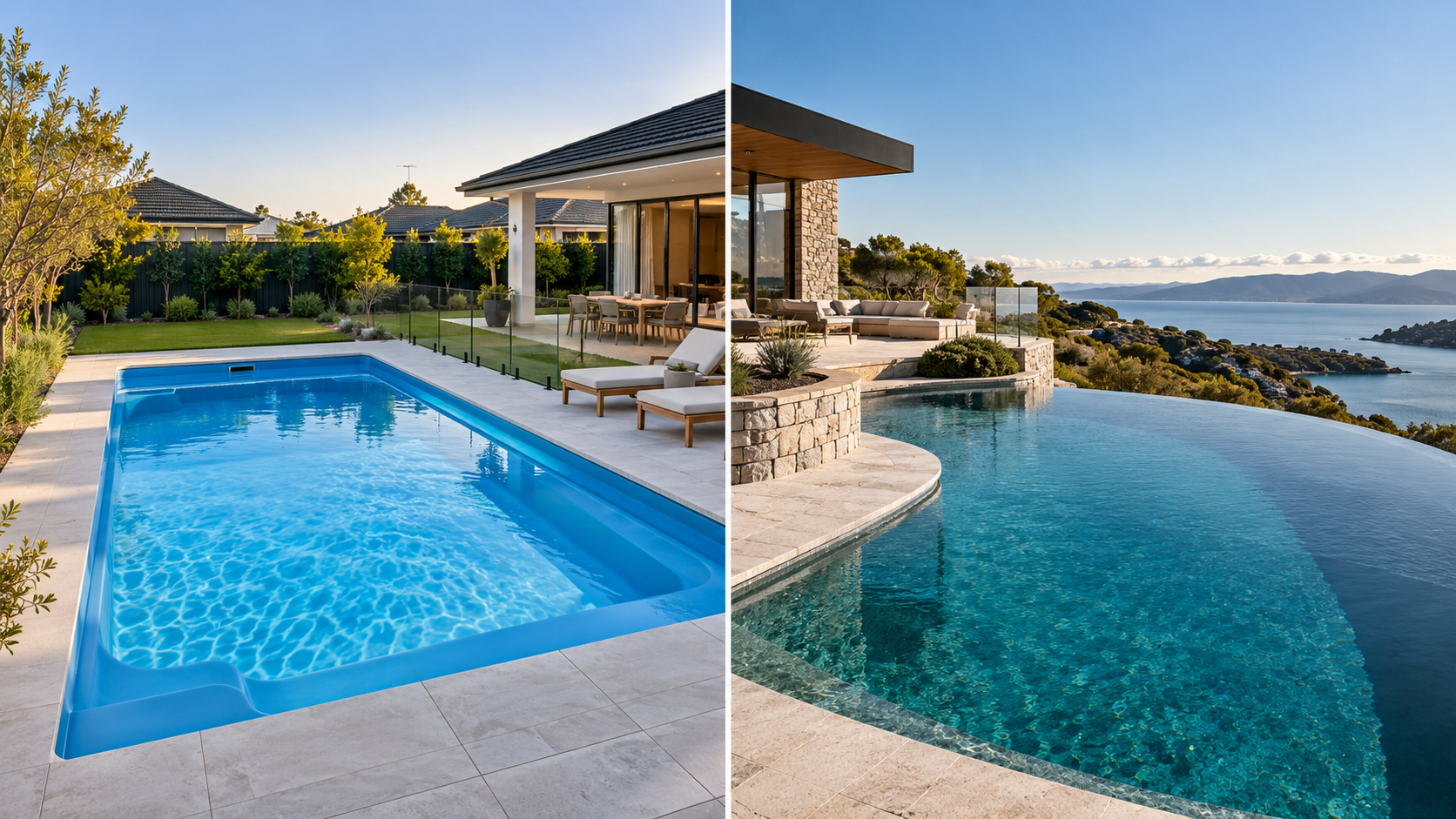
01The difference begins before installation
A factory-manufactured fibreglass shell is formed under controlled manufacturing conditions and arrives with its principal shell geometry already established. A concrete pool is formed on the project site and can accommodate a different set of shape, depth, edge and integration choices. Neither construction method by itself confirms compliance, structural suitability or a completed handover.
The right comparison starts with the site: which pool can be delivered and built at this address, in this soil, with this retaining arrangement and this finished landscape? Avoid selecting a shell from an online image before confirming what is possible below and around it.
Shape and dimensions: standard, made-to-measure and truly bespoke
A preformed pool generally works within a manufacturer’s available moulds or its stated made-to-measure capabilities. That can make model selection more structured, but a non-standard feature must be confirmed by the actual factory rather than inferred from the sales term “custom”. Concrete construction provides greater freedom for some geometries, steps, ledges and irregular sites, although added complexity creates further design and construction requirements.
Apollo presents ORDRAN Standard and ORDRAN Made-to-Measure as distinct enquiry paths. Ask which dimensions, shell details, finishes and fittings can actually be manufactured, and request drawings for the selected configuration. Do not assume every visual design is a stocked or buildable model.
A shell that can be manufactured still has to reach the site
Factory-made shells require an achievable delivery and lifting route. Check road access, overhead power lines, gates, turning circles, adjacent buildings, crane setup, lift radius and permission to use any neighbouring land or road reserve. A tight urban section may change the delivery strategy or rule out a single-piece shell.
Concrete pools avoid transporting one completed shell but still require excavation plant, concrete deliveries, reinforcing materials, pumps, formwork and contractor access. Neither option eliminates site logistics. A feasibility comparison should include a real access review for both routes.
Ground conditions and drainage can change the preferred method
The designer needs to understand soil bearing, groundwater, slopes, adjacent foundations, retaining walls and the consequences of excavation. Hydrostatic uplift and drainage demand project-specific review; a pool should never be specified on the assumption that any generic backfill and base detail will suit a waterlogged or difficult site.
The pool shell and the surrounding works form one structural problem. Obtain manufacturer base and installation requirements for the selected fibreglass model, then have the local project engineer or suitably qualified contractor determine site preparation and any required changes. Concrete pools likewise require project-specific structural design and construction control.
Compare finishes, cleaning and maintainability over the pool life
A factory fibreglass finish and a concrete pool’s selected internal finish behave differently under water chemistry, cleaning equipment, sun exposure, impact and eventual refurbishment. A smooth factory finish may suit an owner prioritising a particular appearance and routine cleaning pattern; a site-applied finish may allow other aesthetic treatments but has its own maintenance regime.
Request written instructions and warranty boundaries for the exact surface, fittings and water treatment. Ask what is covered, what can cause damage or discolouration, how local repairs are performed and which parts must remain accessible after decking. Avoid generic promises of “maintenance free” or universal lifespan.
Pool barriers and approvals are not optional extras
New Zealand residential pools capable of holding 400 mm or more of water generally require a compliant physical barrier, subject to the applicable legal framework. The pool, barrier, excavation, services and property setting should be reviewed with the council and local professionals before committing to manufacturing or building works.
MBIE’s pool safety guidance explains the barrier requirements and inspections; it is the correct starting point for current rules. Neither a factory-produced shell nor a concrete construction method removes the need to establish the site’s actual consent, safety and installation obligations.
How to compare programme without making false promises
Factory production may allow some manufacturing work to happen separately from site preparation, but it does not remove the time needed for technical drawings, factory scheduling, sea freight, customs, cranes, excavation, services or landscape completion. A concrete pool’s programme is influenced by excavation, engineering, formwork, curing, finishes, contractor sequencing and weather.
A useful comparison is a milestone schedule with named responsibilities: specification approval, design sign-off, factory release if applicable, civil works, delivery, lifting or shell works, connections, water treatment, safety barrier and handover. Request current project-specific lead times instead of relying on marketing claims.
What to send for a realistic pool proposal
Start with the destination address, required swim length and width, preferred depth, access photographs, a simple site plan, any geotechnical information, slope and groundwater concerns, desired finish, equipment preferences and intended landscaping. Declare whether the pool will be above ground, partially recessed or in-ground.
Apollo is a supply-only wholesaler. The ORDRAN quotation defines the selected pool package and agreed documentation; local excavation, foundations, crane and lifting work, plumbing, electrical connections, safety barriers, permits and installation remain with the appointed project parties unless expressly included in the written supply scope.
- Site plan with dimensions and access photos
- Standard or made-to-measure requirements
- Known ground and groundwater information
- Preferred filtration and service arrangement
- Local builder or engineer identified