
Apollo NZ Global

Built Intelligence · Public Realm & Development · Public realm

Public Drinking Fountains: Why the Product Is Only Half the Specification

A public drinking fountain can look simple in a schedule, but successful hydration projects depend on much more than the stainless-steel unit. User mix, accessibility, potable-water components, drainage, servicing, exposure, anchoring and maintenance all sit around the product.

Apollo NZ Global EditorialPublished 2026-10-07Project intelligence
Editorial guidance — final product, engineering, compliance and site requirements are confirmed for the actual project.
Public Drinking Fountains: Why the Product Is Only Half the Specification
01

1. Specify the users before the fixture

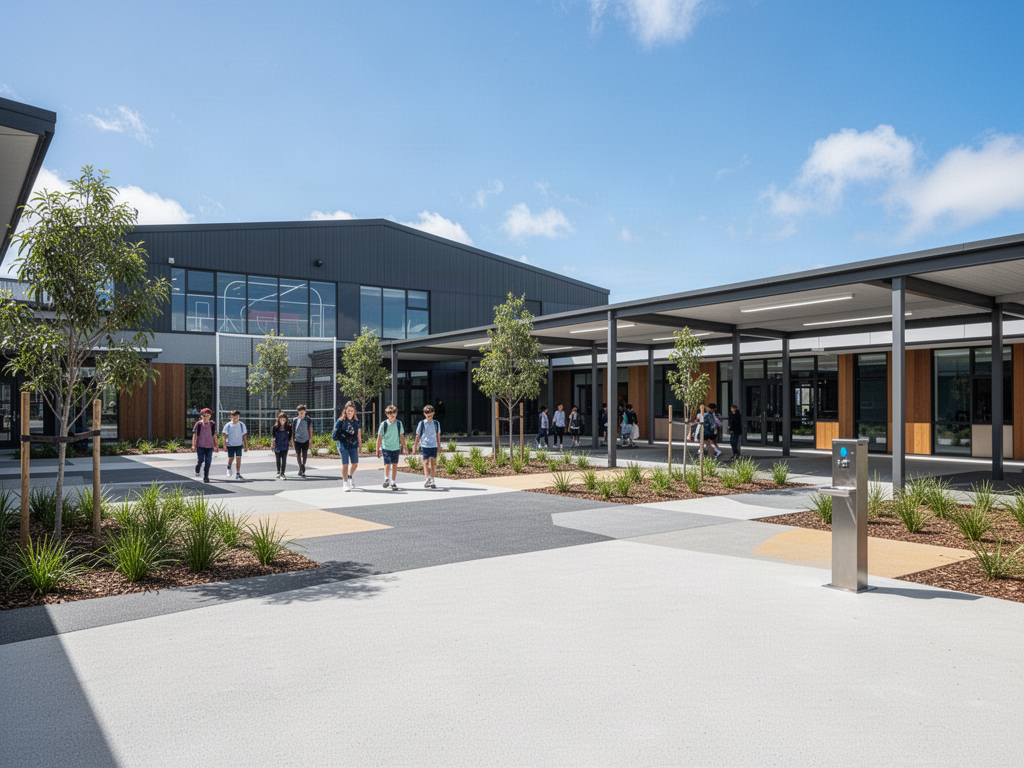
A school courtyard, waterfront reserve, sports facility and dog exercise area have different patterns of use. Bottle filling may dominate in one location while accessible drinking, high-volume refill or people-and-pet use is more important in another.

Start by describing the users, expected demand and operating environment. That narrows the station type before finish or appearance is discussed.

Peak demand matters as much as daily demand. A sports precinct may be quiet for much of the week and then have hundreds of users moving through at the same time. A school can have concentrated use at breaks and after sport. Those patterns influence whether one station is enough and where it should be positioned.

Think about who is likely to be excluded by the wrong layout: young children, wheelchair users, people carrying sports bags, cyclists with bottles or dog owners managing a lead. The user mix should be visible in the brief.

02

2. Accessibility belongs in the layout

A product described as accessible still has to be positioned within an accessible route and coordinated with clear space, reach, knee or toe clearance and the rules that apply in the project jurisdiction.

Do not treat a factory accessibility description as automatic compliance everywhere. Confirm the exact dimensions and local requirements for the selected station and site.

The surrounding paving is part of the accessible solution. Slopes, kerbs, garden edges, bollards and nearby furniture can make an otherwise suitable fountain difficult to approach or use.

For dual-height or combined stations, make sure one user does not block the other and that the bottle-filling function does not create a conflict with the accessible drinking position.

03

3. Bottle filling changes capacity and behaviour

Bottle fillers can reduce queues and suit schools, workplaces, sports and transport environments where users arrive with reusable bottles. They can also change expected flow, filtration demand, splash management and how long people occupy the station.

If bottle filling is the primary use, design the station and surrounding space around that behaviour rather than adding a filler as a secondary feature.

Bottle filling also changes user expectations. People want a reasonably fast fill, enough clearance for common bottle sizes and an outlet that does not require awkward contact with the fixture.

Where chilled or filtered water is proposed, capacity should be considered at peak use. A cooling or filtration system sized for occasional use may not deliver the same experience during a school break or sports tournament.

04

4. Potable-water components need evidence

Materials, filters, bubblers, valves and other wetted components may be subject to destination-specific drinking-water requirements. Evidence should be matched to the actual component or model rather than assumed across an entire product family.

The specification should identify which certifications or local approvals are required before the final station is released.

This is especially important when a station can be configured with different filters, taps or cooling modules. Changing one component may change the evidence that applies to the final assembly.

For procurement teams, the useful document is a component-and-evidence schedule that identifies what is actually supplied and which certificate or standard reference supports the relevant requirement.

05

5. Drainage and cleaning are part of public hygiene

Drinking fountains create splash, waste water and cleaning runoff. Pet bowls add another cleaning and drainage consideration. Poor drainage can make an otherwise robust fixture unpleasant to use or difficult to maintain.

Confirm the waste connection, local falls, cleanability and maintenance access alongside the water inlet and operating pressure.

Standing water around a station can create slip, staining and hygiene problems that are often blamed on the product even when the cause is the surrounding site drainage. The pavement design and fixture design need to work together.

For pet stations, cleaning frequency and bowl drainage deserve explicit attention. A feature intended to improve public amenity should not become difficult for maintenance staff to keep sanitary.

06

6. Coastal exposure is a system decision

Waterfront and high-salt sites can justify a 316 or 316L stainless-steel pathway, but the complete exposed material package, fasteners and maintenance regime still need review. One upgraded panel does not make the whole installation coastal grade.

Salt deposition, cleaning frequency and surrounding materials should be considered together with the selected station.

Waterfront installations can also experience wind-driven salt on surfaces that rarely receive direct rain. Those sheltered zones may need more deliberate fresh-water cleaning than exposed surfaces that are naturally rinsed more often.

Mixed metals, fixings and internal components should be reviewed alongside the visible stainless body. The specification should describe the complete coastal package rather than only the headline material grade.

07

7. Maintenance access should be visible in the brief

Filters, valves, cooling modules, drains and internal plumbing need service access. The project should define who maintains the station, how consumables are replaced and how faults are isolated without dismantling surrounding works.

For councils, campuses and multi-site programmes, standardising consumables and service access can be as valuable as standardising the visible fixture.

Filter-change intervals, shut-off access and the ability to isolate a faulty unit should be understood by the asset owner before handover. A public fixture that requires specialist intervention for every routine task can become disproportionately expensive to operate.

Where chilled-water modules are used, ventilation, drainage and electrical access may add another layer of servicing that should be coordinated into the enclosure and surrounding site.

08

8. The project specification finishes the product

A useful public-hydration specification records users, functions, accessibility requirements, material grade, water inlet and pressure, drainage, filtration or cooling, anchoring, power where required, service access and maintenance expectations.

That is the difference between selecting a drinking fountain and delivering a functioning public hydration point.

For council or developer programmes, that specification can become a repeatable standard while still allowing site-specific choices for coastal exposure, accessible configuration, pet use or cooling.

The final handover should leave the asset owner with a clear record of the supplied station, installed options, service requirements, consumables and maintenance responsibilities. That information is part of the infrastructure, even though it is not visible in the finished photograph.

Move from intelligence to project

Apply the thinking to the actual brief.

Open CIVARO Hydration Send a project brief
Project