
Apollo NZ Global

Built Intelligence · Architecture & Specification · VINEKORVA

Commercial Winery Equipment: Planning Grape Processing, Fermentation and Bottling Systems

Planning a new winery or upgrading an existing cellar calls for more than a list of tanks and machines. Commercial winery equipment must support the desired wine styles, harvest peak, batch sizes, cleaning requirements and future expansion. The most effective procurement strategy follows the wine through its full production journey—from incoming fruit to a sealed, labelled bottle—so that one impressive machine does not create a bottleneck elsewhere.

Apollo NZ Global EditorialPublished 2026-11-10Project intelligence
Final product selection, technical documentation and local approval requirements are assessed for each project.
Commercial Winery Equipment: Planning Grape Processing, Fermentation and Bottling Systems
01

Begin with production capacity and wine style

Define the annual fruit intake, daily peak reception, red-versus-white production, batch separation, fermentation time, maturation requirements and packaging plan. A boutique winery handling small premium batches has different processing priorities from a large producer receiving fruit at speed.

Capacity should be considered at each stage rather than expressed as one annual volume. A destemmer, press, pump, tank bank and bottling line must work together in the busiest period. Leave space for cleaning, access, maintenance and future expansion.

02

Grape reception, sorting, destemming and pressing

Harvest logistics determine what happens first: weighbridge or intake measurement, receiving hopper, conveyance, sorting, destemming, crushing and pressing. Equipment choice depends on varieties, fruit condition, desired extraction and whether whole-bunch or gentle handling is important.

Compare line throughput, contact surfaces, changeover time, ease of cleaning and handling of stems, skins and pomace. A high-throughput crusher does not necessarily improve the quality or flexibility of a small-lot programme. Practical hygiene and waste-management plans should be part of the design.

03

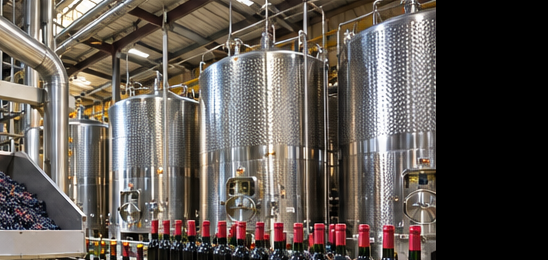
Stainless-steel fermentation tanks and temperature control

Stainless-steel tanks are widely used because they can be made with cleanable interiors, fittings and temperature-management options. But vessel geometry, working capacity, cone or flat-bottom design, door placement, sample valves, drainage and headspace can have a major effect on the process.

Specify working volume rather than assuming nominal volume equals every usable batch. Temperature-control jackets and chilled-water systems must be sized to expected fermentation demand. Consider access, instrumentation, cleaning-in-place design where appropriate, and safety during confined-space-related maintenance.

04

Transfers, pumps, filtration and hygiene

Grapes, must and finished wine have different handling requirements. Pump selection can affect shear, solids handling and cleaning. Transfers should be planned around hose length, routing, oxygen exposure, flow control and how material moves between tanks and process equipment.

Filtration or clarification systems should match the wine style and quality objectives. Ask for membrane or filter specifications, sanitation methods, consumables, cleaning cycles and expected operating costs. A hygienic layout is easier to maintain when drainage and cleaning procedures are considered before equipment arrives.

05

Bottling, closure application and packaging

A complete packaging line can involve bottle rinsing, filling, inert-gas management, closure insertion or capping, labelling, coding, inspection, carton packing and pallet handling. Actual line speed is constrained by the slowest station and by changeovers across bottle sizes and closures.

Oxygen pickup at packaging is a quality concern. Specify fill control, headspace treatment, closure compatibility, sanitation and measurement procedures rather than relying on nominal bottles-per-hour figures alone. Small wineries should compare permanent in-house packaging capacity with mobile or contract bottling services.

06

Automation, utilities and a realistic project brief

Before selecting automated machinery, document electrical supply, water treatment, wastewater handling, compressed air, refrigeration, floor loading, drainage, ventilation and applicable food-safety requirements. Equipment controls should suit operator skills and available service support.

A strong winery request for quotation includes production volumes, processing steps, proposed floor plan, vessel schedule, bottling formats, peak shift length, preferred automation level, country of delivery and phased expansion. Through VINEKORVA, Apollo NZ Global can assess equipment packages for wholesale and project supply, while local specialists handle design approvals, installation and commissioning.

07

Frequently asked questions

What equipment does a small commercial winery need? A typical scope may include fruit reception and handling, processing equipment, fermentation and storage vessels, temperature control, pumps, sanitation provisions and a packaging route. The exact list depends on wine style and whether bottling is outsourced.

Should a winery purchase a bottling line? Compare realistic annual volume, changeovers, labour, maintenance, quality control and the availability of contract services. Owning a line is not always the best first investment.

What should buyers check when ordering fermentation tanks? Verify working volume, material and finish, fittings, access, cooling requirements, cleaning arrangements, lifting and transport constraints, and documented quality standards.

Move from intelligence to project

Apply the thinking to the actual brief.

Open VINEKORVA — Winery Equipment Send a project brief
Project